Cited in Part IX
My father's longtime friend and fellow attorney appeared at our home the day after my arrest. His arrival was natural, almost inevitable—he had been my father's closest confidant for years. But he came with purpose: to help my father find answers to the questions that now haunted him. With quiet authority, he steadied my father, pointing him toward the clarity we all needed.
Cited in Part I (in preparation) · Part IX
Cited in Part IX
Cited in Part IX
See National Oceanic and Atmospheric Association (NOAA), Surface Weather Observations, (Digested)
Cited in Part IX
These data, if cryptic, plainly reveal the police assertion of March 10 being "A VERY BRIGHT, SUNNY DAY, CLEAR SKIES," "VERY BRIGHT, VERY, VERY BRIGHT" with "NO CLOUDS IN THE SKY" as inaccurate. Police lied about the weather conditions on this Broken/Overcast day to manufacture inconsistencies in my account.
These NOAA Surface Weather Observations were never obtained by anyone involved in this case until I did so myself, on February 25, 1998.
Cited in Part IX
Cited in Part IX
These observations were made on the day of the police photo "reconstruction," March 23, 1983, at the Van Nuys Airport, FAA Station ("FAA Van Nuys"), 3.16 statute miles NNW of the Lisker residence.
Again, cryptic data — but plainly showing that a good deal more sunshine and visibility existed on March 23 (when police took their crucial photographs supposedly portraying my "impossible" views) than on the Broken/Overcast March 10, when I did in fact see my mother through the rear living and dining room windows.
Cited in Part IX
Cited in Part IX
Cited in Part IX
That is, he laid the model in relation to where he'd remembered seeing blood on the entry hall rug — a rug that he assisted my dad in throwing away thirteen days prior, as my dad's testimony confirmed:
Cited in Part IX
Cited in Part I (in preparation) · Part IX
Cited in Part IX
Cited in Part IX
Cited in Part IX
Cited in Part IX
Cited in Part IX
Cited in Part IX
Cited in Part IX
Monsue and I never discussed measurements in my interrogation, so precise placement of models and sight lines was impossible unless he took me back to the scene, a basic action he never took. Nevertheless, often in the face of reason and logic, he interpreted views and other evidence in a slanted manner, antagonistic to me.
Detective Landgren likewise testified to an impeded view into the Dining Room window when looking in a northwesterly direction:
But the layout of our house in no way required that an observer place himself in such a position as to be obstructed visually by the dining room table. One could easily stand a few feet west of that incorrect position and look straight northward through the visual 'corridor' created by the dining room table on the east and the fireplace island on the west, and see the portion of entry hall floor just east of the planter's northeast edge, where paramedic Lovato witnessed my mom's head laying when he arrived. Landgren duplicated my vantage point and was similarly able to see that section of floor. But by placing their model, music, behind the planter, not extending past the east or west edges, they then had to assume the incorrect position behind the table to 'try' and see her. But my mom did extend past the east edge, facilitating my easy view.
Cited in Part IX
Monsue testified that I'd relayed this position with some amount of precision
Yet when I'd talked to him in my interrogation I'd had only the pencil diagram I'd made for him, which he himself testified was of very low quality; a very rough sketch:
And he never took me back to our house to clarify this obviously very important issue: and Id.
Cited in Part IX
That is, east of the eastern terminal edge of the planter;
Cited in Part I (in preparation)
Cited in Part I (in preparation) · Part IX
Cited in Part VIII
These "TWO OR THREE" footprints were depicted in three People's Exhibits (photographs) 26, 29, and 31. Each purported to show a footprint in the moist earth at the northeast corner of the house, behind the garage.
Cited in Part VIII
Cited in Part VIII
Cited in Part VIII
Cited in Part VIII
Cited in Part VIII
National Weather Bureau, Canoga Park station observations show no precipitation whatsoever March 7, 8, 9 and 10, 1983.
Cited in Part VIII
Los Angeles County Flood Control District, Record of Climatological Observations, Van Nuys, March 1983.
Cited in Part VIII
No photographs of this purported dirt on the walkway were taken by police.
Cited in Part VIII
Cited in Part VIII
The term "blood spatter" has a very specific, circumscribed meaning within the realm of forensic science:
Cited in Part I (in preparation) · Part III
Dennis H./William M. Juvenile Detention Hearing, April 4, 1983, page 55
Cited in Part III
Cited in Part III
Dennis H. William M. Juvenile Detention Hearing, April 4, 1983, page 56
Cited in Part III
That is, no spatter droplets, and therefore not inculpatory.
Cited in Part III
Cited in Part III
Dennis H./William M. Juvenile Detention Hearing, April 4, 1983, page 43
Again, contact transfer stains are not inculpatory. They are not caused by blunt force being applied to blood-wet objects. They are the result of blood-wet objects coming into contact with the surface on which the stain is observed. These types of stains are expected when one encounters and tends to a bleeding victim, as when I tried to help my mortally wounded mom.
Cited in Part I (in preparation) · Part II (in preparation) · Part V
Cited in Part III
Summarizing Linhart's findings [Notes #53, 57, 61, 62, 63], he found: On my flannel shirt, six droplets; On my right Pacer tennis shoe, one droplet approximately 1 x 2 millimeters in diameter; and on the left Pacer tennis shoe, one droplet approximately 2 x 3 millimeters.
Cited in Part I (in preparation) · Part II (in preparation) · Part V · Part IX
As if speaking directly to this case, the author instructs that blood is to be expected on witnesses who discover victims with bleeding injuries, elaborating that these patterns are not difficult to identify if enough blood is present, but that partial or sparse patterns can confuse the analyst as to true source, as I know happened in my case.
There were only eight droplets on the entirety of my clothing, in contrast with the hundreds of spatter droplets in numerous patterns on the walls of our home [Cf. § III (8)]. Had I been present when the attack/s took place, I would have had bore a similar amount of blood, and I did not.
Moreover, my mom had severe injuries to her airway, and was likely generating 'expiratory blood' when I encountered her and reached in front of her face to raise her arm and take her pulse [Cf. § III (6)]. This appears to be the 'true source' which was not 'immediately apparent' to Mr. Linhart, perhaps due to an over-reliance on detective Monsue's input. (Monsue was presumably in as much contact with Linhart as he was with the Deputy Medical Examiner, SID's Doreen Music, and other analysts and evidence technicians involved in my case.) Linhart was also prevented from properly analyzing much of the blood evidence [Cf. § III (5)].
Cited in Part III
Cited in Part I (in preparation) · Part III
Cited in Part I (in preparation) · Part III
Despite the rather awkward questioning, Linhart's testimony clearly accords with the six droplets on my right cuff having been deposited when I lifted and released my mom's arm in taking her pulse, as the arm fell back to the bloodstained floor beside her severely slashed hand and her bleeding face and head, or else in the path of her exhaled, expiratory blood droplets.
Cited in Part I (in preparation) · Part III
Cited in Part I (in preparation) · Part III
Cited in Part III
Cited in Part III
Here, Monsue claims the quantity of blood which I supposedly reported seeing on my mom's shirt didn't accord with the lack of blood on my own. But why would he rely on my account of the bloodiness of my mom's shirt when the shirt remained in evidence throughout my trials. Have the shirt itself examined! And I never told Monsue or anyone else that I'd "cradled" my mom in my arms. Yet because it buoyed his false case to trumpet the claim, he did so ceaselessly throughout my case.
Cited in Part III
So, only one blood spot larger than a quarter was visible in the photo of the entry hall — near where my mother lay when I discovered her and knelt at her side — in sharp contrast with Monsue's claim of large spots in the entry hall [Cf. § IV (2) (b)].
Taking Monsue's already exaggerated "body hug" scenario to an even more ridiculous degree.
Cited in Part III
Cited in Part III
Cited in Part III
Cited in Part III
Cited in Part III
Cited in Part III
Cited in Part III
Cited in Part III
Cited in Part III
Cited in Part III
Literally, the 25 cents U.S. coin, which is exactly 24 millimeters (15/16 inches) in diameter.
Cited in Part III
Cited in Part III
Cited in Part III
Cited in Part III
Cited in Part III
Cited in Part I (in preparation) · Part III
In short, the massive fractures of the skull and facial bones extended to and included the sinuses, through which my mother continued to breathe after I discovered her. [Note #119]
Cited in Part I (in preparation) · Part III
Cited in Part I (in preparation) · Part III
Both stab wounds were to the left of my mother's spine. Relaying the medical examiner's findings under oath less than a month after the autopsy, Monsue could not keep even their location straight.
Cited in Part III
Cited in Part I (in preparation) · Part III
Cited in Part I (in preparation) · Part III
Cited in Part I (in preparation) · Part III
Cited in Part III
The neighbors reported I did not get along well with my parents, and police observed that I drove a spray-painted primer gray car, had shoulder-length frizzy hair, weighed just ninety-seven pounds, wore worn, 'torn' clothing, had bloodstained hands, and acted erratically.
Cited in Part IV
Cited in Part I (in preparation) · Part III
Cited in Part IV
Cited in Part I (in preparation) · Part IV
Cited in Part IV
Cited in Part IV
Cited in Part IV
Cited in Part I (in preparation) · Part IV
Cited in Part I (in preparation) · Part IV
Monsue repeated this false claim in response to a leading question by the prosecutor at the:
Cited in Part IV
Cited in Part IV
All of the taped statements which I made concerning fingerprints and knives are as follows:
No other statements are found anywhere in the transcript concerning fingerprints and knives. Unless I'd conveyed this supposed fear, that my fingerprints on the knives would implicate me in the murder, to detective Monsue telepathically, he's caught himself in yet another lie.
Cited in Part IV
Cited in Part IV
This deception had a clear purpose: To subtly fashion my account into an ever more implausible tale which the detective could 'debunk.' Yet no support for Monsue's lie appears in the interrogation transcript, which makes him the liar.
Cited in Part IV
Cited in Part IV
Cited in Part IV
Cited in Part IV
Cited in Part IV
Cited in Part IV
Cited in Part IV
Cited in Part IV
Cited in Part IV
LAPD Parker Center is located at 150 N Los Angeles Street, Los Angeles, CA 90026.
Cited in Part IV
Cited in Part IV
Cited in Part IV
Cited in Part I (in preparation)
Cited in Part I (in preparation) · Part VII
LAPD Parker Center is located at 150 N Los Angeles Street, Los Angeles, California 90026
Cited in Part IV
Cited in Part IV
Cited in Part IV
Cited in Part IV
Cited in Part IV
Cited in Part I (in preparation) · Part IV
(People's 53 – the diagram I drew at interrogation, describing my movements through the house after arriving and finding my mother.)
Cited in Part I (in preparation) · Part IV
Though it is clear from Lovato's testimony that my mom's head was nearer, and in fact extended several inches beyond, the planter's northeastern edge (and I can confirm her having been in this position when I arrived) it is further illustrative of our respective positions that I placed the arrowhead representing were I fell to my knees a distance from her head.
Cited in Part I (in preparation) · Part IV
Cited in Part I (in preparation) · Part IV
Cited in Part VII
Cited in Part II (in preparation)
Cited in Part IV
Cited in Part IV
Fingerprints are fragile evidence, and great care must be taken to preserve these so-called "latent prints" prior to their being recorded and preserved for later evaluation. Consider:
Cited in Part IV
Cited in Part IV
Cited in Part IV
Monsue disputed my having knelt beside my mom on what he characterized as the blood-soaked entry hall rug, citing as evidence the fact I had no soaking wet bloodstains on my pant knees [Cf. § III (2) (b)]. Examining rug itself was the only logical way to resolve the issue. But his own actions in helping to throw the rug away prevented that.
Cited in Part IV
Cited in Part IV
Cited in Part I (in preparation) · Part IV
I'd been given ten dollars on the evening of March 9, 1983, the night before my mom's robbery and murder, and could expect that my dad would similarly support me, at least through my eighteenth birthday. Consider:
(emphasis added]; and Id at page 958-959
Cited in Part IV
Actually, three work application forms were found, exactly as I told police they would. These were later admitted as Defense Exhibits M, N, and 0.
Cited in Part IV
; and officer Prado, testifying regarding his notes:
Cited in Part I (in preparation) · Part IV
I didn't somehow realize I needed the jack; it was the exact reason I'd come over that morning.
Cited in Part I (in preparation) · Part IV
Cited in Part I (in preparation) · Part II (in preparation) · Part IV · Part V
Cited in Part I (in preparation) · Part IV
Cited in Part IV
In March 1983, Builder's Emporium stood at 5960 N. Sepulveda Boulevard in Van Nuys — roughly halfway between my apartment at 6500 Sepulveda and the house on Huston Street, in the 15000 block just west of the San Diego Freeway. I stopped at the apartment to change clothes, then drove on to the house to work on my car.
Cited in Part I (in preparation) · Part IV
Cited in Part IV
These "TWO OR THREE" footprints were depicted in People's Exhibits (photographs) 26, 29, and 31. Each of these purported to show a single footprint in the moist earth at the northeastern corner of the house, behind the garage.
Cited in Part IV
Cited in Part I (in preparation) · Part IV
Not in an evidence quality photograph featuring the phone as its subject, which would have allowed for later analysis of this claim. The phone was featured at a distance in a general shot of the porch approaching the front door. Consider:
Cited in Part I (in preparation) · Part IV
Cited in Part I (in preparation) · Part IV
Cited in Part I (in preparation) · Part IV
Cited in Part IV
Cited in Part IV
Cited in Part IV
Police claimed I had battled hand to hand with my mom, she grabbing and rippig my shirt in the process of my executing a brutal, five-weapon attack on her life. She was viciously beaten with a trophy and an exercise bar, repeatedly slashed and stabbed with two steak knives, and choked with a length of narrow cord. Had I done all that, I certainly would have bore some evidence of it; a nick, a scratch, a bump or a bruise. Yet none was found, despite Monsue's observation of me as he ordered that I disrobe [Cf. S V (5)];
Cited in Part IV
Mr. Mulcahy:"MAY THE RECORD REFLECT THAT THE WITNESS IS HOLDING HIS TWO HANDS DIRECTLY STRAIGHT OUT IN FRONT OF HIM AND THEY ARE BENT UP AT THE WRIST SLIGHTLY. PROBABLY A 45-DEGREE ANGLE."
…
The Court:"I THINK THE 45-DEGREE ANGLE IS FAIRLY ACCURATE."
Mr. Rabichow:"THERE IS ALSO A BEND IN THE ARM AT THE ELBOW PORTION."
The Court:"YES."
Cited in Part IV
And then, just before the trial began -- two and a half years after the interrogation, "I SAT DOWN WITH YOU, THE DISTRICT ATTORNEY, AND WE LISTENED TO THE TAPE AND HAD THE TRANSCRIPT IN FRONT OF US. WE WENT THROUGH, AND AS I RECALLED DIFFERENT MOVEMENTS AS THE CONVERSATION OCCURRED, YOU NOTED ON YOUR COPY OF THE TRANSCRIPT THOSE OBSERVATIONS OR REMEMBRANCES OF MINE. YOU HAD ASKED ME TO ALSO NOTE THOSE SAME NOTES.";
The day which was over two and a half years in the past at the time of both his examination of the transcript with DDA Rabichow and his trial testimony.
Cited in Part IV
Obviously this mere "reaching" did not amount to the precise 45-degree arm gesture demonstrated in court two years, seven months later, or the "hugging" he would later allege as well. See also:
Cited in Part IV
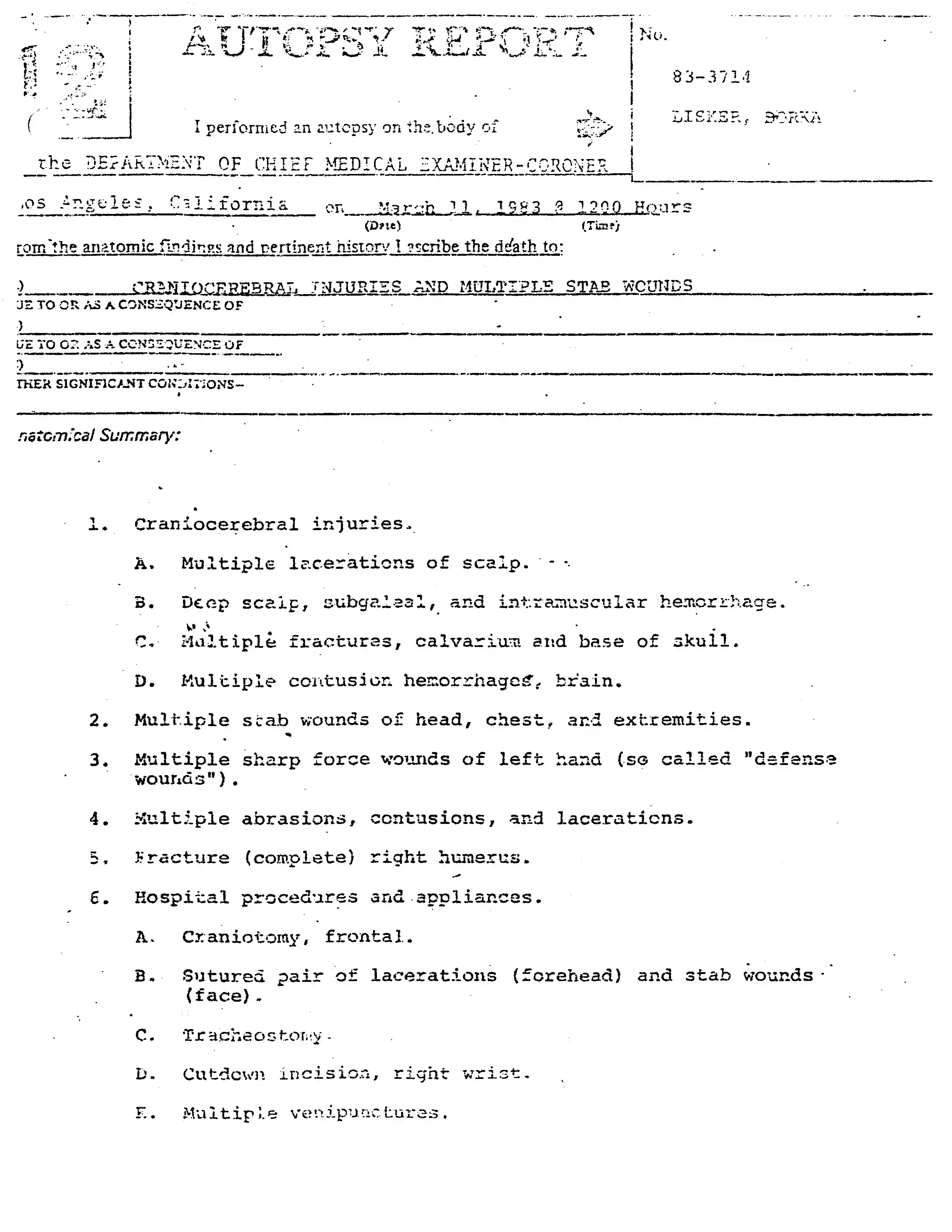
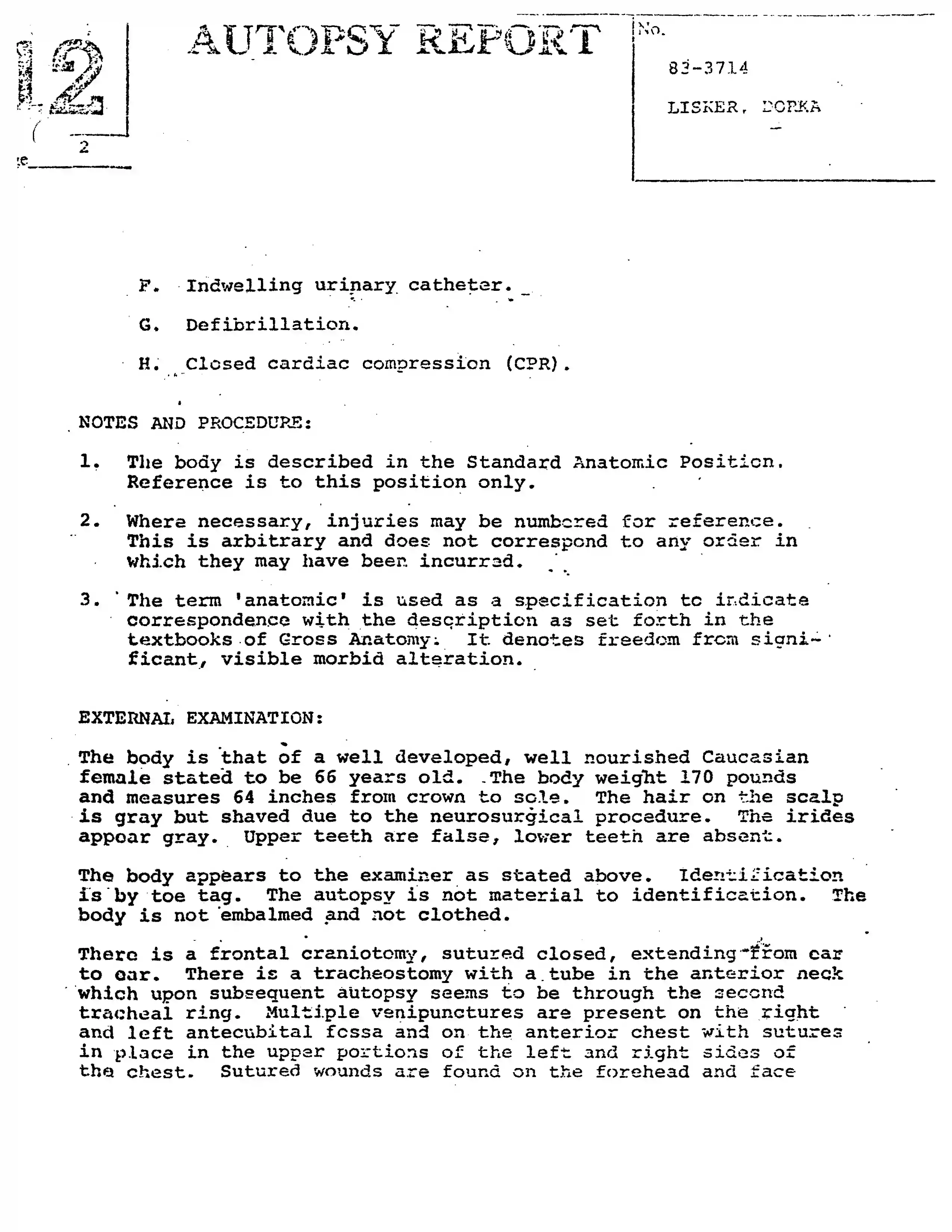
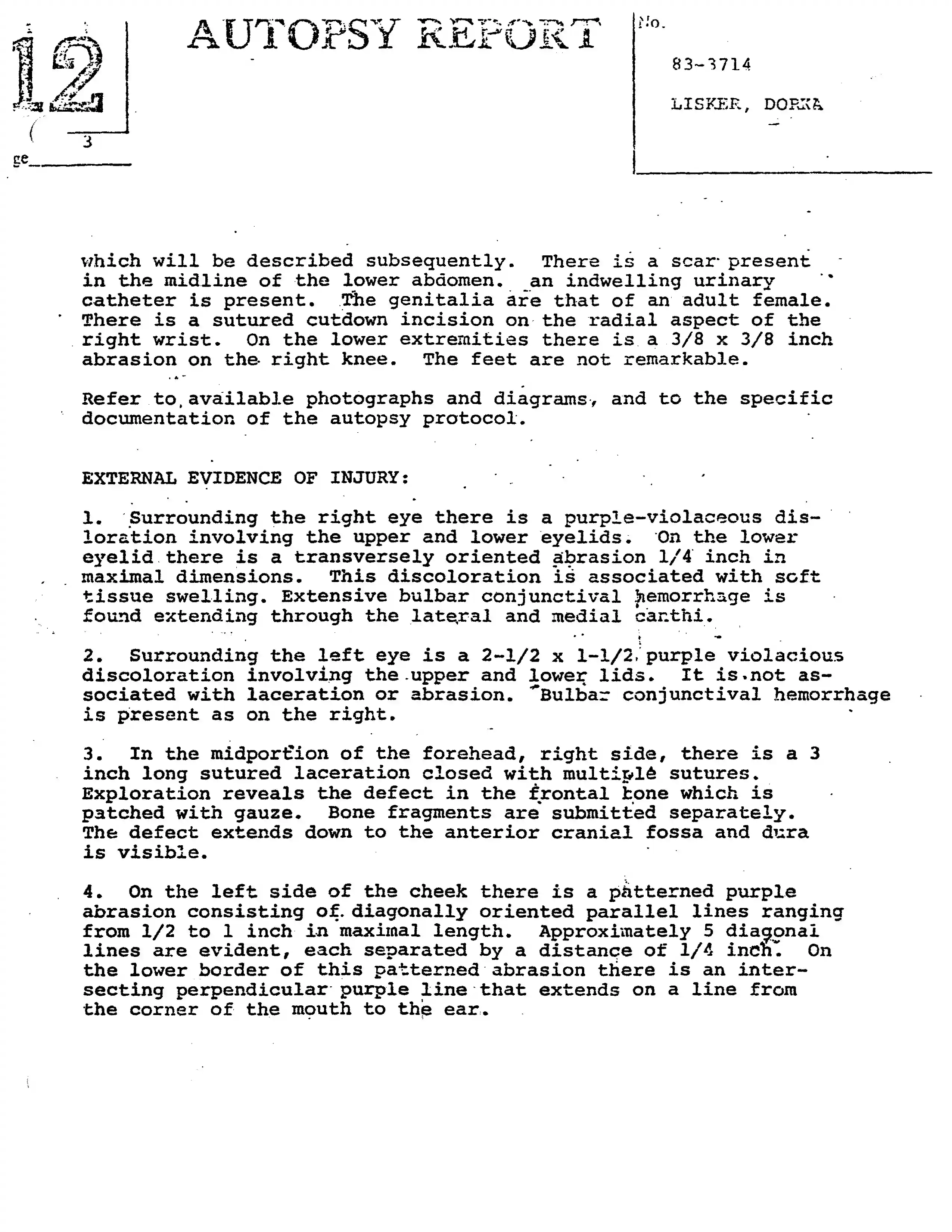
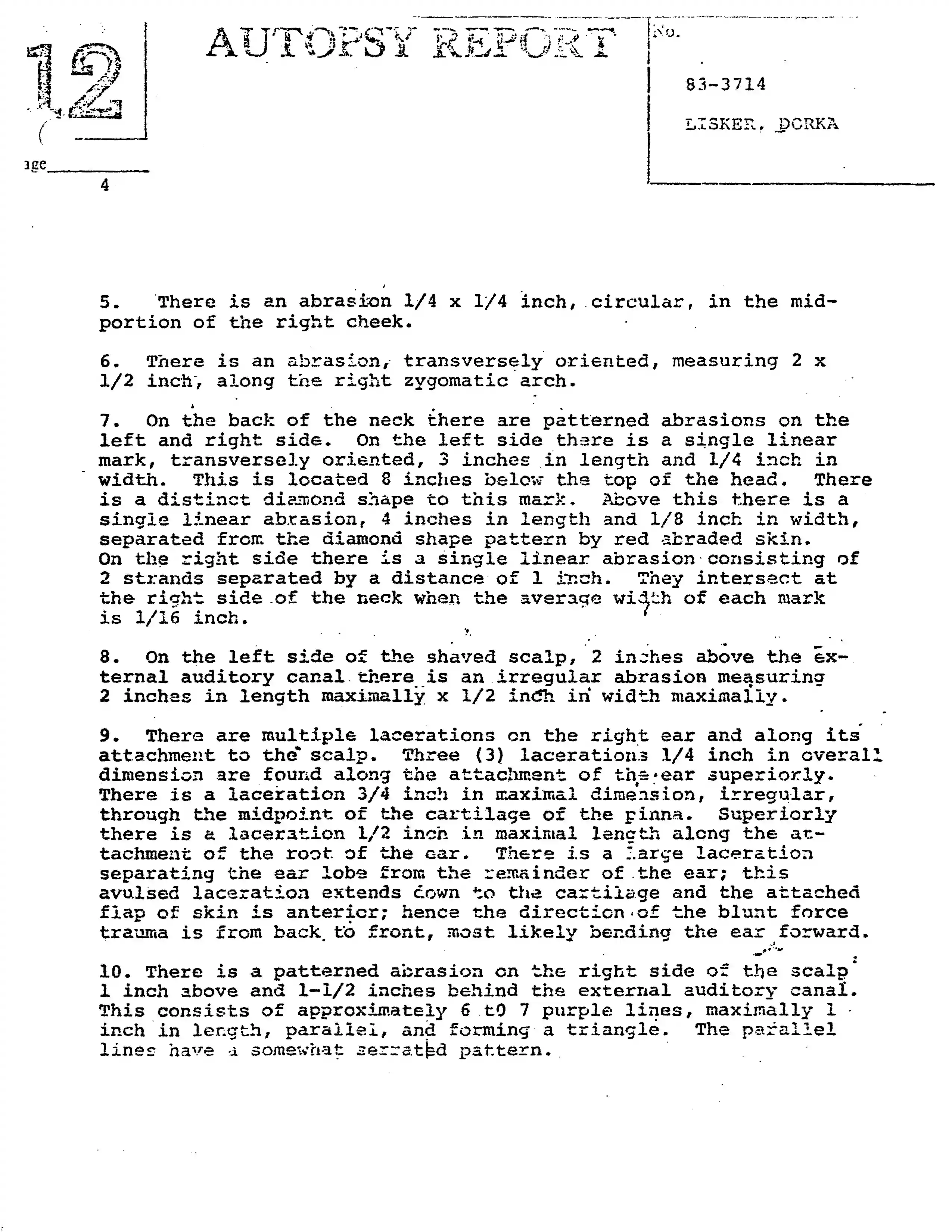
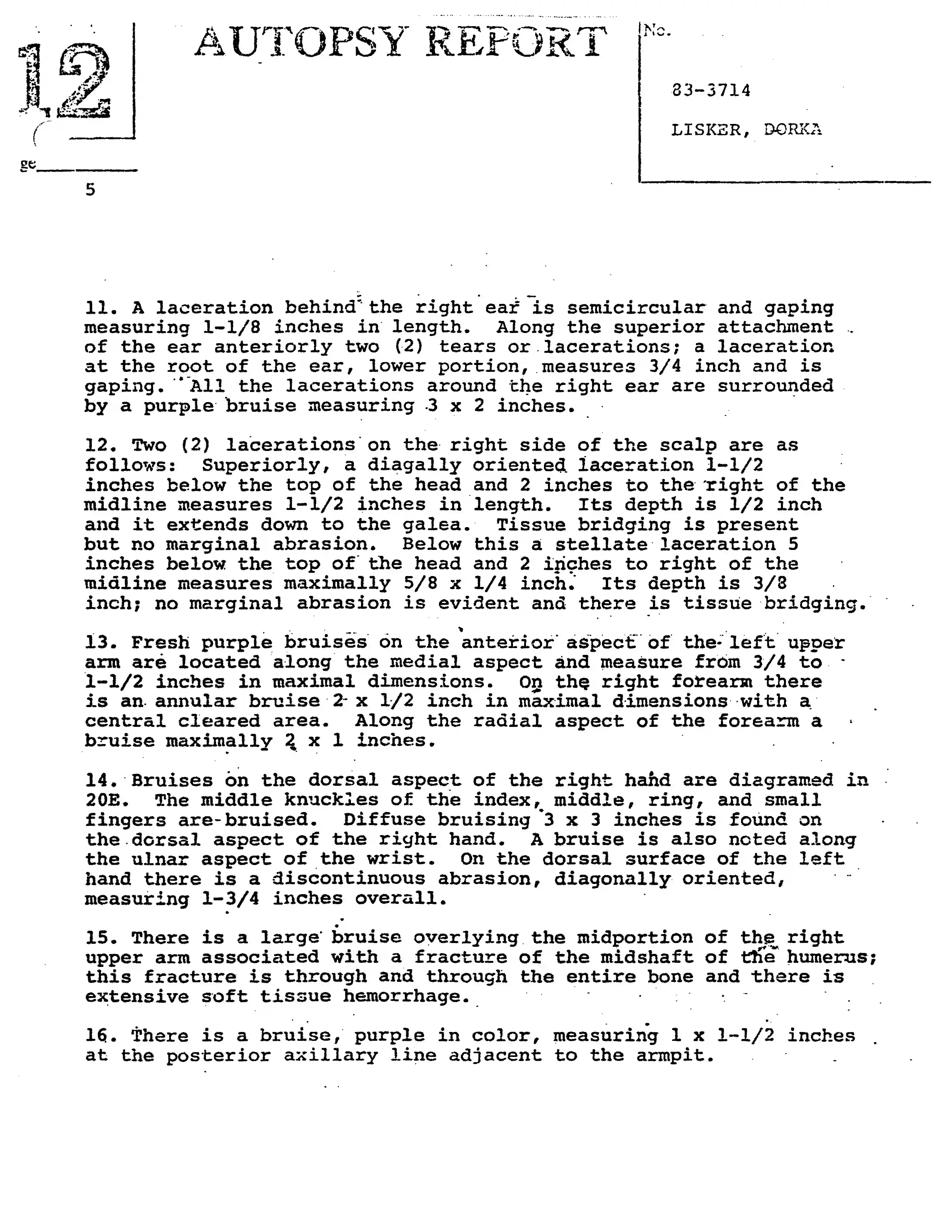
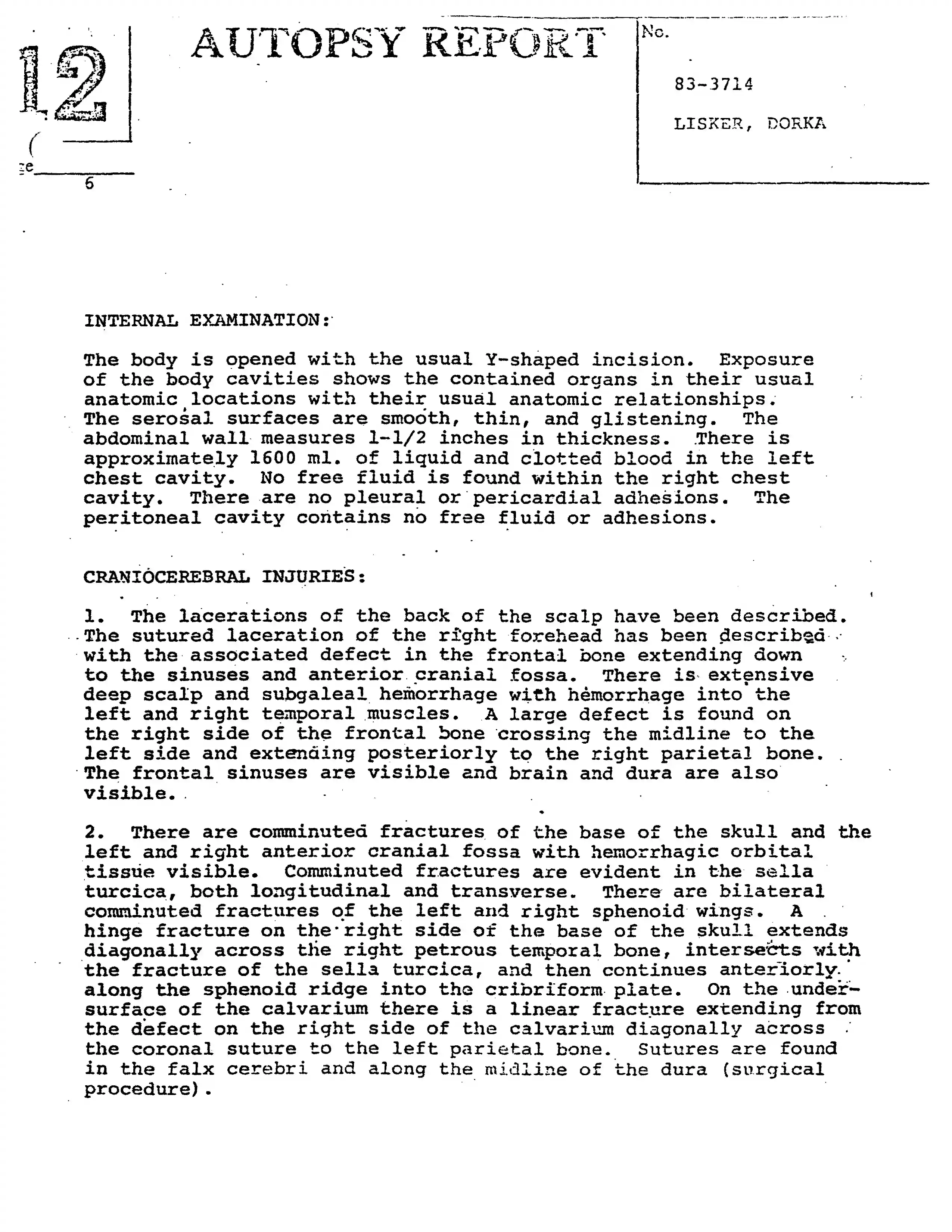
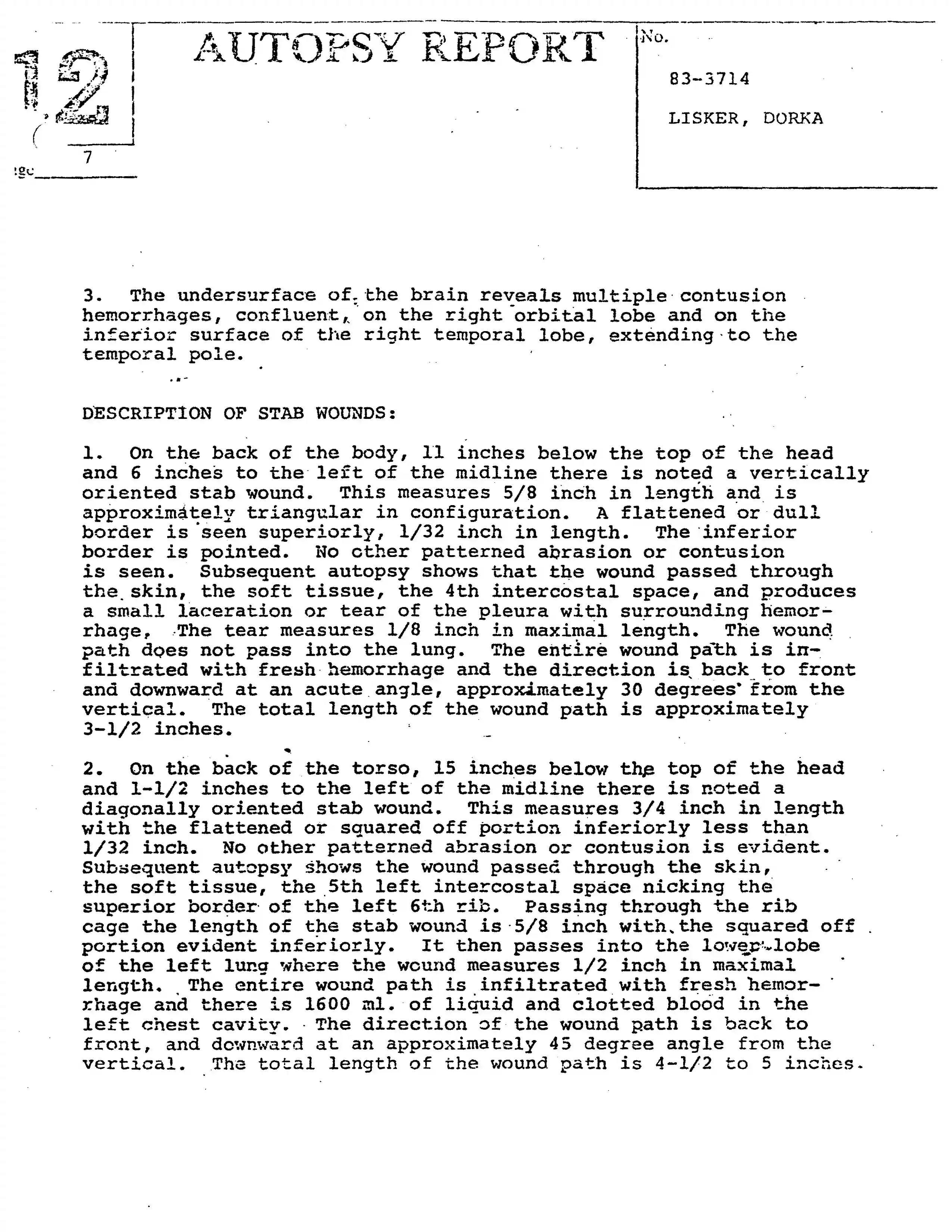
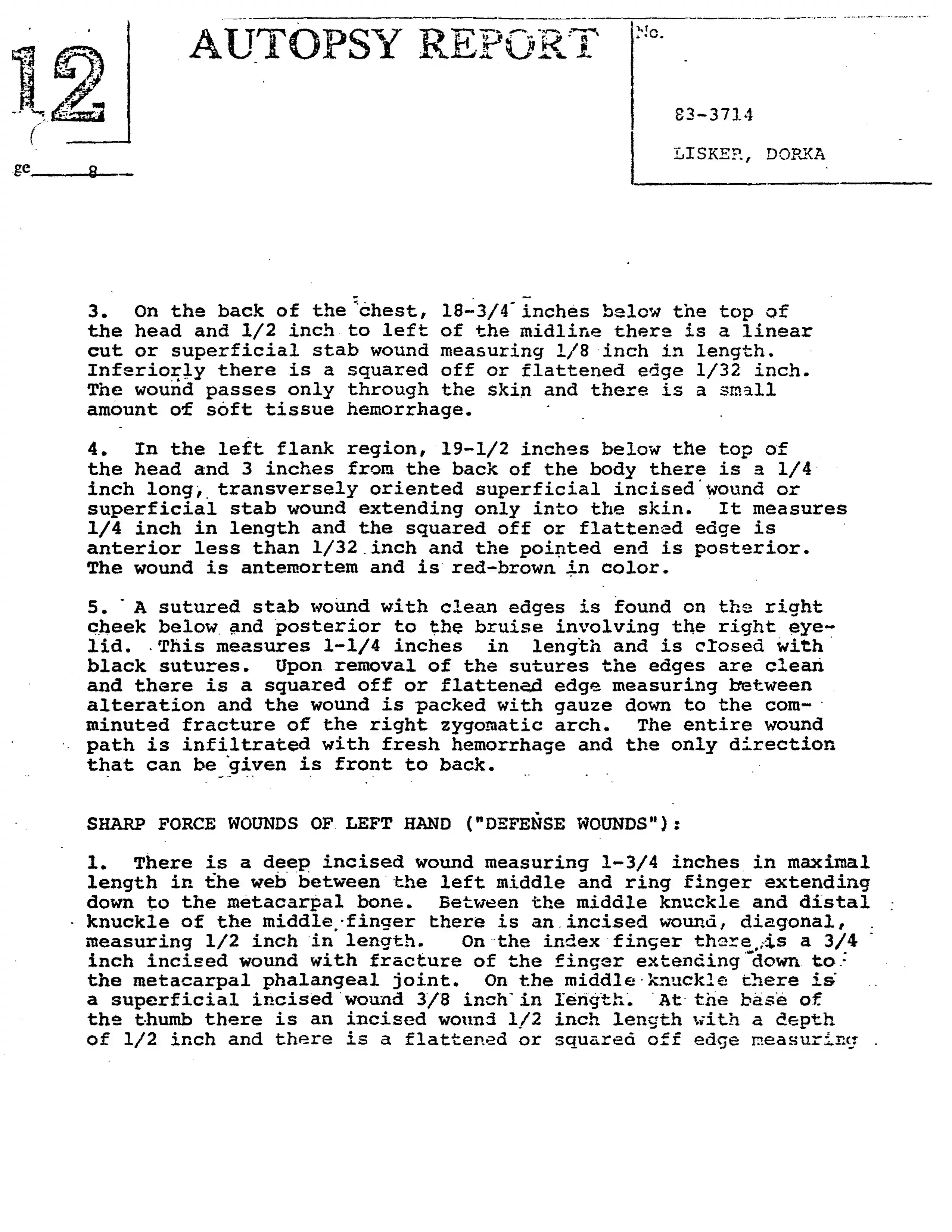
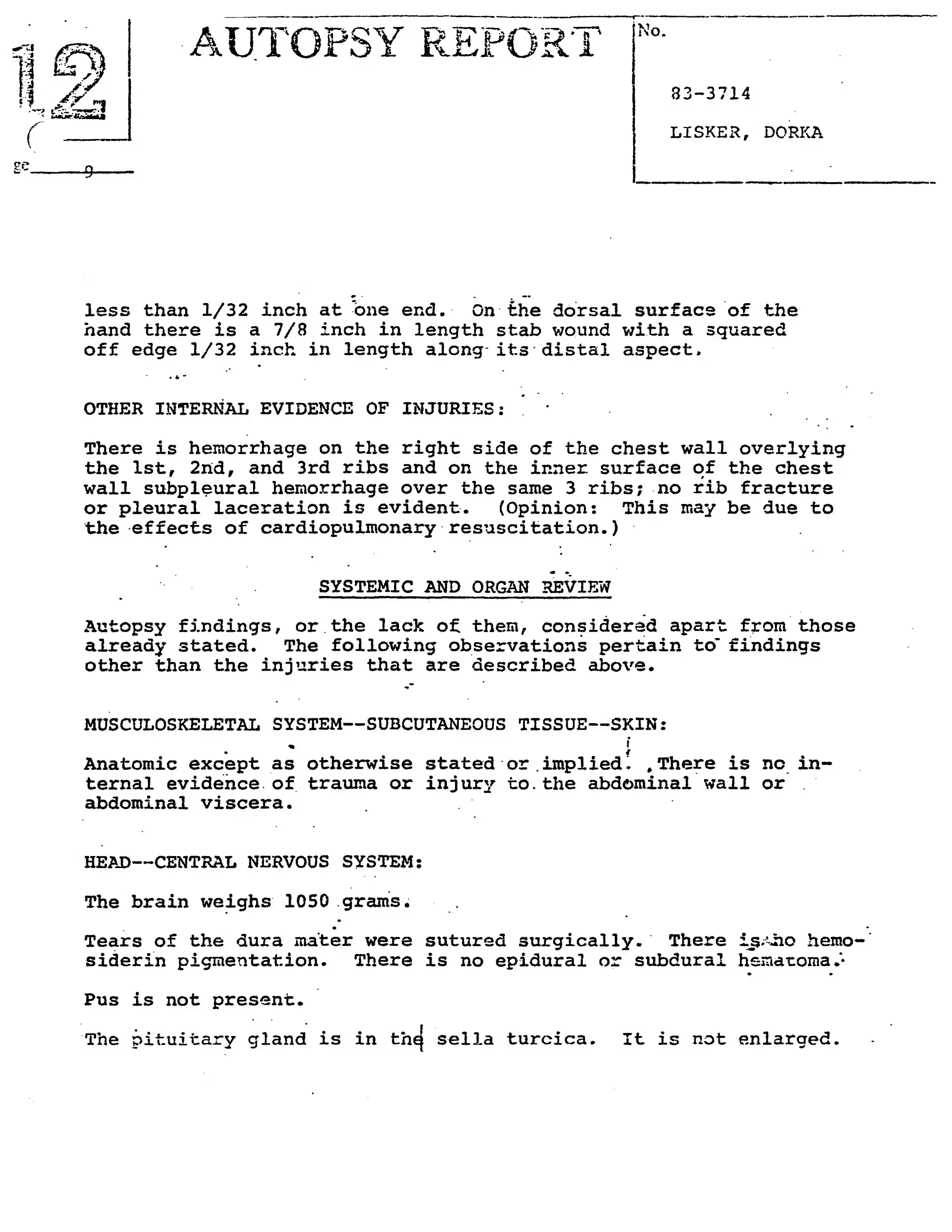
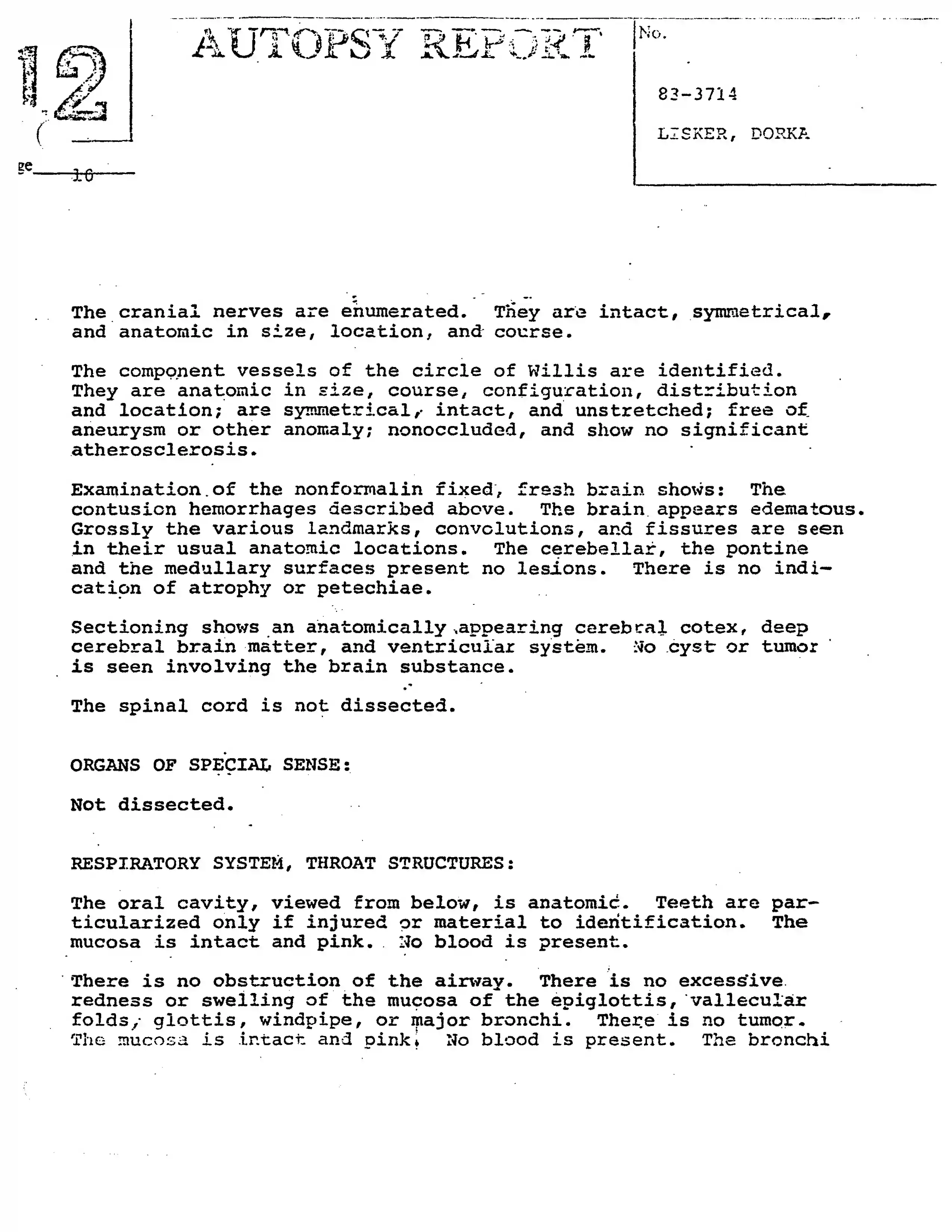
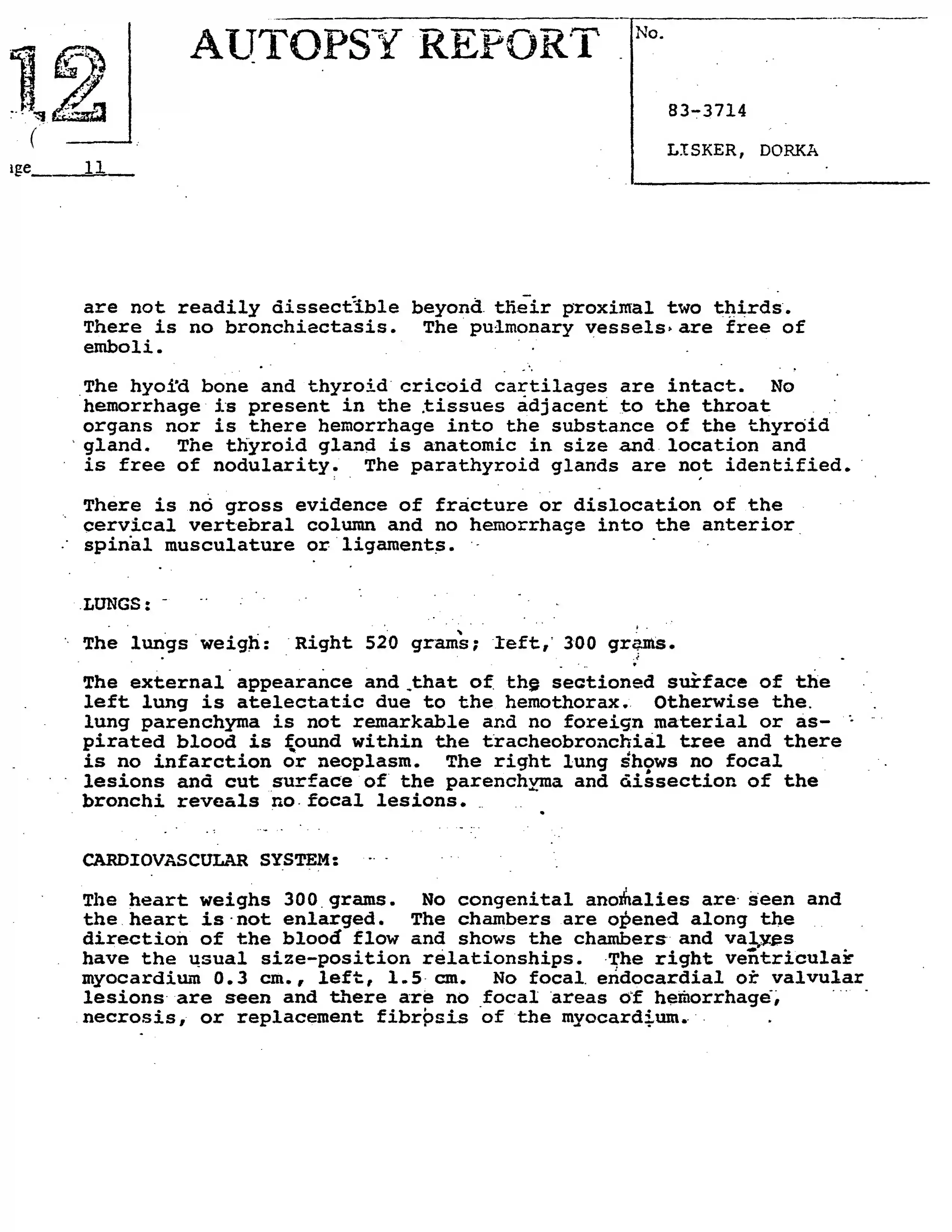
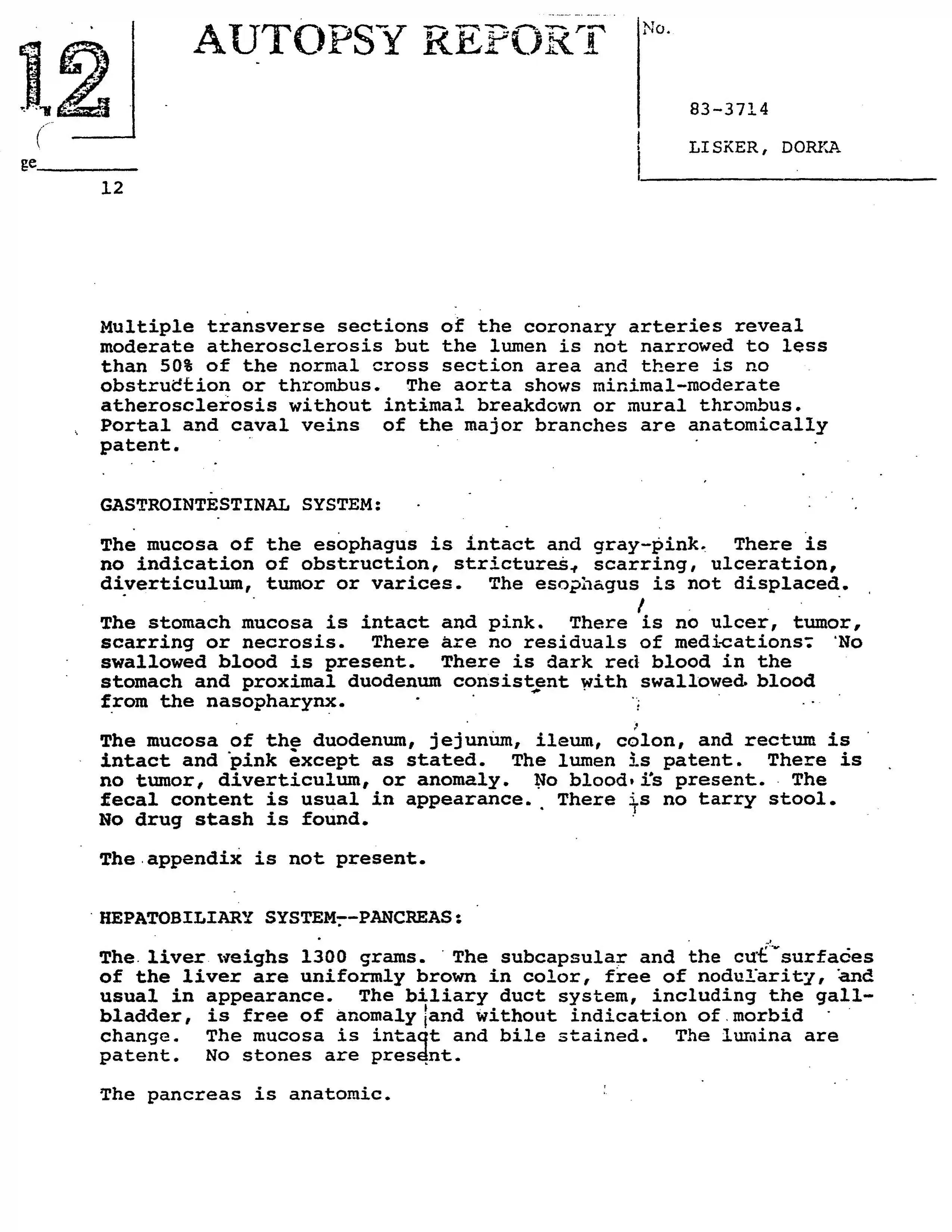
Cited in Part II (in preparation) · Part IV
Cited in Part IV
Cited in Part IV
A number of methods existed in 1983 which could have revealed details in the footprint(s) lost forever because of the coarse perspective photography police used. These methods include:
Oblique Light Photography (using high contrast light and/or filters on all types of surfaces); Cross-Polarized Light Photography (employing two polarizing filters, with the film plane parallel to the plane of the impression); Ultraviolet Light Photography (using an ultraviolet (UV) light source in the 10–400 nanometer wavelength range, and a UV filter).
Electrostatic Lifting (uses high-voltage static electricity to transfer footwear impressions to surfaces of greater contrast); Fingerprint Powder (improves the contrast and allows the gathering of latent footwear impressions in the same manner as fingerprint lifting); Gel and Adhesive Lifting (transfers footwear impressions to surfaces of greater contrast, using gelatin as the transfer medium).
8-Hydroxyquinoline (reacts with calcium, magnesium, iron, aluminum and other metals, and causes the footwear impression to fluoresce when exposed to a UV light source); Iodine and 7,8-Benzoflavone (reacts to fatty, oily and other organic materials in footwear impressions, turning yellow-brown); Potassium and Ammonium Thiocyanates (reacts to iron present in footwear impressions, turning reddish brown); Physical Developer (reacts to oily, waxy, or fatty materials in footwear impressions); Small Particle Reagent (SPR) (adheres to fatty materials in latent fingerprints and some footwear impressions); Ninhydrin (reacts with amino acids in fingerprints and blood, turning a color called "Ruhemann's Purple"); Amido Black — Amido 10B or Naphthaline Black (reacts with blood, turning dark blue to black); Crowle's Staining Solution (reacts to blood, turning red); the ever-popular Luminol (reacts to hemoglobin in blood); and Tetramethylbenzidine (TMB) (reacts with blood, turning bluish-green).
Cited in Part IV
Cited in Part IV
Cited in Part I (in preparation) · Part IV
Cited in Part IV
Cited in Part I (in preparation) · Part IV
Cited in Part IV
Cited in Part I (in preparation) · Part IV
Cited in Part IV
(Scan in LAPD Arrest Report, dated 3-10-83)
and LAPD Preliminary Investigation, dated 3-10-83
(Personal Oddities) "AFRO hair"
Cited in Part II (in preparation) · Part IV
The premise that violence most often comes from within the victim's own circle is not folk wisdom but a settled finding of federal crime data. As Gavin de Becker put it in The Gift of Fear, "we are most often hurt by those we know."a The Bureau of Justice Statistics confirms the pattern at scale: in 2023, the single largest share of U.S. homicides — 39 percent — was committed by someone outside the family but known to the victim, while strangers accounted for a far smaller share.b The intimate violence figures are more striking still. In 2021, roughly 76 percent of female murder victims and 56 percent of male murder victims were killed by someone they knew; 34 percent of female victims were killed by an intimate partner and another 16 percent by a non-intimate family member — a parent, sibling, or other relative.c Put plainly, when a person is killed in America, the perpetrator is statistically far more likely to be a relative, partner, or acquaintance than a stranger.
a Gavin de Becker, The Gift of Fear: Survival Signals That Protect Us from Violence (New York: Little, Brown, 1997).
b Bureau of Justice Statistics, Homicide Victimization in the United States, 2023 (NCJ 309610, U.S. Dep't of Justice, 2025), https://bjs.ojp.gov/library/publications/homicide-victimization-united-states-2023.
c Bureau of Justice Statistics, Female Murder Victims and Victim-Offender Relationship, 2021 (U.S. Dep't of Justice, 2023), https://bjs.ojp.gov/sites/g/files/xyckuh236/files/media/document/fmvvor21.pdf.
Cited in Part IV
Cited in Part IV
Cited in Part IV
Cited in Part IV
Cited in Part IV
Cited in Part IV
Cited in Part IV
Cited in Part IV
Cited in Part IV
Cited in Part IV
Cited in Part IV
I was the only uninjured person they'd yet encountered, therefore I must, have been the first "possible suspect."
Cited in Part I (in preparation) · Part IV
Cited in Part I (in preparation) · Part IV
Cited in Part I (in preparation) · Part IV
Cited in Part I (in preparation) · Part IV
Cited in Part I (in preparation) · Part IV
Cited in Part I (in preparation) · Part IV
And contrary to Monsue's apparent implication, neither did anyone else. My dad was the one who told me my mom had died when he came to Van Nuys police station.
But recall that Monsue had earlier testified that I'd "ASKED SEVERAL QUESTIONS ABOUT IT THROUGHOUT THE ENTIRE INTERVIEW". (Nov 6 1984, -above).
Cited in Part IV
Strikingly little compassion for a youngster whom Monsue steadfastly maintained had been no worse off than being considered a possible witness to the attack on his mother. During the interrogation, Monsue used the prospect and promise of my finally being able to wash my mother's gore from my hands as a tool of influence as we discussed my waiving my Miranda rights. He dangled the hand-washing, further linked to my actual release from custody, like a Constitutionally tainted carrot. Consider:
Monsue told me I could wash my hands after we talked, but in order to talk I first had to waive my rights. That's called coercion. Against an adult, able to fend for himself, it would nevertheless have been illegal. But against me — a teenager, ill-equipped to deal with such intense pressure from an adult authority figure, having minutes earlier been completely blasted emotionally by the discovery of my brutalized, bloody, and dying mother — it is reprehensible.
The Court, however, was content to label the error "harmless" and move on:
"Overwhelming evidence" — meaning the tainted, paid-for testimony of the lying jailhouse snitch Robert Donald Hughes [Cf. § V], which the State manufactured by illegally placing me in the 7000 Module snitch tank [Cf. § VI]. Or the State's own blood expert, who testified that every bloodstain detective Monsue claimed implicated me [Cf. § III (1)] could just as easily have come from the innocent first aid I told Monsue I had rendered [Cf. § III (2) (a)]. Or the 'footprints in the dirt' [Cf. § VIII] and 'visibility through the rear windows' [Cf. § IX] questions, which implicated me in nothing — more sparks Monsue threw into the tinder in his effort to start a fire of suspicion he could not start with facts. This is what the Court was willing to call "overwhelming" in denying me a new and fair trial.
Cited in Part IV
Cited in Part I (in preparation) · Part IV
That answer doesn't survive the rest of the record. By the time the paramedics arrived I was in the driveway in front of our house, screaming at them — independently confirmed by both law enforcement and fire department personnel on scene. The neighbors directly east apparently heard none of it.
⚠ Warning — explicit content.
The claim never made it into court. It surfaces only in the Follow-Up report — and my father's sworn testimony contradicts it outright. The Bullworker exercise bar wasn't mine. It was a Christmas gift my mother and I had given him a few years prior, and I do not believe it had ever, even once, left the house. There was no conceivable reason it would have. It lived where he used it: in their bedroom, directly beneath its exercise-routine wall chart, still taped above the spot where police found it — visible together in LAPD crime-scene photograph #112‑075 taken that tragic day.
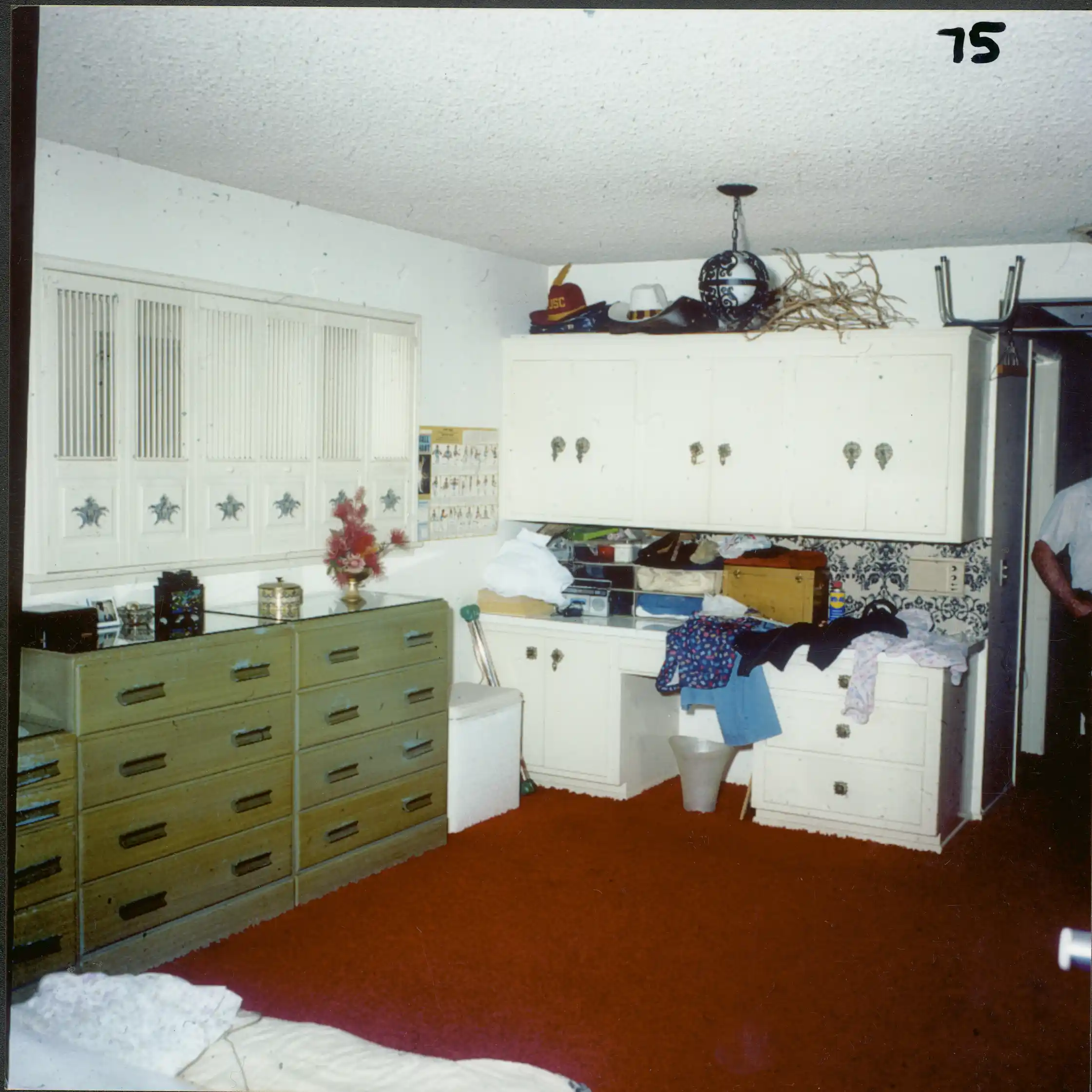
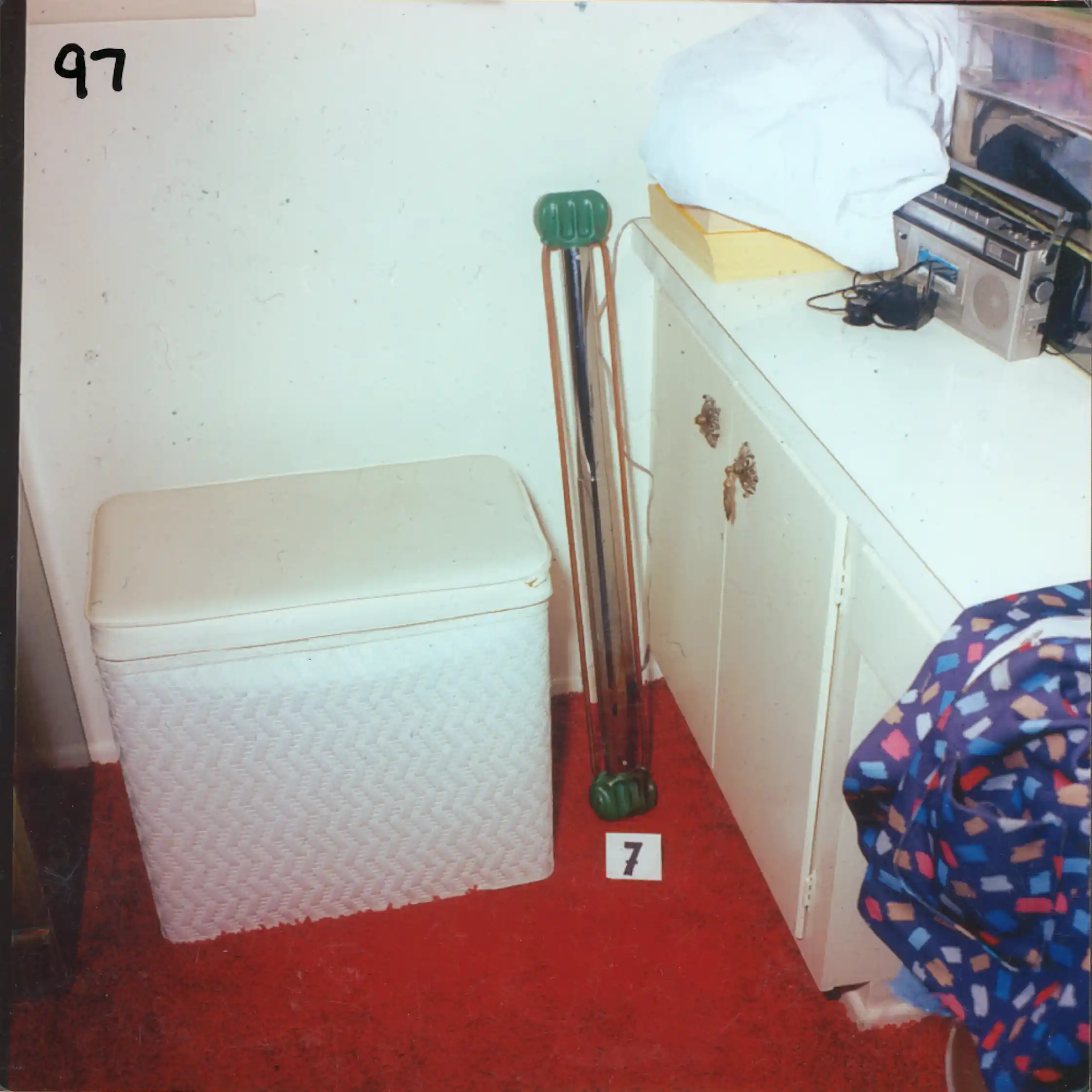
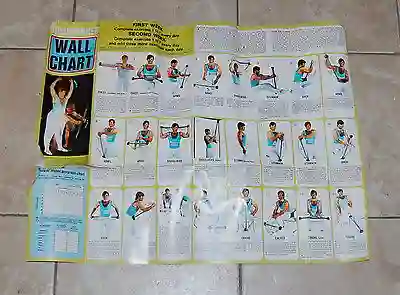
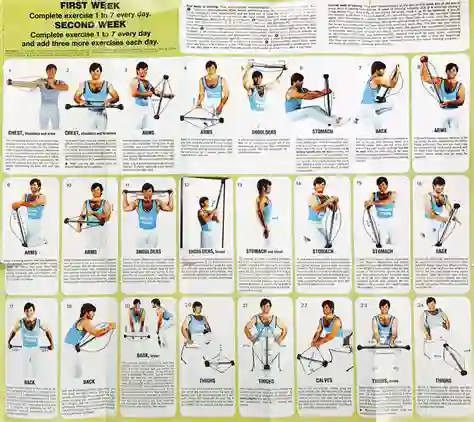
Cited in Part II (in preparation) · Part IV
Exactly where it was found by police.
Cited in Part II (in preparation) · Part IV
LAPD Arrest Report, dated 3-10-83;
and LAPD Follow-Up Investigation, March 13, 1983 – Page 1
Cited in Part IV
LAPD Death Investigation
Cited in Part IV
Cited in Part IV
Three months before Hughes ran his jailhouse-Christian-conversion con on me in a County Jail cell, I weighed 97 pounds. Hughes was a former combat Marine and a career criminal whose entire adult life had been spent cycling through jails and prisons. He told a jury he had been afraid of me. Afraid of a 97-pound teenager. The fear was theater. The conversion was a fiction. Both were sold to a credulous prosecution in exchange for a discount on the sentence his record had earned many times over. He wasn't afraid. He was working a con. The State bought it.
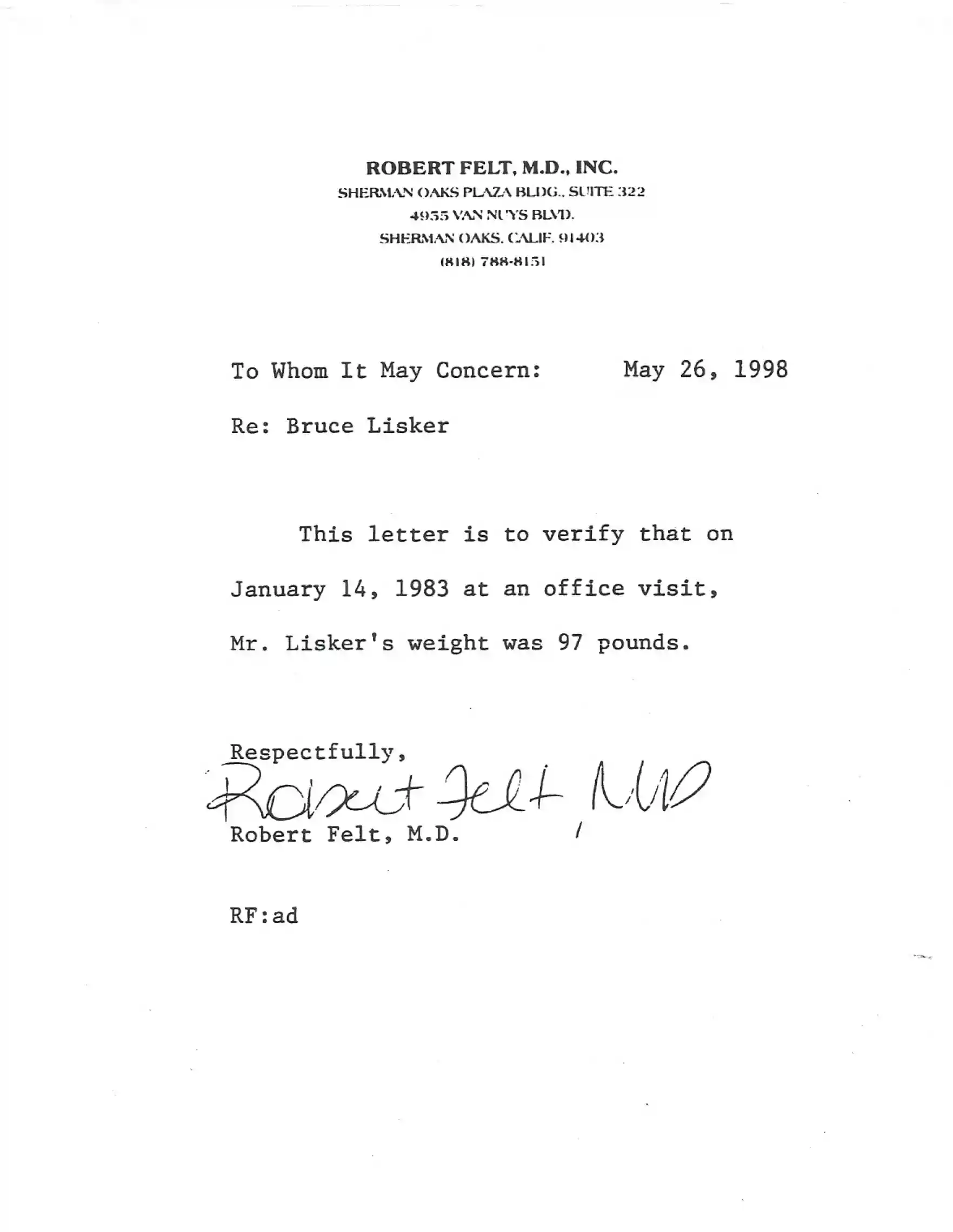
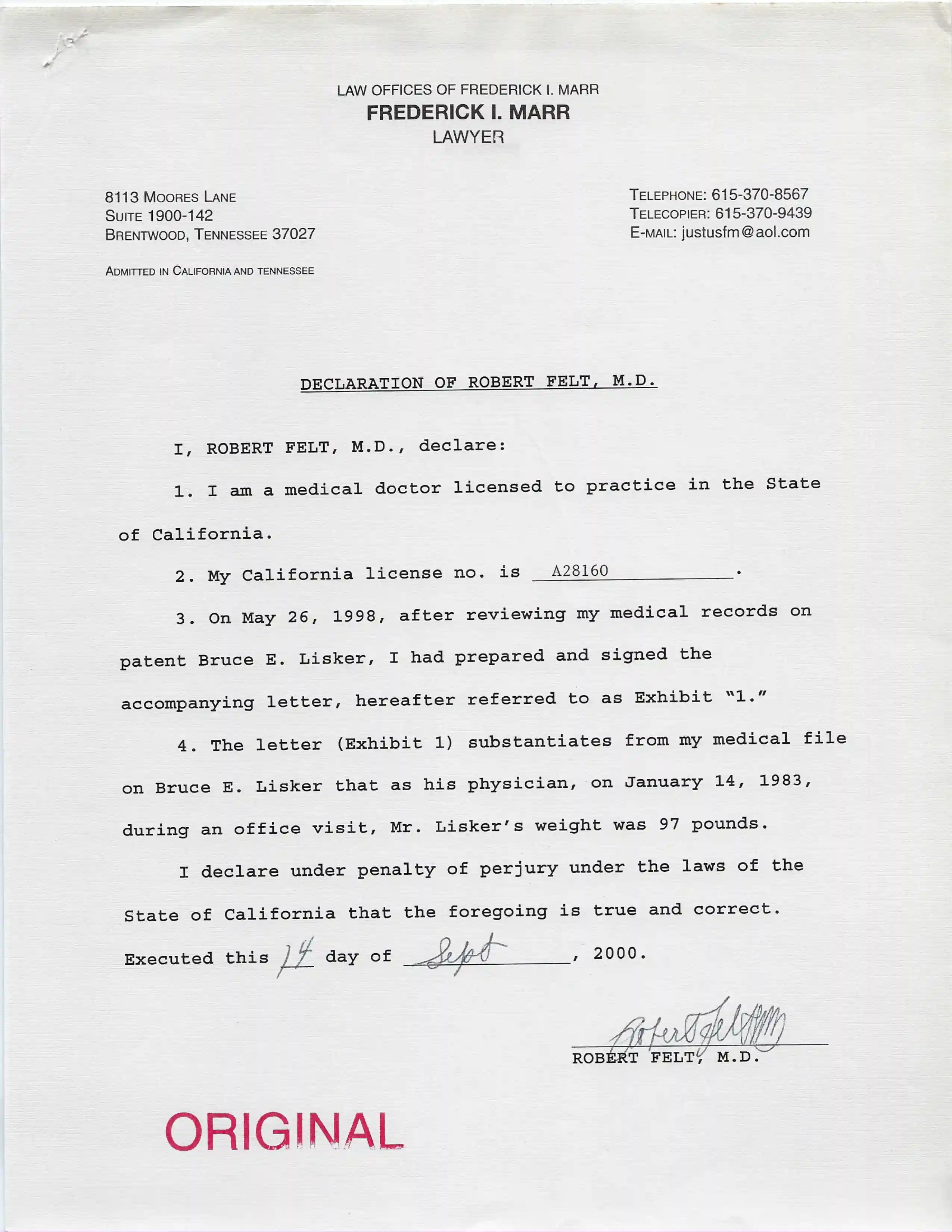
LAPD Booking Photo, Bruce Eliot Lisker, 3-10-83. (As of this date, LAPD has refused to release this photograph.)
Cited in Part I (in preparation) · Part IV
Cited in Part IV
With the exception of the defensive slash wounds on the left hand, which the Coroner similarly indicated could have been caused by sharp instruments of any type or size.
It is illogical that if I were the attacker, I would have incorporated the search knives into the attack [Cf. § IV (10); § V (3) (a) through (d), (4)]. Why would I have said I'd used them to search the house, if I'd just attacked my mom with them and thereby gotten her blood on them? And why would I have attacked her with knives I'd retrieved, according to the police theory only to create an alibi? And if I were the attacker, why would I have selected "knives from our kitchen" as an alibi, if I'd just attacked my mom with other "knives from our kitchen"? Finally, the width of the two deep stab wounds precluded with of the search knives' having caused them; the knives were wider across than the wounds' entry points.
Cited in Part IV
In reporting only that the wound "WAS CHANGED AT THE HOSPITAL. THEY SUTURED THIS WOUND."
Dr. Golden does not accurately reflect the degree of "CHANGE" which the wound was subjected to. In fact, doctors likely enlarged it surgically, cutting it open with a scalpel before packing it tightly, down to the bone with gauze material and sewing it closed. [Note #283] Any observation of the wound's texture, shape, or size was thus rendered completely unreliable for purposes of forensic comparison, such as connecting its apparent "SQUARED OFF OR FLATTENED EDGE" to any weapon, this edge, and the overall size, having likely been altered prior to Dr. Golden's examination.
Cited in Part IV
Cited in Part IV
Cited in Part IV
Cited in Part I (in preparation) · Part IV
That is, he did not approach me, Johnson or the police vehicle;
Contrast that once the Miranda issue arose, and Monsue had an interest in claiming I wasn't a suspect until well after my transport to Van Nuys station and the commencement of my interrogation, he flip-flopped. He then claimed that he hadn't even seen me in the car upon arrival. That way he could deny awareness of blood on my hands and my supposedly 'ripped' shirt, things he later claimed made me a suspect in his eyes.
Cited in Part IV
Black's Law Dictionary, Sixth Ed.
Miranda v. Arizona 384 U.S. 436, 444, 478, 479; 86 S.Ct. 1602, 1612, 1630; 16 L.Ed.2d 694
"PRIOR TO ANY CUSTODIAL INTERROGATION (THAT IS, QUESTIONING INITIATED BY LAW ENFORCEMENT OFFICERS AFTER A PERSON IS TAKEN INTO CUSTODY OR OTHERWISE DEPRIVED OF HIS FREEDOM IN ANY SIGNIFICANT WAY) THE PERSON MUST BE WARNED: 1. THAT HE HAS A RIGHT TO REMAIN SILENT; 2. THAT ANY STATEMENT HE DOES MAKE MAY BE USED AGAINST HIM; 3. THAT HE HAS A RIGHT TO THE PRESENCE OF AN ATTORNEY; 4. THAT IF HE CANNOT AFFORD AN ATTORNEY, ONE WILL BE APPOINTED FOR HIM PRIOR TO ANY QUESTIONING IF HE SO DESIRES.
"UNLESS AND UNTIL THESE WARNINGS OR A WAIVER OF THESE RIGHTS ARE DEMONSTRATED AT THE TRIAL, NO EVIDENCE MAY BE USED AGAINST THE ACCUSED."
Though in the aggregate this is true, in reality, in California, no evidence may be used which either 1) takes the form of a statement the arrestee makes in response to law enforcement questioning after becoming an in-custody suspect but before he is read his Miranda rights, or; 2) evidence which is discovered through statements made under these circumstances, if discovery of the evidence is found not to have been inevitable, independent of the statements.
Further limiting Miranda's exclusionary power in California is the so-called "Victim's Bill of Rights" Amendment to the California Constitution.
California Constitution, Article I., Section 28
"[The "Victim's Bill of Rights"]
"(d) RIGHT TO TRUTH-IN-EVIDENCE. EXCEPT AS PROVIDED BY STATUTE HEREAFTER ENACTED BY A TWO-THIRDS VOTE OF THE MEMBERSHIP IN EACH HOUSE OF THE LEGISLATURE, RELEVANT EVIDENCE SHALL NOT BE EXCLUDED IN ANY CRIMINAL PROCEEDING, INCLUDING PRETRIAL AND POST CONVICTION MOTIONS AND HEARING, OR IN ANY TRIAL OR HEARING OF A JUVENILE FOR A CRIMINAL OFFENSE, WHETHER HEARD IN JUVENILE OR ADULT COURT. NOTHING IN THIS SECTION SHALL AFFECT ANY EXISTING STATUTORY RULE OF EVIDENCE RELATING TO PRIVILEGE OR HEARSAY, OR EVIDENCE CODE SECTIONS 352, 782 OR 1103. NOTHING IN THIS SECTION SHALL AFFECT ANY EXISTING STATUTORY OR CONSTITUTIONAL RIGHT OF THE PRESS."
Cited in Part IV
Cited in Part IV
Cited in Part IV
Cited in Part IV
Cited in Part I (in preparation) · Part IV
Cited in Part IV
Cited in Part IV
Cited in Part I (in preparation) · Part IV
No record in the LAPD Follow-Up Investigation, March 13, 1983, of Monsue's discovery of the Hide-A-Key case (the report, at page 5, records only my own account of the magnetic key box);
Cited in Part I (in preparation) · Part IV
Cited in Part I (in preparation) · Part IV
Cited in Part I (in preparation) · Part IV
Cited in Part I (in preparation) · Part IV
Cited in Part IV
Cited in Part IV
Cited in Part IV
Cited in Part IV
Cited in Part IV
Cited in Part IV
Cited in Part IV
Cited in Part IV
Cited in Part I (in preparation) · Part IV
Cited in Part I (in preparation) · Part IV
In fact officer Prado revealed I'd never made it up onto the porch:
Cited in Part I (in preparation) · Part IV
Only after officers approached and physically grabbed me as I paced, frantic but totally unaggressive, did I instinctively try to wriggle free of their grasp. It was at that point that they overpowered and handcuffed me:
Cited in Part I (in preparation) · Part IV
Cited in Part IV
Cited in Part IV
Cited in Part IV
Cited in Part IV
Cited in Part IX
Cited in Part IX
Cited in Part IX
Located at 441 Bauchet Street, in Los Angeles.
Cited in Part V
Born March 7, 1954 as Robert Donald Campeau, his surname was changed at approximately age five to that of his step-father, Hughes.
Cited in Part V
This is Robert Donald Hughes’s criminal record as of October 6, 1983 — the day he took the stand at my preliminary hearing and admitted he was already on his third snitch case. Deuel Vocational Institution (Tracy State Prison) prepared it and sent it to Detective Monsue at his request. Monsue knew exactly who Hughes was. Fourteen years of arrests, plea deals, and prison sentences, newest first. Dates and charges are in bold; handed-down sentences are underlined.
The State put the man behind this record on the witness stand as a credible source in a murder case:
1.On June 8, 1981 he is arrested by Santa Ana police for: 459 Penal Code (PC) Burglary; 484-487.1 PC Grand Theft Property; 484-487.3 PC Grand Theft Misc./Auto; 496 PC Receiving Stolen Property; 459 PC Arson*; 12021 PC Felon Addict in Possession of a Firearm; and 10851 Vehicle Code (VC) Taking Automobile Without Owner's Consent;
* PC 459 is Burglary, not Arson — the rap sheet has it mislabeled. This list is reproduced verbatim, errors included.
2.On June 4, 1981 he is arrested by Huntington Beach police for: 496.1 PC Possession of Stolen Property; 487/3 PC Auto Theft (2 Counts); 12021 PC Illegal Possession of a Firearm; 240 PC Assault; and 245(a) PC Assault With a Deadly Weapon;
3.On March 3, 1980 he is charged with 4350(b) PC Prison Escape Without Force;
4.On March 22, 1978 he is sentenced to 4 years, 8 months in State Prison for 664 211 PC Attempted Robbery With 12022 PC Use of a Firearm and 664 211 PC Attempted Robbery;
5.On November 29, 1977 he is arrested by Santa Ana police on a Bench Warrant (#76 CMO 6735) issued on October 8, 1977 for 11550 Health & Safety Code (HSC) Use or Under the Influence of a Controlled Substance;
6.On November 21, 1977 he is arrested by Santa Ana police for 211 PC Robbery (after being detained by Anaheim police), and on March 2, 1978 a 245 PC Robbery charge is dismissed when he PLEADS GUILTY TO TWO COUNTS OF 211 PC ROBBERY. He is sentenced to an unspecified term in State Prison;
7.On October 18, 1977 he is arrested by Santa Ana police for 11550 HSC Use or Under the Influence of a Controlled Substance (after being detained by Westminster police);
8.On October 8, 1977 he is arrested by South Santa Ana police for: 11550 HSC Use or Under the Influence of a Controlled Substance; 488 PC Violation of Probation; 11550 HSC Violation of Probation; and 23105(a) VC Misdemeanor Drunk Driving Under the Influence of Drugs on the Highway;
9.On October 3, 1977 he is arrested by South Santa Ana police, and on October 11, 1977 he PLEADS GUILTY TO 11550 HSC USE OR UNDER THE INFLUENCE OF A CONTROLLED SUBSTANCE and on a Warrant for 23103 VC Reckless Driving, and is sentenced to 11 months in jail and 36 months probation;
10.On June 25, 1977 he is arrested by Santa Ana police for 488 PC;
11.On May 14, 1977 he is arrested by South Santa Ana police for 23102(a) VC Driving Under the Influence (Drugs) and is held for the Central Orange County Court;
12.On April 28, 1977 he is arrested by South Santa Ana police, and is either FOUND OR PLEADS GUILTY TO 487 PC GRAND THEFT, and is sentenced to 30 days in jail and 12 months of probation;
13.On April 20, 1977 he is arrested by South Santa Ana police for 11550 HSC Use or Under the Influence of a Controlled Substance, and on June 24, 1977 he PLEADS GUILTY TO 231054 VC and is sentenced to 24 months probation;
14.On February 24, 1977 he is arrested by South Santa Ana police for 459 PC Residential Burglary and is held for Costa Mesa police;
15.On September 19, 1976 he is arrested by South Santa Ana police for 11550 HSC Use or Under the Influence of a Controlled Substance and 484-488 PC. On October 29, 1976 he PLEADS GUILTY TO 11550 HSC USE OR UNDER THE INFLUENCE OF A CONTROLLED SUBSTANCE and is sentenced to 90 days in jail and 36 months suspended sentence;
16.On July 4, 1974 he is arrested by South Los Angeles police for 11550 HSC Use or Under the Influence of a Controlled Substance;
17.On September 9, 1970 he is arrested by Long Beach police for 211 PC Strong-Arm Robbery; 487.3 PC Grand Theft Purse; and Leading a Lewd and Dissolute Life and is referred to the Juvenile Justice Bureau;
18.On November 11, 1969 he is arrested by Los Angeles police for 602 Welfare & Institutions Code (WIC) 10851 VC and is released to his parents;
19.On July 17, 1969 he is arrested by Los Angeles police for 602 WIC 10851 VC and is released to his parents;
20.On March 21, 1969 he is arrested by Los Angeles police for 602 WIC 10851 VC (Delinquent), is counseled and released to his parents.
Not every line is a conviction. Some are arrests, and a few are old warrants logged as fresh “arrests” while he was already locked up. The underlined sentences are the convictions: robbery, attempted armed robbery, grand theft, narcotics. They are more than enough.
Robert Donald Hughes was a career criminal, fourteen years deep and unbroken, when he sat down across from a 17-year-old in jail and started talking about Jesus. By April 1983 he had pled guilty to multiple counts of robbery, been sentenced to four years, eight months for attempted armed robbery, been charged with escaping from prison, and been arrested by police in five different cities. He took every plea deal offered and was back in court before the ink dried. He stole for a living and lied his way out when he was caught. Then he found a better racket: lying for the State. Selling a teenager’s life to shave nine months off his own sentence was the most expensive thing he ever stole.
This is the man on whose word the State of California asked twelve jurors to put me away for the rest of my natural life.
Cited in Part V
Before Hughes ever met me, he was already a practiced repeat operator. He had testified, or agreed to testify, as an informant in at least two prior murder prosecutions: People v. Richard Crowell (Orange County Superior Court Case No. C-47061; prosecuted by DDA Patty Manoukian, investigated by DA Investigator Wayne Harver) and People v. Bernard Milberger (Los Angeles County Superior Court Case No. A561270; prosecuted by DDA Greg Denton, investigated by Sheriff's Homicide Sergeant Frank Salerno and Detective Peter Finnegan). He admitted as much, on the stand, in my own preliminary hearing:
By the time Hughes was done he had testified against four homicide defendants in three cases: Crowell; both defendants in the Milberger case; and me. He also informed against a defendant in a Beverly Hills police-shooting case (Hughes's only attempted-murder case), but never testified in that case.
Three cases, four defendants. Three times a prosecutor decided a serial liar was their best shot.
Cited in Part V
The date on which he received his five year prison sentence for the June 8, 1981 Orange County arrest (by Santa Ana police) for: 459 PC Burglary; 484-487.1 PC Grand Theft Property; 484-487.3 PC Grand Theft Misc./Auto; 496 PC Receiving Stolen Property; 459 PC Arson*; 12021 PC Felon Addict in Possession of a Firearm; and 10851 VC Taking Automobile Without Owner's Consent. It was Hughes' sentencing judge in this case, Donald A. McCartin, who denied DDA Patty Manoukian's request that Hughes sentence be reduced because of his snitching activities in the Crowell case.
When Hughes reported he'd had first contact with me in the County Jail's infamous 7000 Module snitch tank
Cited in Part V
Cited in Part V
The following discussion occurred at my April 4, 1983 Sylmar Juvenile Court hearing; here read into the record by DDA Phillip H. Rabichow
Cited in Part I (in preparation)
Cited in Part I (in preparation) · Part VI
Cited in Part I (in preparation)
Cited in Part V
Cited in Part V
Cited in Part V
Cited in Part V
Hughes without question claims the supposed confession happened during our first conversation.
Cited in Part V
Cited in Part V
Cited in Part V
ON APRIL 30, 1981, HUGHES TOOK A VOLKSWAGON AUTOMOBILE BELONGING TO ██████████ WITHOUT HER PERMISSION.
ON MAY 1, 1981, HUGHES SOLD THE VICTIM'S RING AT A JEWELRY STORE IN HUNTINGTON BEACH, CALIFORNIA.
ON MAY 25, 1981, HUGHES CONTACTED A JEWELRY STORE IN NEWPORT BEACH AND ATTEMPTED TO SELL SOME JEWELRY. THE MAN AT THE JEWELRY STORE REFUSED TO PURCHASE THE JEWELRY. HUGHES PULLED A STEEL REVOLVER FROM HIS PERSON AND STARTED HITTING THE VICTIM IN THE HEAD. HUGHES LATER ADMITTED THAT THE GUN HAD BEEN STOLEN IN A BURGLARY IN THE ANAHEIM HILLS SECTION OF ORANGE COUNTY.
ON MAY 26, 1981, HUGHES TOOK A PARKED TRUCK IN COSTA MESA, CALIFORNIA. HUGHES WAS SEEN LEAVING A RESIDENCE IN ORANGE COUNTY THAT HAD BEEN BURGLARIZED AND DRIVING OFF IN THE TRUCK THAT HE HAD STOLEN. HUGHES WAS CAUGHT ON JUNE 4, 1981, DRIVING THE STOLEN TRUCK IN LOS ANGELES COUNTY.
AT APPROXIMATELY 7:30 A.M., DEPUTIES OF THE LOS ANGELES SHERIFF'S OFFICE RECEIVED A RADIO CALL WHILE ON ROUTINE PATROL TO CONTACT DETECTIVE ██████████ OF THE HUNTINGTON BEACH POLICE DEPARTMENT AT THE INTERSECTION OF FLOWER STREET AND ARDMORE AVENUE IN THE CITY OF BELLFLOWER. WHILE IN ROUTE, THEY WERE STOPPED BY OFFICER ██████████ WHO SAID HE HAD BEEN FOLLOWING HUGHES AND HIS COMPANION, WHO WERE DRIVING THE STOLEN VEHICLE. THE DEPUTIES ATTEMPTED TO EFFECT A TRAFFIC STOP AT WHICH TIME THE STOLEN VEHICLE TURNED INTO A PARKING LOT. THE VEHICLE WAS BEING DRIVEN BY HUGHES AND HE ACCELERATED TO A HIGH RATE OF SPEED, IN EXCESS OF 60 MILES PER HOUR. IT WENT OVER THE CURB INTO THE DRIVEWAY ON THE WEST SIDE OF ROMONA ELEMENTARY SCHOOL AND NEARLY STRUCK FIVE CHILDREN, WHO IMMEDIATELY SCATTERED. THE VEHICLE THEN DROVE EASTBOUND BEHIND SEVERAL CLASSROOMS AND ABRUPTLY STOPPED, AT WHICH TIME HUGHES AND HIS COMPANION FLED. THE COMPANION, ██████████, WAS IMMEDIATELY APPREHENDED AND STATED THAT HUGHES WAS ARMED AND DANGEROUS.
AT APPROXIMATELY 9:10 A.M. HUGHES WAS FOUND ATTEMPTING TO HIDE UNDER SOME BUSHES OUTSIDE THE RESIDENCE AT ██████████ STREET, BELLFLOWER, CALIFORNIA. HE WAS IMMEDIATELY APPREHENDED. HUGHES' COMPANION HAD BEEN CONTACTED BY OFFICER ██████████ AND WAS GIVEN PERMISSION TO SEARCH HIS RESIDENCE. CONTACT WITH ██████████ AT THIS RESIDENCE ALSO RESULTED IN HER PERMISSION TO SEARCH THE RESIDENCE. OFFICER ██████████ FOUND A DUFFLE BAG IN THE LIVING ROOM, BELONGING TO HUGHES, WHICH CONTAINED A .22 CALIBER AUTOMATIC TARGET PISTOL WHICH HAD BEEN STOLEN IN A PREVIOUS BURGLARY. THAT BURGLARY WAS COMMITTED AT THE RESIDENCE OF ██████████ IN THE CITY OF CERRITOS, SOME TIME BETWEEN MAY 23, 1981 AND MAY 29, 1981.
TAKEN FROM THAT BURGLARY WAS A .22 CALIBER TARGET PISTOL ALONG WITH SEVERAL OTHER HANDGUNS, HOLSTERS, AMMUNITION FOR THE HANDGUNS, SOME KNIVES, JEWELRY AND MISCELLANEOUS SPORTING BAGS.
HUGHES BEGAN HIS CRIMINAL JUSTICE INVOLVEMENT IN 1969 WITH A WELFARE AND INSTITUTIONS CODE DELINQUENCY OF A JUVENILE. HIS HISTORY THEN PROGRESSED WITH MULTIPLE ARRESTS FOR DRUGS AND AN ARMED ROBBERY.
HE WAS SUBSEQUENTLY COMMITTED IN 1978 TO THE DEPARTMENT OF CORRECTIONS FOR ATTEMPTED ROBBERY WITH THE USE OF A FIREARM FOR WHICH HE RECEIVED FOUR YEARS AND EIGHT MONTHS.
HE IS PRESENTLY A PAROLE VIOLATOR WITH A NEW TERM."
Cited in Part V
Cited in Part V
Cited in Part V
Cited in Part V
Cited in Part V
One of a dozen cases the Grand Jury laid out. In every one, the same pattern: a brief encounter, an elaborate “confession,” details that don't match the actual crime, a jury that bought it anyway. Hughes worked from that playbook because it worked. Read the full report. The 1980s jailhouse-snitch perjury scandal in Los Angeles was not a few bad apples. It was the business model.
Cited in Part V
In 1988, jailhouse informant Leslie Vernon White stopped pretending. He sat down in front of the LA County Sheriff's Department and demonstrated, step by step, how he and his fellow snitches manufactured confessions out of nothing. The scandal that demonstration cracked open was too large to ignore. A Grand Jury was empaneled. This is how they described what they were forced to investigate:
"In an effort to examine the causes of the problem internally and assess the impact upon of the criminal justice system, high-ranking District Attorney officials announced efforts to review case files and memoranda from deputies who had encountered or who had involved such informants in their cases.
"On December 15, 1988, California Attorneys for Criminal Justice and the Los Angeles Criminal Courts Bar Association filed application with the Presiding Judge of the Superior Court requesting a Grand Jury investigation into the jail house informants matter. The application further called for appointment of special counsel to advise the Grand Jury in its investigation. A supplement to the application was filed in February, 1989. Pursuant to Section 936 of the Penal Code of the State of California, the Attorney General formally appointed the first Special Counsel in May, 1989, and the second Special Counsel in December, 1989.
--------
"[1] From October 29, 1988, through December 17, 1988, the Los Angeles Times alone published at least 15 articles (editorials excluded in the count) on the subject of the disclosures and issues related to jail house informants. ";
OF THE INVESTIGATION."This report of the 1989-1990 Los Angeles County Grand Jury is the result of an intensive investigation and the presentation of evidence by Special Counsel. One hundred twenty witnesses testified before the Grand Jury and 147 exhibits were introduced into evidence.
"Witnesses included jail house informants, public officials, judges, prosecutors from the Los Angeles County District Attorney’s Office and the California Attorney General's Office, county and state public defenders, members of the Bar, including representatives of defense bar organizations, law enforcement officials from the Los Angeles County Sheriff's Department, the Los Angeles Police Department, and other police agencies within the county, custodial officers at both the local and state level, and private citizens.";
Cited in Part I (in preparation) · Part V
"Regardless of how this testimony is evaluated, it cannot be ignored. But for one informant's public exposure of these practices the Special Counsel would probably not have been appointed to investigate and present evidence before the Grand Jury and the extent of this problem within Los Angeles County would not have been examined by the Grand Jury."
Cited in Part V
Cited in Part V
This is exactly the script Hughes ran on me. He opened with God, salvation, and hope — the language of the home I'd lost. He worked his way into my trust until he could safely ask about the charges I was facing. When rumors began circulating that Dowtu and Wallace were fabricating a confession against me, Hughes was right there with reassurance: he would defend me, challenge them, testify on my behalf if it came to it.404,407,411 Every word of it was rehearsal. The Grand Jury's “wily informant” preying on a juvenile's “naiveté” was not a hypothetical. It was Hughes. It was me.
Cited in Part V
* “We know the defendant did it.” Police and others in law enforcement who somehow "know the defendant did it" are not a rare or recent development. They are the very reason for due-process jurisprudence — the reason we do not lock people up, or summarily execute them, on mere suspicion, "gut feeling," or whim. They are why we demand a higher standard of justice. The fact that even those more stringent safeguards sometimes fail is why we have courts of appeal and a two-tiered (state and federal) legal system to hear petitions for redress. It is why Habeas Corpus — the so-called "prisoner's last chance" — not only exists but was incorporated by the Framers into the most important document in the land: the Constitution of the United States. This is no small afterthought and no trifling matter of "legal technicality." It is an essential component of all our freedom.
Van Nuys police probably would have reported that they also "knew the defendant did it" after encountering me disheveled, long-haired and bloody-handed, hysterical and ranting outside the home in which my mom — with whom I'd had a history of disagreements — lay beaten, stabbed, unconscious, and near death. And in remarkable accord with the Grand Jury's report, law enforcement in my case did, in fact, find that "sooner or later those [snitch] statements become available" to them.
A senior officer in the Los Angeles District Attorney's Office, under oath, admitted that he assumed every jailhouse informant was a liar — and used them anyway. Not as deterrents. As tools. The State's own management knew the men it was putting on the witness stand could not be believed. They used them in my case all the same.
Cited in Part V
Defense wounds are injuries appearing primarily on the extremities (hands; forearms, legs and feet) and sometimes the face and chest, which are caused when a victim fights back or defends against an attacker's thrusts or stabs with a sharp object. The fact that a number of these wounds were present on my mother’s left hand only is highly suggestive of her killer having stabbed and thrust at her with the steak knives numerous times after her right upper arm had been shattered by being hit with the exercise bar.
Cited in Part V
Cited in Part II (in preparation) · Part V
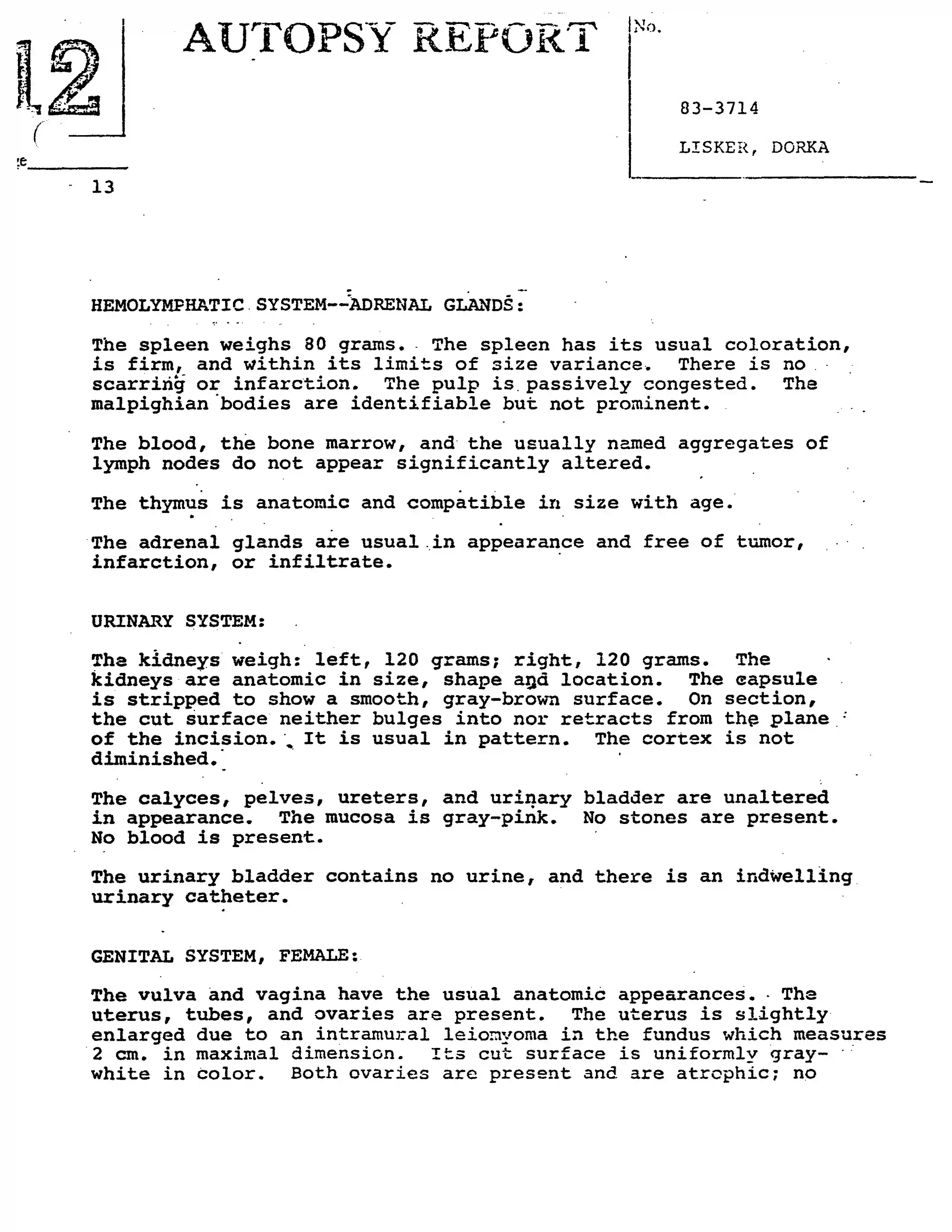
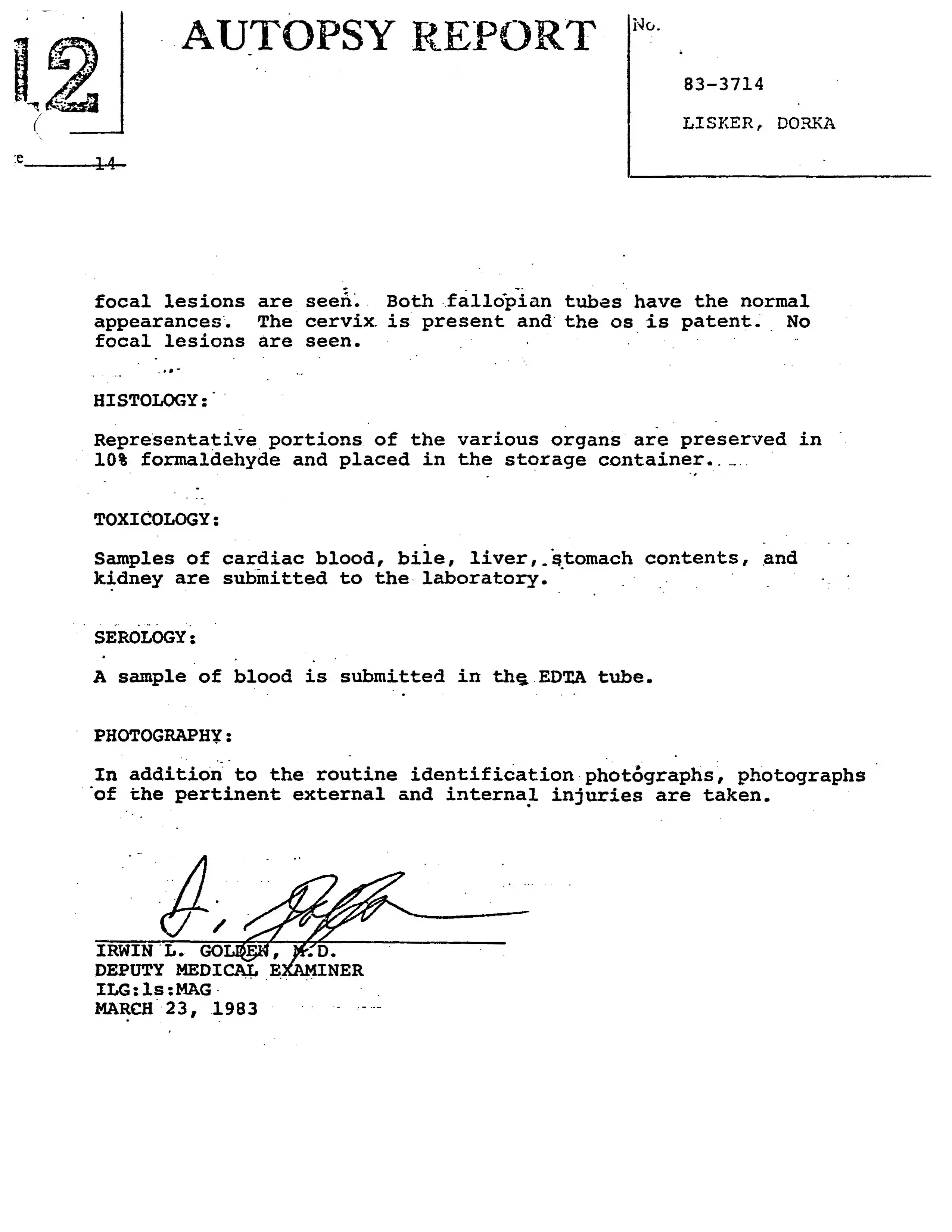
Los Angeles Count Autopsy Report No. 83-3174 (Lisker, Dorka G.)
There was a total absence of slashes or cuts on the right hand.
[View Autopsy Diagrams]
Cited in Part II (in preparation) · Part V
Cited in Part V
Cited in Part V
Reading the LAPD Follow-Up Investigation report from beginning towards end, the following passages are encountered, in the sequence indicated:
Cited in Part V
Well before Hughes would crawl out of the muck and start singing for his supper, Det. Monsue had stitched me into my mother's murder. Here is the choreography: Trophy, supposed shirt-Rip, Knives, exercise Bar — TRKB. A sequence reverse-engineered from what he needed to prove. Note the R. The shirt-ripping never happened. That was a greasy old work shirt — torn already, threadbare already — that I had on that morning because I needed to crawl under my car and fix the shock. Monsue invented the rip because his choreography required one.
Cited in Part II (in preparation) · Part V
Hughes, having gotten the (RKTB) sequence directly from the police report, logically believed it to be the police theory of the sequence of attack. Hoping to present a story in virtual perfect harmony with that theory, he simply echoed the sequence at his July 6, 1983 interview with detective Monsue.
Meanwhile from a mathematical standpoint it is exceedingly likely that Hughes obtained his sequence, in one way or another, from the police report which featured the incidental sequence (RKTB), rather than from any other source. Probability theory supports this.
There are five hundred seventy-six (576) ways to uniquely distribute the letters R, K, T, and B, twice each, in an eight character string. Said in another way, there are that many possible permutations of the eight characters.
(The string consists of letters which represent each weapon. Each letter appears only once in Hughes,' and once in police' accounts, strung together. (For example, RKTB/RRTB) The formula for determining this is: 4! x 4! where 4!, termed four "factorial," represents (4 x 1) + (4 x 2) + (4 x 3) = 24. Thus, there are twenty-four unique permutations of the letters R, K, T, and B in a four character string. Then, the number of possible permutations in Hughes' letters (24) and the number of possible permutations of police' letters (24) are factored to yield the statistical probability that both Hughes and police acting independently could randomly specify the sequence (RKTB): one in five hundred seventy six. Said in another way, there is a five hundred seventy-five in five hundred seventy-six (575/576) probability that Hughes somehow obtained his sequence from police or their report.)
Refer to Note #363.
Los Angeles County Autopsy Report No. 83-3174 (Lisker, Dorka G.), pages 1 through 33, inclusive.
Immediately following my interrogation at Van Nuys police station, I was ordered to disrobe and surrender all the clothing I wore, down to and including my boxer shorts and socks, so they could be subjected to forensic testing. This decloaking took place under the watchful eyes of Monsue and his colleagues.
Cited in Part V
Cited in Part I (in preparation) · Part II (in preparation) · Part V
Cited in Part V
Cited in Part V
Concerning the only blood patterns which police and prosecutors alleged were inclupatory: A total of eight tiny droplets, each about one millimeter in diameter, which bloodstain expert Linhart observed, one on each of my tennis shoes and six in a small grouping on the right sleeve cuff of my outer shirt.
Cited in Part IV
See note #363.
Cited in Part V
See Note #379.
Cited in Part V
Los Angeles County Autopsy Report No. 83-3174 (Lisker, Dorka G.) No abrasions or damaged fingernails were observed or documented.
[View Autopsy Diagrams]
Cited in Part V
Cited in Part V
Cited in Part V
Cited in Part V
Cited in Part V
Cited in Part V
Cited in Part V
Because Hughes claimed that the supposed confession had occurred during our very first conversation, and that we'd never met prior to that conversation, these letters were written by him at a point in time after the initial conversation --and the supposed confession,
Cited in Part V
Cited in Part V
Cited in Part I (in preparation) · Part V
Cited in Part I (in preparation) · Part V
Cited in Part I (in preparation) · Part V
Cited in Part V
Court Reporter's notation, in trial transcript
Cited in Part V
Cited in Part V
Cited in Part V
Cited in Part V
Preliminary Hearing, November 14, 1983, page 265
Hughes threatened to withdraw his testimony in my case because his earlier snitching efforts had not bore sentence-reduction fruit, and he was reportedly losing time credits testifying in my case. Then DDA Rabichow told Hughes he would do all he could to 'look into' the snitch's premature release, and Hughes decided to resume his testimony, commenting on his decision:
"WELL, THE MAIN THING THAT MADE ME CHANGE MY MIND FROM THE TIME I CALLED YOU [and threatened to withdraw] AND WHY I'M FINISHING THE CROSS-EXAMINATION WAS MORALS. THERE'S A LITTLE PERSONAL BENEFIT THERE, I STILL GOT A HOPE THAT I'M GOING TO GET A TIME CUT BUT THERE'S MORALS INVOLVED IN WHAT BRUCE DID."
Cited in Part V
Cited in Part V
Cited in Part V
See Note #406.
See Note #404.
Cited in Part V
Cited in Part V
Cited in Part I (in preparation) · Part V
Cited in Part V
Cited in Part V
Cited in Part V
Cited in Part V
Cited in Part V
Cited in Part V
Cited in Part V
Cited in Part II (in preparation) · Part V
John Michael Ryan, Jr., on his living arrangements during his trip to Los Angeles near the time of the murder
Cited in Part V
Phencyclidine, also called PCP, is an inexpensive street drug popular mostly in the 1970's and 80's, widely known to drug users and substance abuse experts -- and lying jail house snitches -- as a cause of aberrant, unpredictable and even violent outbursts on the part of its users. Because Hughes knew it was impossible for me and my attorney to prove a negative, that I'd never used the drug before, and, obviously because of the drug's notorious reputation, this position represented a win-win situation for Hughes. It provided an acceptable motive for this violent, otherwise motiveless suburban murder, it was unable to be effectively contested, and it appeared to link the missing cash with me by virtue of the sophistic claim that I needed it to buy more of the drug. And consider:
MAJOR DRUG OF ABUSE BECAUSE OF ITS POTENT PSYCHOLOGICAL AND
BEHAVIORAL EFFECTS. INTRODUCED IN THE 1950'S AS A RELATIVELY NON-TOXIC ANIMAL ANESTHETIC, PCP HAS HARSH SIDE EFFECTS THAT MAKE IT UNSUITABLE FOR ANESTHESIA IN HUMANS. WITHIN A FEW YEARS, HOWEVER, ILLEGAL PCP WAS SOLD AS A SUBSTITUTE AND ADULTERANT FOR SUCH HALLUCINOGENS AS LYSERGIC ACID DIETHYLAMIDE (LSD), MESCALINE, AND TETRAHYDROCANNABINOL (THC). CUSTOMARY USERS OF OTHER HALLUCINOGENS USUALLY DID NOT LIKE THE SEVERE PSYCHOLOGICAL EFFECTS OF PCP; IT BECAME POPULAR AMONG TEENAGERS IN THE 1970'S, HOWEVER, UNDER SUCH STREET NAMES AS 'ANGEL DUST' AND 'HOG.' USERS HAVE MORE SHARPLY CONTRASTING RESPONSES TO PCP THAN TO OTHER DRUGS OF ABUSE. IT HAS PROFOUND EFFECTS ON THINKING, TIME PERCEPTION, SENSE OF REALITY, AND MOOD; DREAMLIKE STATES, EUPHORIC OR DEPRESSED MOODS, AND BIZARRE PERCEPTUAL EXPERIENCES ARE REPORTED. NEGATIVE ASPECTS OF PCP INGESTION INCLUDE DISORIENTATION, CONFUSION, ANXIETY, IRRITABILITY, PARANOID STATES, AND DANGEROUSLY VIOLENT BEHAVIOR. HOSTILITY AND BELLIGERENCE CAN REMAIN LONG AFTER THE DRUG IS NO LONGER MEASURABLE IN THE BLOOD. CHRONIC USERS MAY ALSO EXPERIENCE DEPRESSION OR A SCHIZOPHRENIA-LIKE STATE THAT CAN LAST MONTHS AFTER DISCONTINUATION. DEATH CAN RESULT FROM ACUTE EFFECTS SUCH AS DEPRESSION OF BREATHING AND DISTURBED HEART FUNCTION. PCP ABUSE CONTINUED IN THE 1980'S AND 1990'S, AND IT REMAINS A SERIOUS PUBLIC HEALTH PROBLEM." [emphasis added]
Cited in Part II (in preparation) · Part V
And again Monsue's selective memory, so precise when detailing three-year old and otherwise unsubstantiated gestures, yet so fleeting when the truth would exonerate me, prevents his 'recall'. But consider: Testimony .of Robert B. Lisker concerning the money he gave to me the evening prior to my mom's murder
(emphasis added] However I'd not been successful in finding a job. Therefore, my dad continued to support me by paying my rent, buying me food and clothing, paying for gas money and auto parts for my car, and giving me spending money; the ten dollars given me on March 9 was just one such payment.
Christianity is a branch of the Christian faith founded in the belief that one's soul must be "saved" by a process of invitation and "acceptance" of Jesus Christ into one's heart, to be one's savior and Lord. This process, according to Born-Again doctrine, is in accord with several passages in the Holy Bible: Holy Bible (NKV), at John 3:3 "JESUS ANSWERED HIM AND SAID TO HIM, 'MOST ASSUREDLY I SAY TO YOU, UNLESS ONE IS BORN AGAIN, HE CANNOT SEE THE KINGDOM OF GOD.' "; and Id. at John 3:7 "DO NOT MARVEL THAT I SAY TO YOU, 'YOU MUST BE BORN AGAIN.' "; and Id. at John 3:16 "FOR GOD SO LOVED THE WORLD THAT HE GAVE HIS ONLY BEGOTTEN SON, THAT WHOEVER BELIEVES IN HIM SHOULD NOT PERISH BUT HAVE EVERLASTING LIFE. FOR GOD DID NOT SEND HIS SON INTO THE WORLD TO CONDEMN THE WORLD, BUT THAT THE WORLD THROUGH HIM MIGHT BE SAVED. HE WHO BELIEVES IN HIM IS NOT CONDEMNED; BUT HE WHO DOES NOT BELIEVE IS CONDEMNED ALREADY, BECAUSE HE HAS NOT BELIEVED IN THE NAME OF THE ONLY BEGOTTEN SON OF GOD."; and Id. at Ephesians 2:4-7 "BUT GOD, WHO IS RICH IN MERCY, BECAUSE OF HIS GREAT LOVE WITH WHICH HE LOVED US, EVEN WHEN WE WERE DEAD IN TRESPASSES, MADE US ALIVE TOGETHER, AND MADE US TO SIT TOGETHER IN THE HEAVENLY PLACES IN CHRIST JESUS..."; and Id. at Ephesians 2:7 "BY GRACE YOU HAVE BEEN SAVED THROUGH FAITH."
Cited in Part V
Cited in Part V
And consider the testimony heard by the Grand Jury, wherein a certain inmate was placed in the jail's "hospital section" (i.e., the 7000 Module, where I met Hughes), and said to be suicidal so that jail staff could place a snitch in his cell, ostensibly to alert jailers if he attempted to harm himself. But of course the snitch presented almost immediately with an alleged confession:
Cited in Part V
See Note #428 (Trial November 6, 1985 – Page 580).
Cited in Part V
Cited in Part V
Cited in Part V
Cited in Part V
One-On-One is essentially a suicide or self-harm prevention measure, where staff maintain direct and constant, twenty-four hour a day supervision on a juvenile detainee. While only precautionary in my case, it is practically routine when a minor is arrested on serious charges, the school of though]: being 'better safe that sorry'; to watch a kid- who doesn't need it is better,, than losing a suicidal kid who went undetected.
Cited in Part V
[Cf. § II. The Impossibility of the Police Theory] (Cf. § IV. Police Lies and Distortions]
Cited in Part V
Cited in Part V
Cited in Part V
Cited in Part V
Cited in Part V
Cited in Part V
Cited in Part V
Cited in Part V
Cited in Part V
Testimony of jail house informant Robert Donald Hughes before being confronted with the letters he wrote me, asking for various things
Cited in Part V
Informants will collaborate in an effort to "book" an unsuspecting inmate:
; Dowtu and Wallace were. doubtless hoping Hughes would participate in the common practice of informants sharing information in order to 'book' a targeted inmate:
Informants will even 'book' another informant if they are able, and even such a targeted snitch may not be able to detect the plot against hint:
Cited in Part V
See Note #428 (Trial November 6, 1985 – Page 580).
Cited in Part V
Cited in Part V
Cited in Part VI
I was present at all times in the courtroom when this testimony was given, and thus heard: 1) What a 'spatter' and 'blood spot' are; 2) What types of forces/actions cause spatters and blood spots; 3) The fact that police claimed to have found blood spatters on my T-shirt, outer shirt, pants and shoes; 4) The relative number of these alleged spots (assuming I had a view of the small tags police had attached to the clothing (I did have); and 5) That a large part of the police allegation rested on the allegedly inculpatory spots and spatters. When I was questioned by Hughes, these were all pertinent facts which flowed freely from my naive lips into the ears of the liar.
Cited in Part V
Cited in Part V
While our March, 1983 home telephone bill remains in my possession, I will release its contents only to a court examining this matter because many persons, including members of my own family, still have the same numbers, and I do not wish to invade anyone's privacy. However, I give my word that any representations I make about the bill's contents are true and correct.
I would not turn eighteen for another three months, ironically on the very day I would be removed from the adult 7000 Module and returned, by Court order, to Central Juvenile Hall.
Welfare & Institutions Code Section 707.1 "IF THE MINOR IS DECLARED NOT A FIT AND PROPER SUBJECT TO BE DEALT WITH UNDER THE JUVENILE COURT LAW, THE DISTRICT ATTORNEY OR OTHER APPROPRIATE PROSECUTING OFFICER SHALL ACQUIRE THE AUTHORITY TO FILE AN ACCUSATORY PLEADING AGAINST THE MINOR IN A COURT OF CRIMINAL JURISDICTION. THE CASE SHALL PROCEED FROM THAT POINT ACCORDING TO THE LAWS APPLICABLE TO A CRIMINAL CASE, PROVIDED THAT UNLESS THE JUVENILE COURT SPECIFICALLY ORDERS THE INDIVIDUAL MINOR DELIVERED TO THE CUSTODY OF THE SHERIFF UPON A FINDING THAT THE PRESENCE OF THE MINOR IN THE JUVENILE HALL WOULD ENDANGER THE SAFETY OF THE PUBLIC OR [...] BE DETRIMENTAL TO THE OTHER INMATES DETAINED IN JUVENILE HALL, THE MINOR, IF DETAINED, SHALL REMAIN IN THE JUVENILE HALL PENDING FINAL DISPOSITION BY THE CRIMINAL COURT. IF A PROSECUTION HAS BEEN COMMENCED IN ANOTHER COURT BUT HAS BEEN SUSPENDED WHILE JUVENILE COURT PROCEEDINGS ARE BEING HELD, IT SHALL BE ORDERED THAT THE PROCEEDINGS UPON SUCH PROSECUTION RESUME. WHEN A PERSON UNDER 18 YEARS OF AGE IS DETAINED PURSUANT TO THIS SECTION IN A FACILITY IN WHICH ADULTS ARE CONFINED, IT SHALL BE UNLAWFUL TO PERMIT SUCH PERSON TO COME OR REMAIN IN CONTACT WITH SUCH ADULTS." [emphasis added] First, the Sylmar Juvenile Court did not find that my presence in the juvenile hall would "endanger the safety of the public" or "be detrimental to the other inmates detained in juvenile hall." The Court also did not "specifically order [me] delivered to the custody of the Sheriff." Go figure. And in further violation of the statute, once I was delivered, in defiance of a court order, into the custody of the Sheriff, I was illegally permitted "to come or remain in contact" with the adult snitches. and consider Welfare & Institutions Code Section 207 (b) "NO COURT, JUDGE, REFEREE, OR PEACE OFFICER SHALL KNOWINGLY DETAIN IN ANY JAIL OR LOCKUP ANY PERSON UNDER THE AGE OF 18 YEARS, UNLESS A JUDGE OF THE JUVENILE COURT SHALL DETERMINE THAT THERE ARE NO OTHER PROPER AND ADEQUATE FACILITIES FOR THE CARE AND DETENTION OF SUCH PERSON, OR UNLESS SUCH PERSON HAS BEEN TRANSFERRED BY THE JUVENILE COURT TO ANOTHER COURT FOR PROCEEDINGS NOT UNDER THE JUVENILE COURT LAW AND HAS BEEN CHARGED WITH OR CONVICTED OF A FELONY. IF ANY PERSON UNDER THE AGE OF 19 YEARS IS TRANSFERRED BY THE JUVENILE COURT TO ANOTHER COURT AND IS CHARGED WITH OR CONVICTED OF A FELONY AS HEREIN PROVIDED AND IS NOT RELEASED PENDING HEARING, SUCH PERSON MAY BE COMMITTED TO THE CARE AND CUSTODY OF A SHERIFF, CONSTABLE, OR OTHER PEACE OFFICER WHO SHALL KEEP SUCH PERSON IN THE JUVENILE HALL OR IN SUCH OTHER SUITABLE PLACE AS SUCH LATTER COURT MAY DIRECT, PROVIDED THAT NO SUCH PERSON SHALL BE DETAINED IN OR COMMITTED TO ANY HOSPITAL EXCEPT FOR MEDICAL OR OTHER REMEDIAL CARE AND TREATMENT OR OBSERVATION." [emphasis added] The Sylmar Juvenile Court judge did in fact determine that a “proper and adequate facility" for my care and detention existed -- the juvenile hall she ordered me retained in: DDA Rabichow's reading of the Sylmar Juvenile Court discussion on April 4, 1983, concerning where I was to be housed
'THERE ARE NO ADULT PRISONERS IN JUVENILE HALL.' "; Yet on April 8, just four days after this very unambiguous court order, I was illegally transferred to the County Jail. There, staff who knew that I was a minor (per Hughes' testimony of a "juvenile" tag on my door) and were thus obligated to keep me away from all adults, placed me in continuing contact with the snitches Hughes, Dowtu and Wallace. Welfare & Institutions Code Section 208 (a) WHEN ANY SUCH PERSON UNDER 18 YEARS OF AGE IS DETAINED IN OR SENTENCED TO ANY INSTITUTION IN WHICH ADULTS ARE CONFINED, IT SHALL BE UNLAWFUL TO PERMIT SUCH PERSON TO COME OR REMAIN IN CONTACT WITH SUCH ADULTS. [emphasis added]
Cited in Part VI
Cited in Part I (in preparation) · Part VI
Cited in Part VI
Cited in Part VI
This is either an early police theory of the crime or Monsue's scare tactics for Ryan. I had no contact with Ryan after March 8, when I encountered him on Orion Avenue approaching our street, and drove him to the Haskell onramp to the westbound Ventura Freeway.
Cited in Part VI
✓ WITH APRIL, SAME AS STEPHANIE
✓ WITH IRA AT PALMER.
✓ MICHAEL PARENTS LIVE IN SIMI VALLEY, (PARENTS SAME LAST NAME)
- JOHN SCAPICCHIO -- LIVED AT TROPICA MOTEL ON VENTURA BLVD (VENTURA &
VINELAND)
Cited in Part I (in preparation) · Part II (in preparation) · Part V · Part VII
Cited in Part VII
Cited in Part VII
Cited in Part VII
Cited in Part I (in preparation) · Part VII
Cited in Part VII
Cited in Part VII
Cited in Part VII
Cited in Part VII
Cited in Part VII
Cited in Part VII
Cited in Part VII
Cited in Part VII
Cited in Part VII
Cited in Part VII
Cited in Part VII
Monsue's Handwritten Notes of Interview with Ryan's Father (John Michael Ryan, Sr.), 1983
Cited in Part VII
Postulated at between 10;40 and 11:00 A.M. by Deputy Medical Examiner Irwin L. Golden, who said my, mom could likely have survived her wounds a minimum of fifteen and a maximum of forty-five minutes absent life-saving emergency treatment.
Cited in Part VII
Actually 10.36 statute miles, per a popular mapping software title.
Cited in Part VII
Located at 5200 W sunset Boulevard, Hollywood, California [Photo]
Cited in Part VII
Cited in Part VII
Cited in Part VII
Cited in Part VII
Cited in Part VII
Cited in Part VII
Cited in Part VII
Cited in Part VII
THEN I TOOK OFF AND A I WENT, TOOK A BUS TOWARD HOLLYWOOD AND A TOOK A BUS AND I SLEPT, SLEPT IN LAUREL CANYON. I THINK IT WAS LAUREL CANYON, COLDWATER, ONE OF THE CANYONS. STAYED THERE ONE NIGHT. AND I GOT DOWN THERE INTO HOLLYWOOD THURSDAY MORNING REAL EARLY AND A THEN I GOT A MOTEL. THAT WAS ON SUNSET BOULEVARD. IT WAS NEXT TO A PIZZA HUT. AND "
Cited in Part VII
Had Ryan disembarked a bus at Ventura Boulevard and Coldwater Canyon, he would have found himself in familiar territory indeed, since for all practical purposes he lived on Coldwater Canyon for the duration of his in-patient stay.
Cited in Part VII
Prior to March 10, Ryan had slept in the carports at or near Burbank and Sepulveda Boulevard and, he claimed, the night before my mom was robbed and killed in Laurel or Coldwater Canyon, he couldn't recall (likely a retrospective lie to distance himself from our house as the crime approached) —
Cited in Part VII
(scan in Monsue's Notes of Interview with Ryan's Counselors)
Cited in Part VII
(Though it should be noted that Monsue's notes of his interview with my dad reveal no such claim of missing money in the day preceding the crime)
Cited in Part VII
Cited in Part VII
Cited in Part VII
Cited in Part VII
Cited in Part VII
Cited in Part VII
Cited in Part VII
Cited in Part VII
Cited in Part VII
Why would Ryan plan to travel another 1,700 miles to return to the intolerable living arrangement which according to him existed at his father's Mississippi home so soon after escaping it?
Cited in Part VII
Though I am, by my own admission, the only present witness to Ryan's tote bag handles having resembled the yellow cord I found around my mother's neck.
Cited in Part VII
Cited in Part VII
To clarify, Ryan was walking north on Orion Avenue near the tunnel under the 405 Freeway. This tunnel opens onto Orion, at Camarillo Street. The Hilton hotel which Ryan uses as his bearings in this account, is located at Orion Avenue and Ventura Boulevard. The freeway on-ramp to his mom's house was, according to Ryan, the on-ramp to the westbound Ventura Freeway at Haskell Avenue. This was the last place I saw Ryan before my mother's murder.
Cited in Part VII
Cited in Part VII
Cited in Part VII
Cited in Part VII
Cited in Part VII
Cited in Part VII
Cited in Part VII
Cited in Part I (in preparation) · Part II (in preparation) · Part IV
Cited in Part I (in preparation) · Part II (in preparation) · Part V
Cited in Part I (in preparation) · Part II (in preparation)
A blood puddle, my mom's two shoes and my broken Little League trophy are later found in this area around the master bedroom door.
Cited in Part II (in preparation)
ABOVE FLOOR." [emphasis added]
Cited in Part II (in preparation)
Cited in Part II (in preparation)
(Scan in Fire Department Letter)
Cited in Part II (in preparation)
This cat was named, ironically, "Little Bruce."
Cited in Part II (in preparation)
Police observed several small papers apparently removed from the purse, strewn about it on the love seat: r
Both the heavily hemorrhaging scalp lacerations caused by the numerous trophy blows, and the nearby blood drops in the master bathroom and hallway area were well documented. As to my mother's heavily lacerated and bleeding scalp, consider:
And the blood in the master bathroom:
Cited in Part II (in preparation)
Despite bloodstain expert Ronald R. Linhart finding, upon examination of the crime scene photographs, that two separate and distinct blunt force events had occurred in the living room hallway at that point, leaving blood spatter evidence on the adjacent mural wall:
One of which is a contact transfer pattern. The two remaining patterns are blunt force-induced spatter patterns:
Also consider that other blood droplets were observed in the area, which for whatever reason never appeared in any police photograph:
- 538 r-- 544 I had only pocket change, and no paper money, -when police arrested me at our home:
Numerous LAPD personnel immediately began a several-hours long search of our r.-- house and grounds, continuing until shortly after my dad returned home in the late afternoon, at which time they finally began to disburse. Monsue himself returned to our house several times to investigate, and of course could not have found the money at any time, as the killer/s had it.
Cited in Part I (in preparation) · Part II (in preparation) · Part IV
The doctor later expanded -- tripled, actually -- this estimate to a full forty-five minutes or longer. And if the first aid I delivered is factored in, that estimate expands considerably. Nevertheless, the timeline remains tight enough to render highly unlikely my supposedly setting up an elaborate cover-up scant minutes after they claimed I'd executed an insanely violent, five-weapon brutalization of my own mother. r 1
Cited in Part IV
Cited in Part IV
Cited in Part IV
Cited in Part II (in preparation)
Cited in Part II (in preparation)
Dr. Golden's flip "or something" poorly represented my having given my mom the best treatment I could manage at the direction of the Fire Department paramedics' telephone call-back, well before the paramedics and police arrived.
Cited in Part II (in preparation)
Cited in Part II (in preparation) · Part VII
(additional content was garbled in scanning)
Cited in Part I (in preparation) · Part II (in preparation) · Part V
Cited in Part I (in preparation) · Part II (in preparation) · Part V
Cited in Part I (in preparation) · Part II (in preparation) · Part V
Cited in Part I (in preparation) · Part II (in preparation) · Part V
LAPD Property Report, dated 3-10-83 1500 hours, indicating that my fingernail clippings were collected "BY SHB [i.e., S. H. Bassett] AT VALLEY CRIME LAB FROM SUSPECT BRUCE LISKER IN THE PRESENCE OF DET. MONSUE VNYS DET. BOOKED VNYS TO TRANSFER TO CENT. PROP.";
Cited in Part I (in preparation) · Part V
LAPD Analyzed Evidence Report, dated 6-17-83, indicating that "ITEM 2 - 6 -FIVE COIN ENVELOPES CONTAINING NAIL CLIPPINGS" were analyzed, and that "MATERIAL RECOGNIZABLE AS SKIN SCRAPINGS WAS NOT FOUND ON THE NAIL CLIPPINGS.
Cited in Part I (in preparation) · Part II (in preparation) · Part V
Cited in Part I (in preparation) · Part IV
Cited in Part I (in preparation) · Part III
Per testimony of Paramedic Jay Lovato, and LAPD officer George Prado, and the handwritten LAPD Officer's Reports of Prado and his partner G.M. Derousseau, working in the .immediate area around where my mom lay in the entry hall were: 1) Senior Paramedic Jay Lovato; 2) Paramedic Steve Lillienthal; 3) Paramedic Trainee Greg Dean; 4) LAPD officer George Prado; and 5) LAPD officer G.M. Derousseau.
Cited in Part III
Cited in Part V
Cited in Part III
Los Angeles County Autopsy Report No. 83-3174 (Lisker, Dorka G.), Detail 20F featuring Dr. Golden's handwritten notation indicating that "ROPE MARKS" were found on the back and left side of Mrs. Lisker's throat.
[View Autopsy Diagrams]
Cited in Part I (in preparation) · Part II (in preparation) · Part V
Cited in Part II (in preparation)
Cited in Part II (in preparation)
[View Autopsy Diagrams]
Cited in Part VII
Cited in Part I (in preparation) · Part II (in preparation) · Part VI
Mr. Rabichow:"FOR THE RECORD, THE CORONER HAS PICKED UP THE TROPHY BY THE CYLINDRICAL PORTION OF IT AND MADE A DOWNWARD MOTION ON THE RECTANGULAR OR FLAT PORTION OF THE BASE."
The Court:"BY THE FLAT PORTION, YOU MEAN THE BOTTOM -- LIKE WHAT IS ON THE BENCH RIGHT NOW, IS THAT WHAT YOU MEAN BY THE FLAT PORTION?"
The Witness:"YES."
Cited in Part II (in preparation)
Cited in Part I (in preparation) · Part VI
Cited in Part VI
Cited in Part I (in preparation) · Part II (in preparation) · Part VI
Cited in Part I (in preparation) · Part II (in preparation) · Part VI
Cited in Part I (in preparation) · Part II (in preparation) · Part VI
Cited in Part I (in preparation)
My mother had numerous defensive slash wounds to her left hand, only:
Cited in Part I (in preparation)
Cited in Part I (in preparation) · Part II (in preparation) · Part V
Cited in Part I (in preparation) · Part II (in preparation) · Part VI
CORRIDOR [...] CLOSET, APPROX 38 [feet] 0 [inches] N OF S WALL."
Cited in Part I (in preparation) · Part II (in preparation) · Part VI
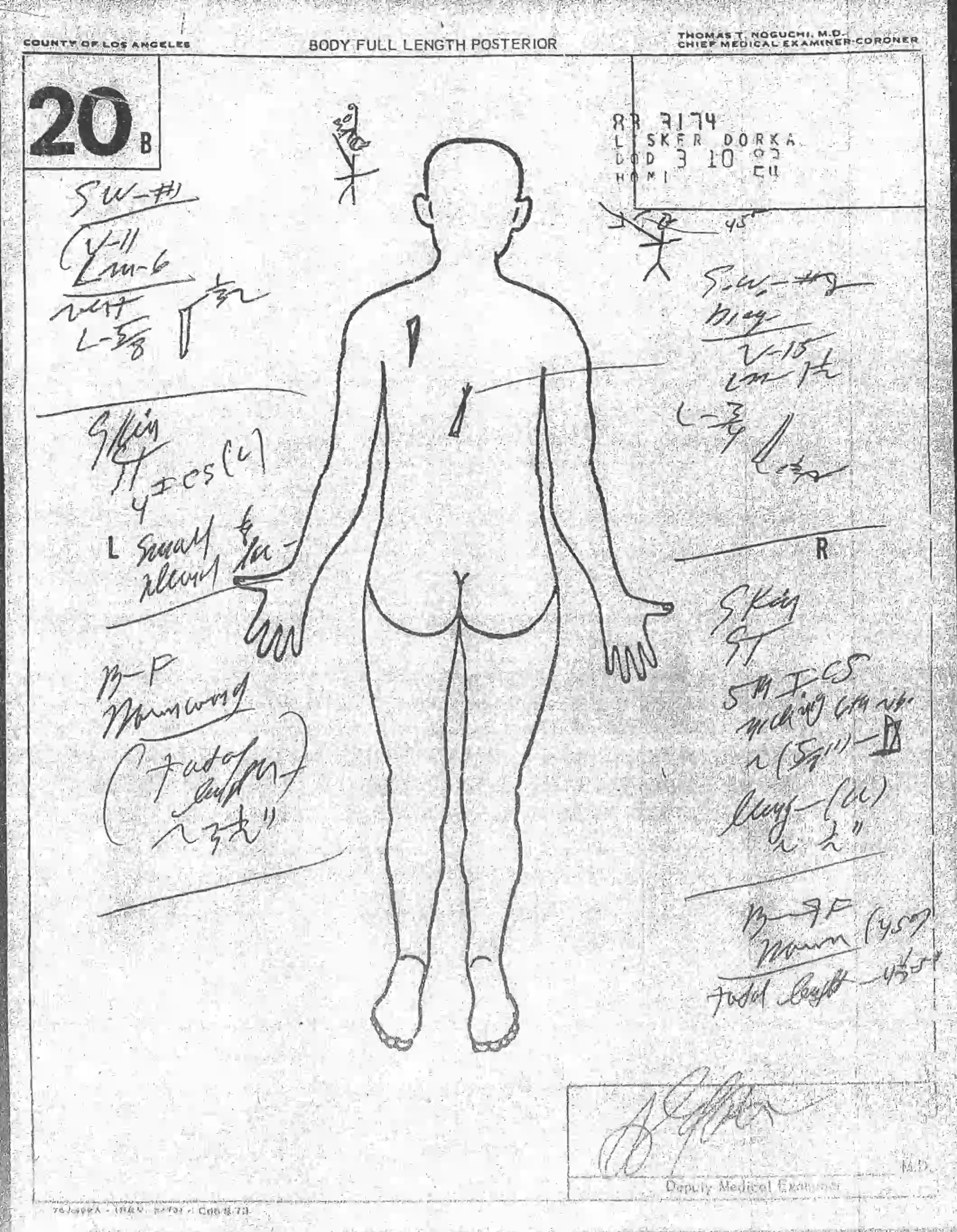
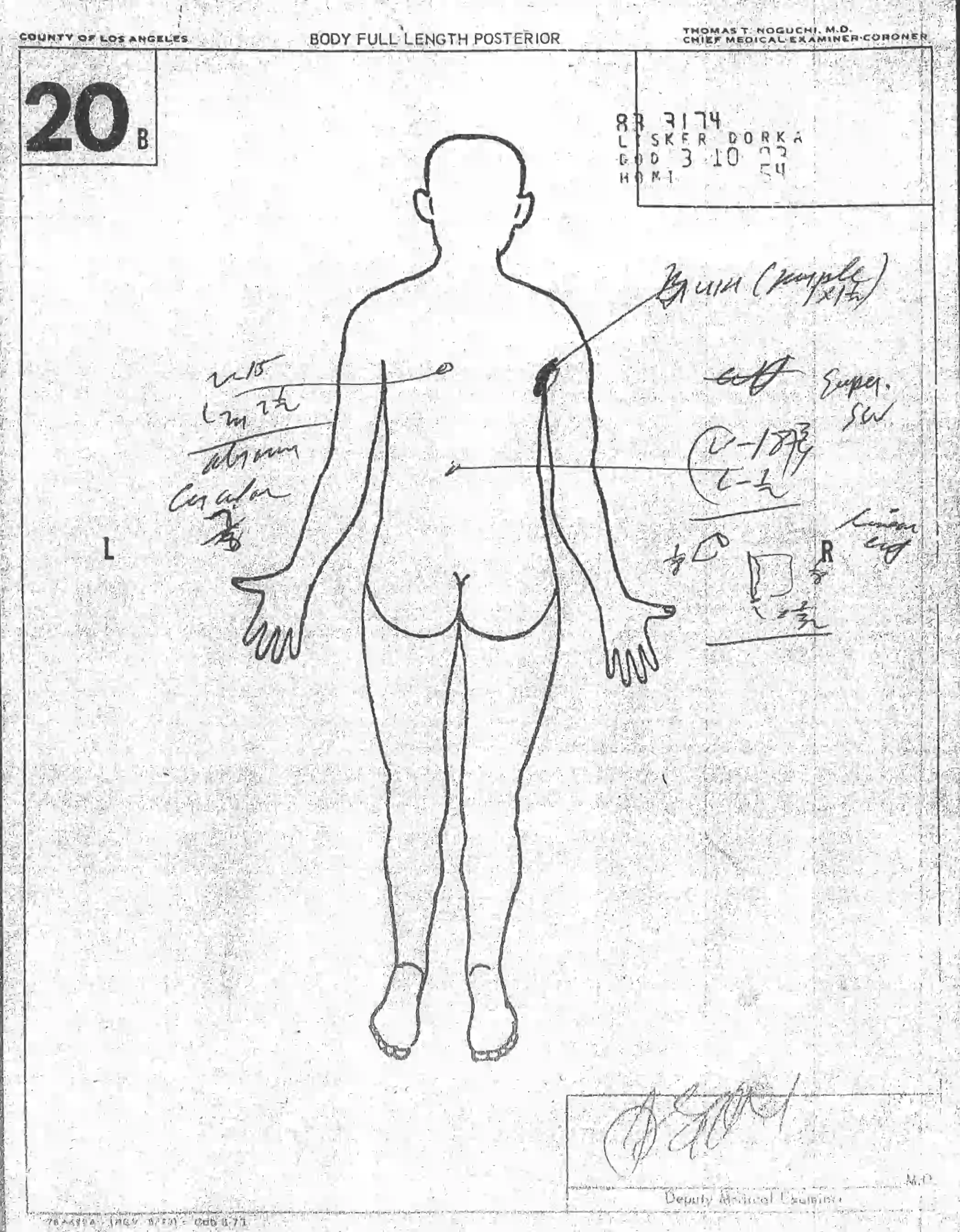
Cited in Part II (in preparation)
Cited in Part I (in preparation) · Part IV
Cited in Part IV
Cited in Part IV
Cited in Part IV
Cited in Part IV
Cited in Part VII
Cited in Part IV
Second Declaration of Robert Lisker
Cited in Part IV
Lisker/Monsue Interrogation, March 10, 1983, page 43
Cited in Part IV
Cited in Part IV
Cited in Part IV
(Scan in Declaration of Morton P. Borenstein)
Cited in Part IV
Throughout the Lisker Case Analysis (LCA), I use the term 'interrogation', rather than 'interview' to describe my questioning at the hands of detective Monsue on March 10, 1983. This phrasing makes the necessary distinction between a police officer asking questions of a witness (an interview), and their questioning of a suspect (an interrogation). It is clear from the actions of police, and the result of those actions -- my accusation, arrest, set-up and conviction for this crime -- that I was an interrogated suspect from the first moments of police contact. [Cf. § IV., Introduction]
The Appellate Court later found that I was indeed in custody before I was taken to Van Nuys police station and questioned, and had been entitled to my Miranda warnings before questioning began [Note #268].
Cited in Part IX
Cited in Part VI
DDA Rabichow's Memo to David Disco, November 4, 1988
Cited in Part VI
Cited in Part I (in preparation) · Part VI
Cited in Part VI
DDA Rabichow's reading of the Sylmar Juvenile Court discussion concerning where I would be housed
Cited in Part VI
Cited in Part VII
Cited in Part VII
Cited in Part VII
Cited in Part VII
Cited in Part VII
Cited in Part VII
Cited in Part VII
Cited in Part VII
Cited in Part VII
Cited in Part VII
Cited in Part VII
Cited in Part VII
(Scan in photo of Hollywood Tropics Motel, c. 2001)
"I WAS SCARED. SHORTLY AFTER I WENT TO THE POLICE (DET. REAL). HE WASN'T THERE. I SAW HIS PARTNER DETECTIVE ARNOLD. I TOLD [him] I KNEW WHO KILLED BRUCE'S MOTHER AND IT WASN'T BRUCE. HE SAID 'GET THE HELL OUT OF MY OFFICE, THAT CASE IS WRAPPED UP. THAT KID DID IT. GET OUT OF HER[e] PUNK.
"JUNE 24, 1987
"I UNDERSTAND THIS DOES NOT INCRIMINATING TO ME."
[signature]
"JOHN SCAPICCHIO, JR.
"FRANK, BECKY AND DAVE KENNEDY TOLD ME IN MARCH - FIRST WEEK -- 1983 AT 6500 SEPULVEDA, JUST BEFORE I LEFT FOR FLORIDA, THEY WERE GOING TO ROB BRUCE'S PARENTS HOUSE. THEY TRIED TO GET ME TO GO WITH THEM. I DIDN'T GO.
"JUNE 24, 1987
[signature]
"JOHN SCAPICCHIO, JR."
(Scan in Statement of Officer Prado)
Cited in Part II (in preparation)
(Scan in Statement of Officer Derousseau)
Cited in Part II (in preparation)
Cited in Part II (in preparation)
Cited in Part I (in preparation) · Part II (in preparation)
(Scan in Monsue's Interview Notes of Ryan's Mom)
(Scan in Monsue's Interview Notes at Autopsy)
Cited in Part II (in preparation)
(Scan in Monsue's Interview Notes of My Interrogation)
Cited in Part I (in preparation)
(Scan in Monsue's Interview Notes of Robert Lisker)
(Scan in Canceled Checks to Diamond, Marr, and Amidon)
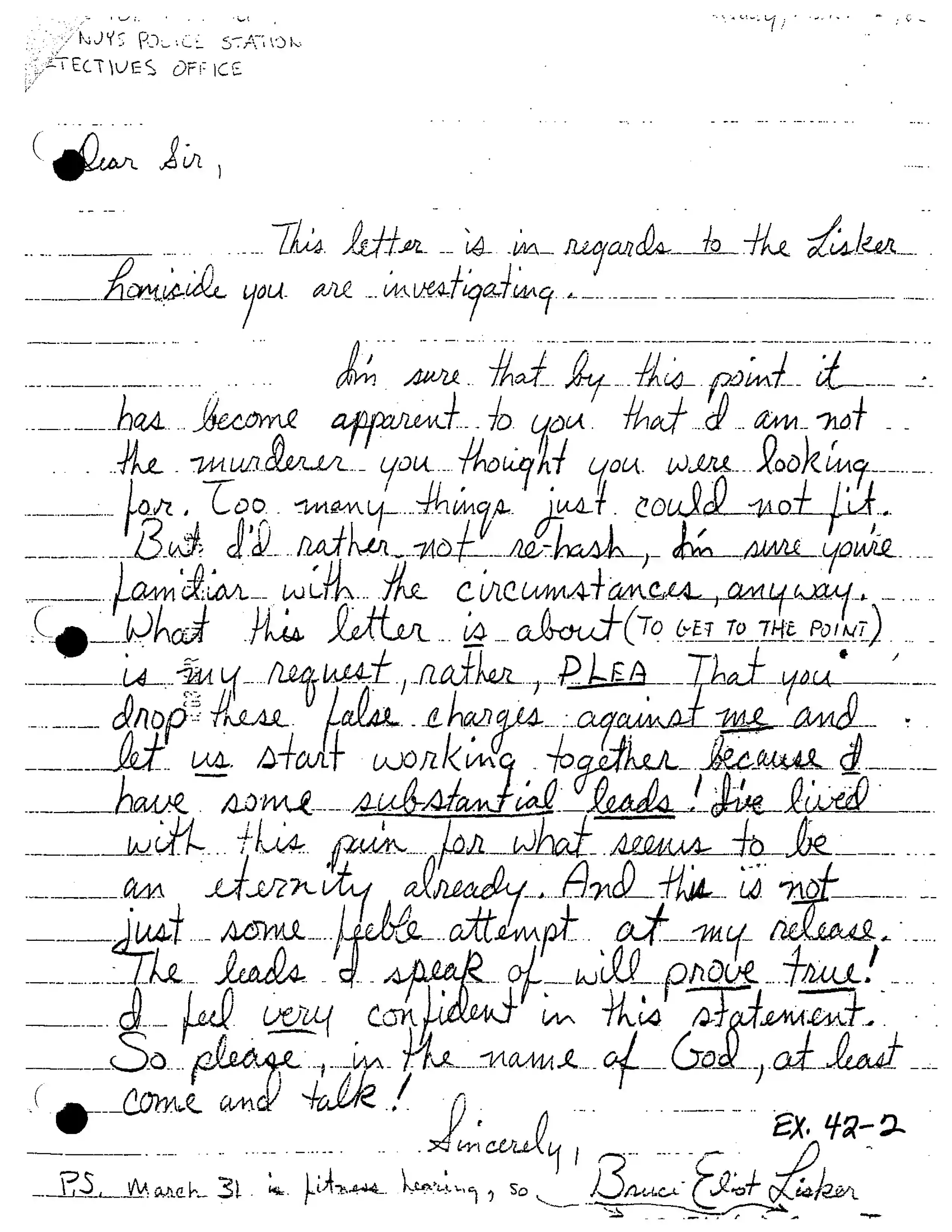
(Scan in Officer Angelo's Notes of LAFD Paramedic Statements)
Cited in Part I (in preparation)
Throughout the Lisker Case Analysis (LCA), I use the term 'interrogation' rather than 'interview' to describe my questioning at the hands of detective Monsue on March 10, 1983, This phrasing makes the necessary distinction between a police officer asking questions of a mere witness (an 'interview'), and police questioning of a suspect (an 'interrogation'). It is clear from the actions of police, and the result of those actions -- namely my accusation, arrest, set-up and conviction for this crime -- that I was an interrogated suspect from the first moments of police contact.
The Appellate Court later found that I was indeed in custody before I was taken to Van Nuys police station and questioned, and had been entitled to my Miranda warnings before questioning began268 [Note #268].
Cited in Part I (in preparation)
Cited in Part I (in preparation)
Monsue/Lisker Interrogation, p.17
MONSUE: Hum Ha. Let me ask you this, when you went and grabbed the knives...
LISKER: Hum Ha.
MONSUE: Before you put them down outside on the front [porch], did you walk around the house at all?
LISKER: I sure did. I searched that whole house, except I didn't end up going into my bathroom, OK...
MONSUE: Hum Ha.
LISKER: not going into my bedroom. I went into the spare bedroom. I went all the closets, in every room I went into. I came out here in the living room [sic]. I looked [behind] this couch, that's likeway [sic] out in this corner, the one that goes around the [sic] wall. Look (behind] that, I was screaming all the time, "If you are still [here], you are dead!!". Tried to fish him out, tried to smoke him [sic] out so they would run and I could catch them. Because all I wanted right then was revenge.
MONSUE: Hum Ha.
LISKER: I'll tell you what.
Cited in Part I (in preparation)
Monsue/Lisker Interrogation, p.38
MONSUE: Alright, I'm interested in a bowling trophy. Did you have a bowling trophy?
LISKER: Yeah, I saw that!!! Oh my God!! Where did I see it? It was on the floor somewhere! It was in the way of I think a door. Oh my God! I can't believe I spaced that. That's right, there was a bowling trophy.
MONSUE: Hum Ha, Where?
LISKER: Was it a bowling trophy or was it a T-ball trophy?
[Note: It was a Little League baseball trophy I'd earned as a kid.]
Cited in Part I (in preparation)
Cited in Part I (in preparation)
Monsue testified under oath that March 10, 1983 was "A VERY BRIGHT, SUNNY DAY, CLEAR SKIES; VERY BRIGHT, VERY, VERY BRIGHT... A VERY CLEAR DAY ALL DAY LONG" and "...IT WAS A VERY BRIGHT SUNNY DAY, NO CLOUDS IN THE SKY" and "...THEY DID HAVE BRIGHT, BRIGHT SUNLIGHT THAT PARTICULAR DAY."
Did he lie? Here are the satellite images from the morning he was describing. March 10 is on the left. You be the judge.
He also claimed March 23, 1983 — the day he and LAPD photographer Wilson came back to stage a photo “reconstruction” of my views — was "VERY SIMILAR" to March 10 in the condition of the sun.
Again, here's the slider. You be the judge.
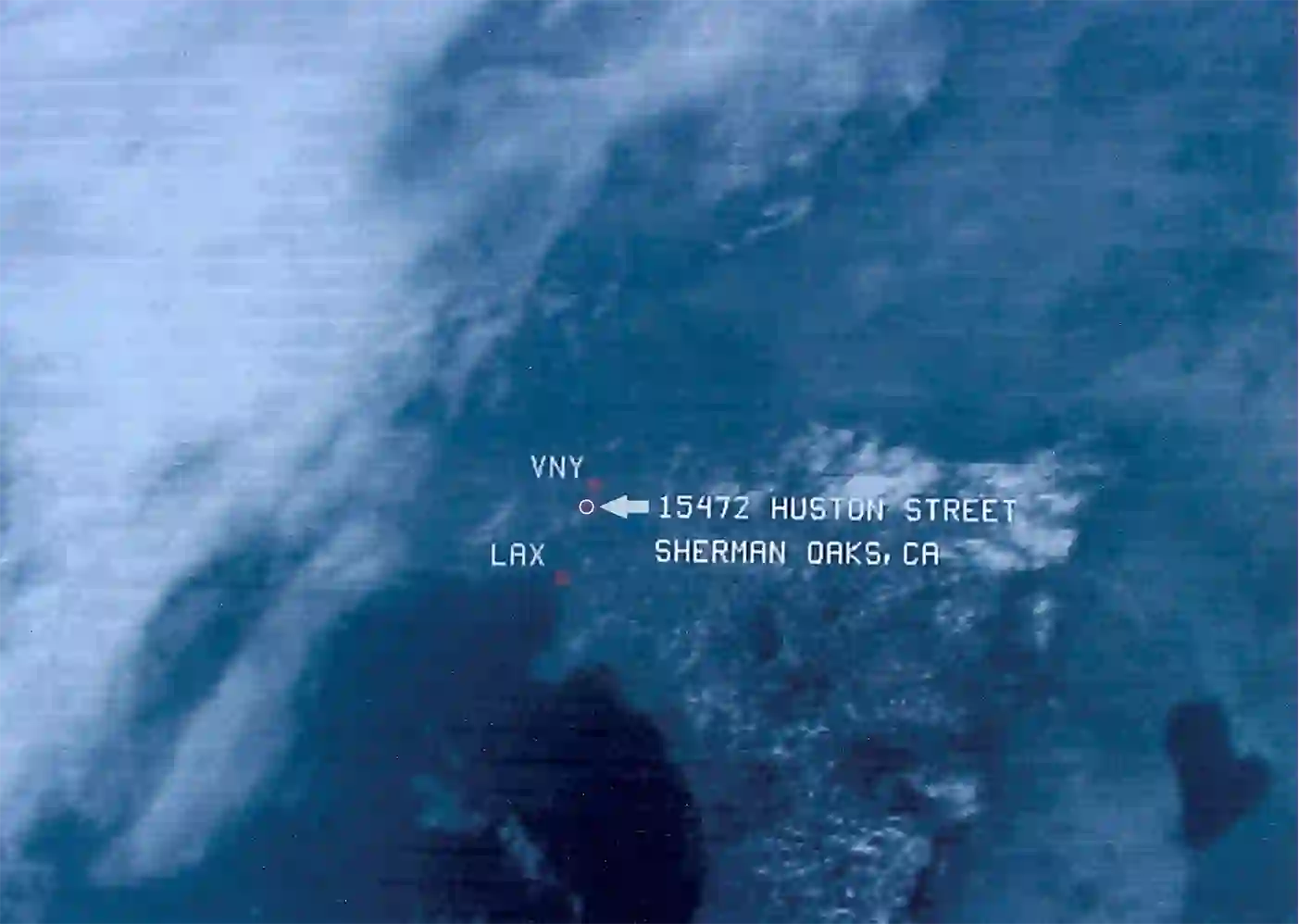
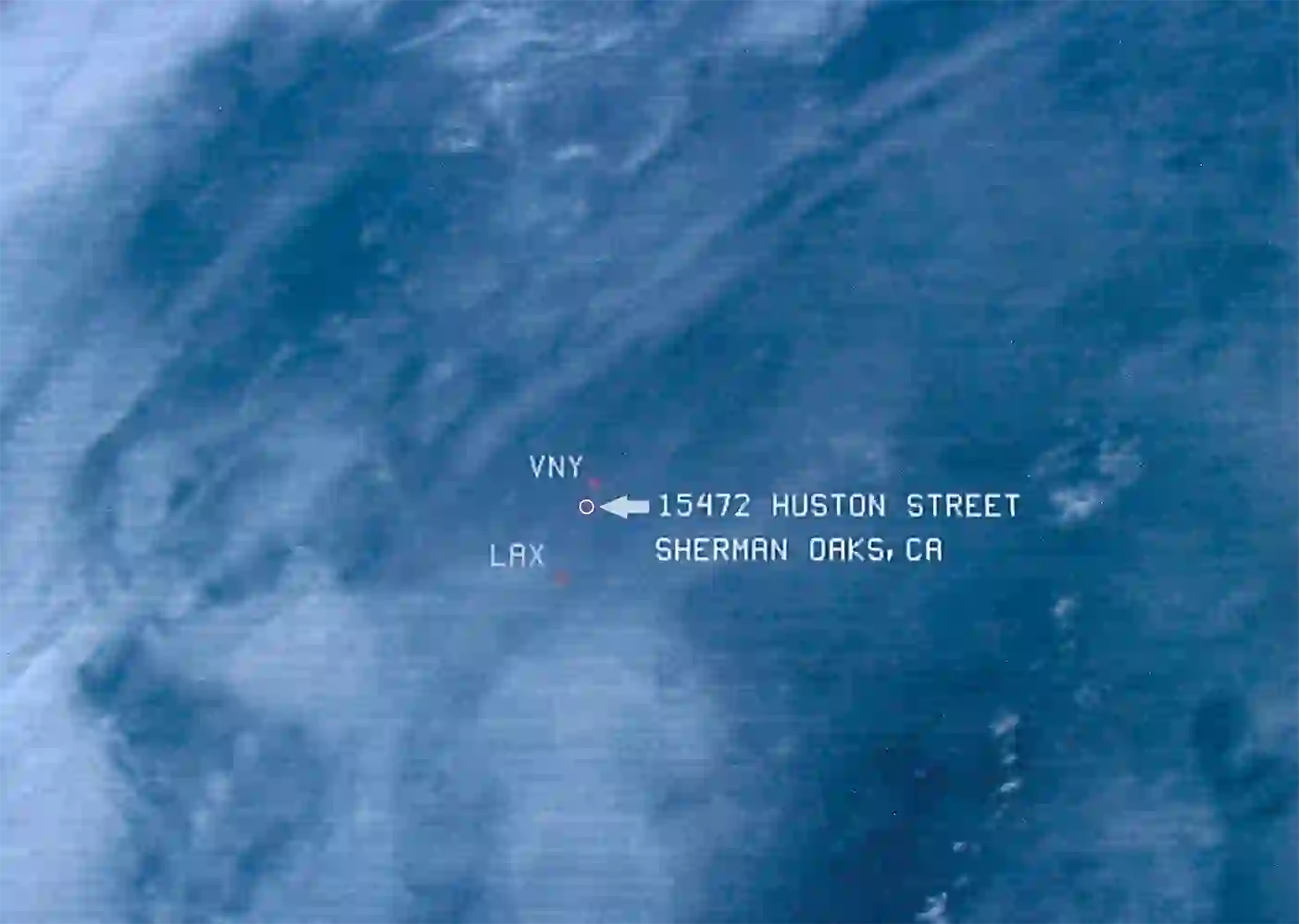 March 10, 1983 — my views
March 23, 1983 — police photos
About the satellite. GOES-5 was a NASA weather satellite parked 22,300 miles above the Pacific, photographing the Western Hemisphere every thirty minutes from 1981 to 1990 — too high to falsify, too automated to bribe. The two frames above are its 11:00 A.M. captures from March 10 and March 23, 1983.
Cited in Part IX