...a confession I never made, sworn to by a manipulative liar I barely met...
When I first met Robert Donald Hughes338 in Los Angeles County Men's Central Jail323 in April 1983, I had no way of knowing he was a practiced predator already on his fourth jailhouse confession-for-hire. Hughes was 29324 with nearly twenty arrests since 1969325 and convictions running from theft to burglary to attempted robbery.325A He had already alleged confessions from three other homicide defendants in two cases; mine would be his third case and his fourth defendant.327 Cloaked in a Born-Again Christian persona,425 he opened with God and hope335 — knowing I was a juvenile,334 a stranger, and visibly broken337 — and began extracting the details of my charges.336
I gave him those details. I was seventeen, in jail accused of killing my own mother, undone in every way a person can be undone, and the God-talk had reassuring echoes of my Catholic upbringing — anything that felt like home, even faintly, was a tiny salve on the raw, tortured nerve my soul had become.
Hughes was a well-rounded operator. He offered not just spiritual reassurance but legal advice too, telling me he could plainly see I was innocent — just as I'd been saying — and that his years as a repeat criminal defendant gave him real working knowledge of the system, the kind that might help me. I believed him.
That was the whole point of his operation.
Hughes later told a jury that in our very first half-hour340 conversation339 I confessed to murdering my mother. He lied. What Hughes wanted from prosecutor Phillip Rabichow was the same thing he'd wanted from every prosecutor before him: a discount on the time he had earned. After the California Department of Corrections recommended against early release342 and the bid was denied,343 Rabichow escalated things344 directly to District Attorney Robert Philabosian, a former Van Nuys DA's office colleague.345
Philabosian was not happy with how hard Rabichow was pushing—outside of normal channels—for the early release of his star snitch Hughes.346
Hughes himself admitted that, ever since his five-year prison sentence had been imposed, he had constantly "ATTEMPTED TO DO THINGS TO GET A PERSONAL GAIN AND BENEFIT AND EARLY RELEASE."330 Preliminary hearing judge Judith Meisels Ashmann called out these undeniably manipulative designs.331 So did trial judge Richard Kolostian, who said from the bench that Hughes "OBVIOUSLY WAS LOOKING. I DON'T THINK THERE IS ANY QUESTION. HE WAS TRYING TO GET INFORMATION."341 Yet Kolostian allowed Hughes to testify against me anyway. The price was my life: before Hughes took the stand, Rabichow had offered a plea to voluntary manslaughter with a six-year cap — the State's signal that its case was thin. After Hughes took the stand, the offer was gone.701
What Hughes did to me wasn't aberration. It was the script.346A In 1989 the Los Angeles County Grand Jury was convened347 to investigate exactly this pattern: rampant perjury by jailhouse informants.348 Snitches routinely gave false testimony.349 They re-worded innocent statements from unsuspecting defendants350 — precisely how Hughes worked the police reports I'd handed him into a manufactured confession. Their fabrications invariably aligned with the State's theory.351 They were paid in early-release time.352
The danger was sharpest for juveniles.353 The prosecutors who testified before the Grand Jury conceded that claims against such juveniles are inherently suspect.354
The Grand Jury saw informant perjury everywhere it looked — and could not find a single prosecution the LA District Attorney's Office had ever brought against any of them.355 Not one.
That is the system Hughes worked. What he did inside it was sell a scared 17-year-old up the river for life, to shave nine months off his own sentence. The specific lies he told to do it, and the contradictions in his own words and writing that expose them, follow below. There are twenty-seven.
Hughes painted me to Det. Monsue and to the State as a cold, calculating, murderous monster.
Of my supposed confession, he claimed:
- "HE DIDN'T SEEM LIKE HE WAS TOO BUSTED UP ABOUT IT, EITHER ... HE WAS MORE BUSTED UP ABOUT ... BEING IN JAIL THAN WAS HIS MOM DYING. IT'S COLD, MAN";390
- "IT WAS A PRETTY COLD THING"391 and;
- "THAT'S BAD. HE'D GIVE ME THE CHILLS."392
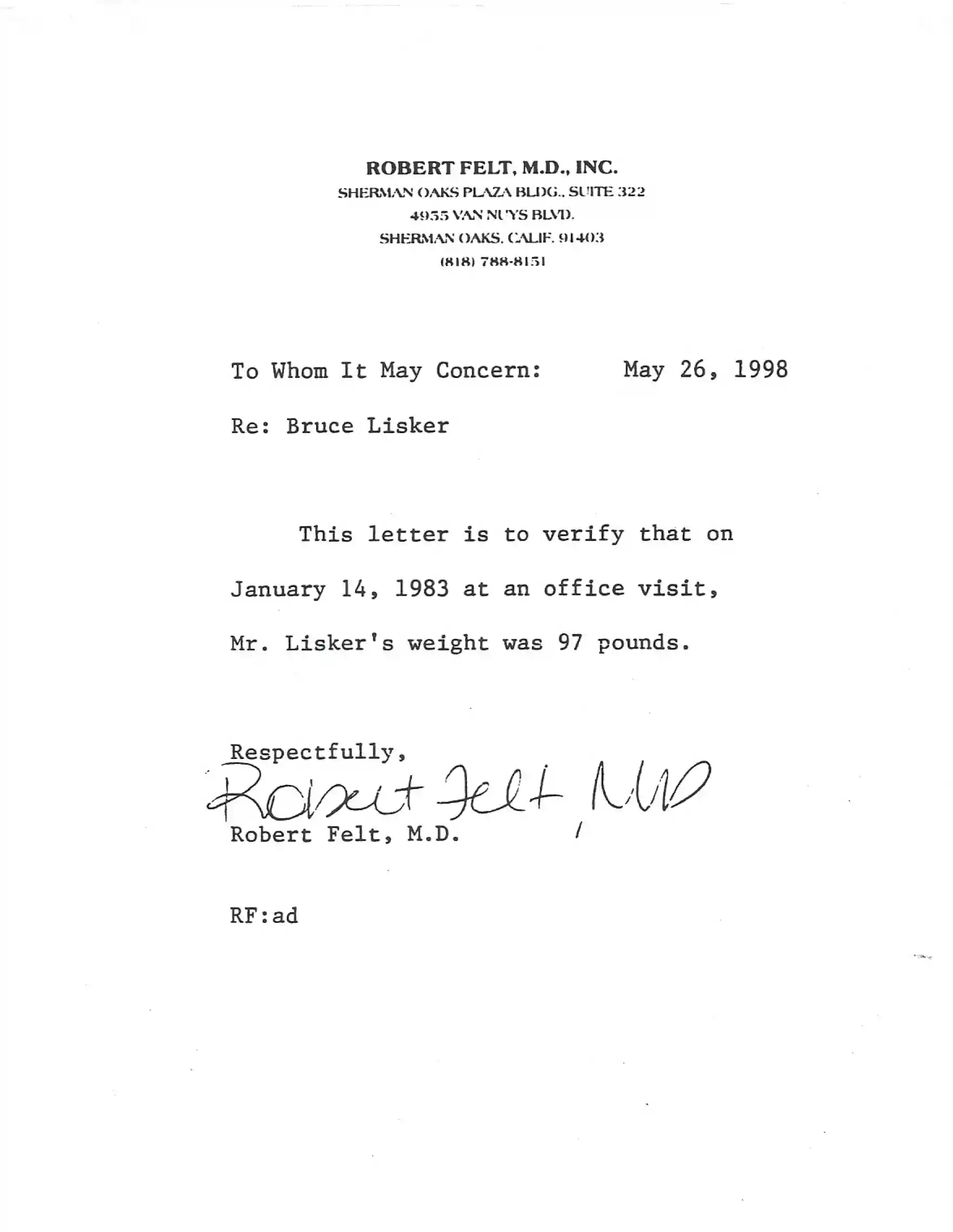
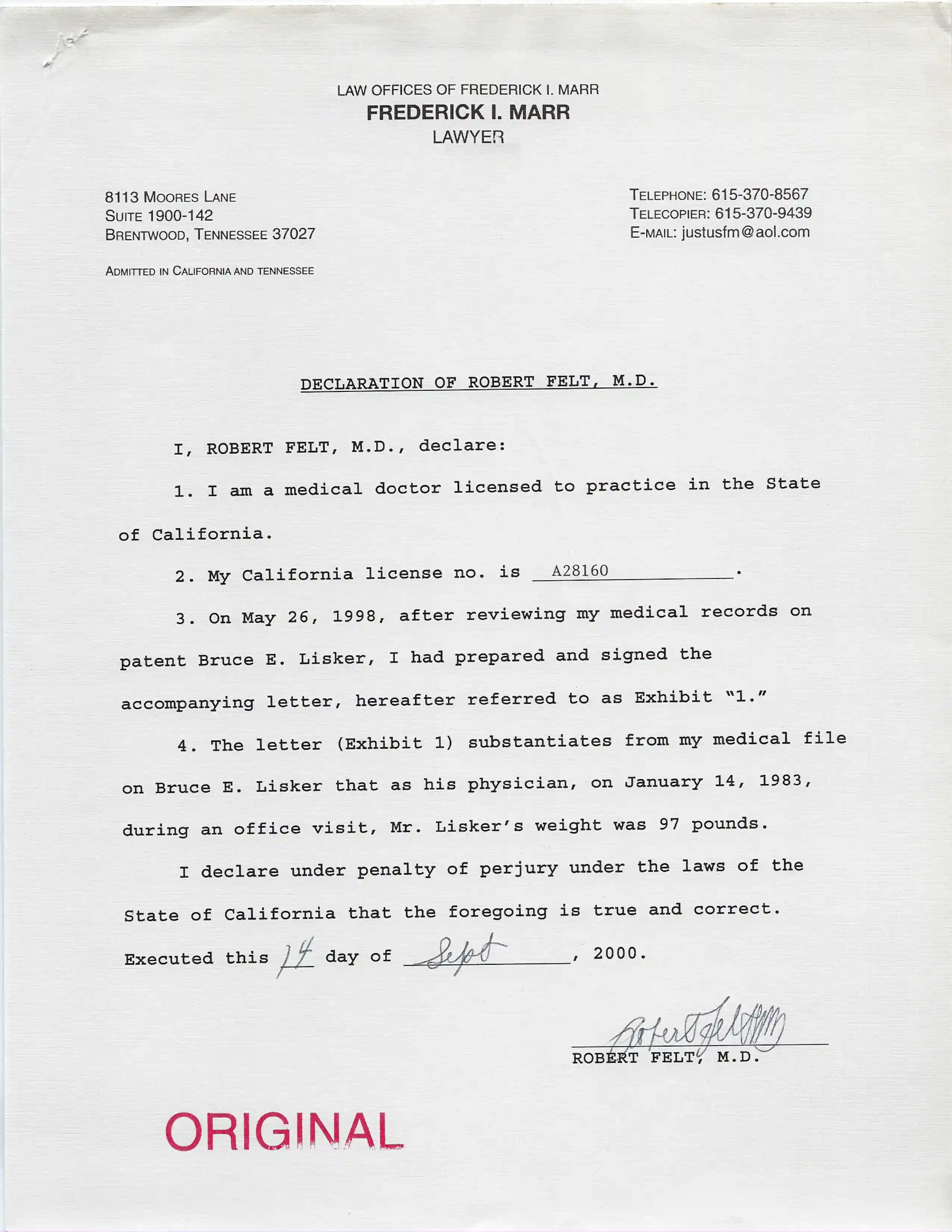
One of Hughes' arrest reports puts his weight at 185 pounds, and his own testimony establishes that he had been a combat Marine. So this career criminal's sworn testimony before the jury was that he'd actually been afraid of me — a 97-pound277 juvenile — and was relieved we were not in the same cell.393
Days after the “confession”394 — and after I'd been moved to a cell down the hall — this man who claimed to be so terrified of me wrote me a series of undeniably warm and encouraging letters.396
- Defense H:
- "I AM PRAYING FOR YOU LITTLE BRO. I FEEL YOU ARE GOING TO THE STREETS SOON. PRAISE GOD. LOVE YOU, BOBBY."397
- Defense I:
- "PRAISE JESUS . . . THE LORD GIVES ME A STRONG FEELING YOU WILL BE OUT OF THIS PIT SOON."398
- Defense J:
- "THE LORD GAVE YOU A GOOD HEART."399
Confronted with them on the stand, Hughes initially squirmed through lame denials of authorship.400 Then after a two hour, twenty minute noon recess (presumably featuring a pointed conversation with prosecutor Rabichow),401 he admitted he had written all of them.402
A man who believes you just confessed to butchering your own mother in cold blood does not write you, “PRAISE GOD. LOVE YOU, BOBBY.” And he does not equivocate under oath about whether or not he wrote that.
In another letter Hughes wrote me: "KEEP YOUR MOUTH SHUT ABOUT YOUR CASE TOTALLY."403
Read that twice.
The man who claimed he had taken my confession to deliver it to justice405 was telling me, in writing, to confess to no one else. Justice would want corroboration.
A snitch protecting his exclusive product wants silence.
He wasn't worried I'd be cleared. He was worried another snitch in the same viper's pit would catch the same naive teenager talking, and cut into his deal.
Hughes claimed I confessed to an attack in a very specific order.356
First, an unarmed struggle in which my mother ripped my shirt.
Then steak knives.
Then the trophy.
Then the exercise bar.
The sequence — call it RKTB: rip, knife, trophy, bar — is forensically impossible.
Four independent reasons:
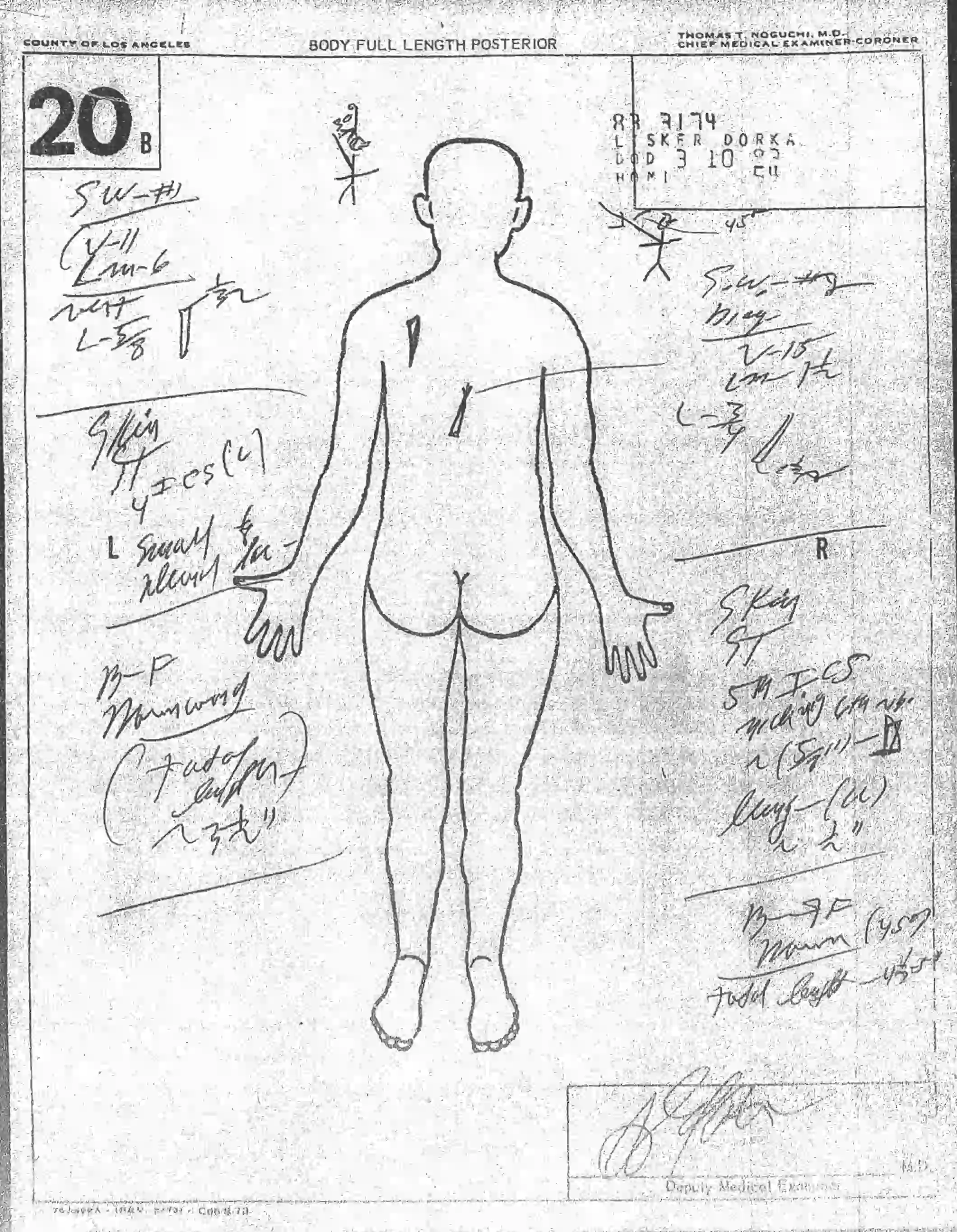
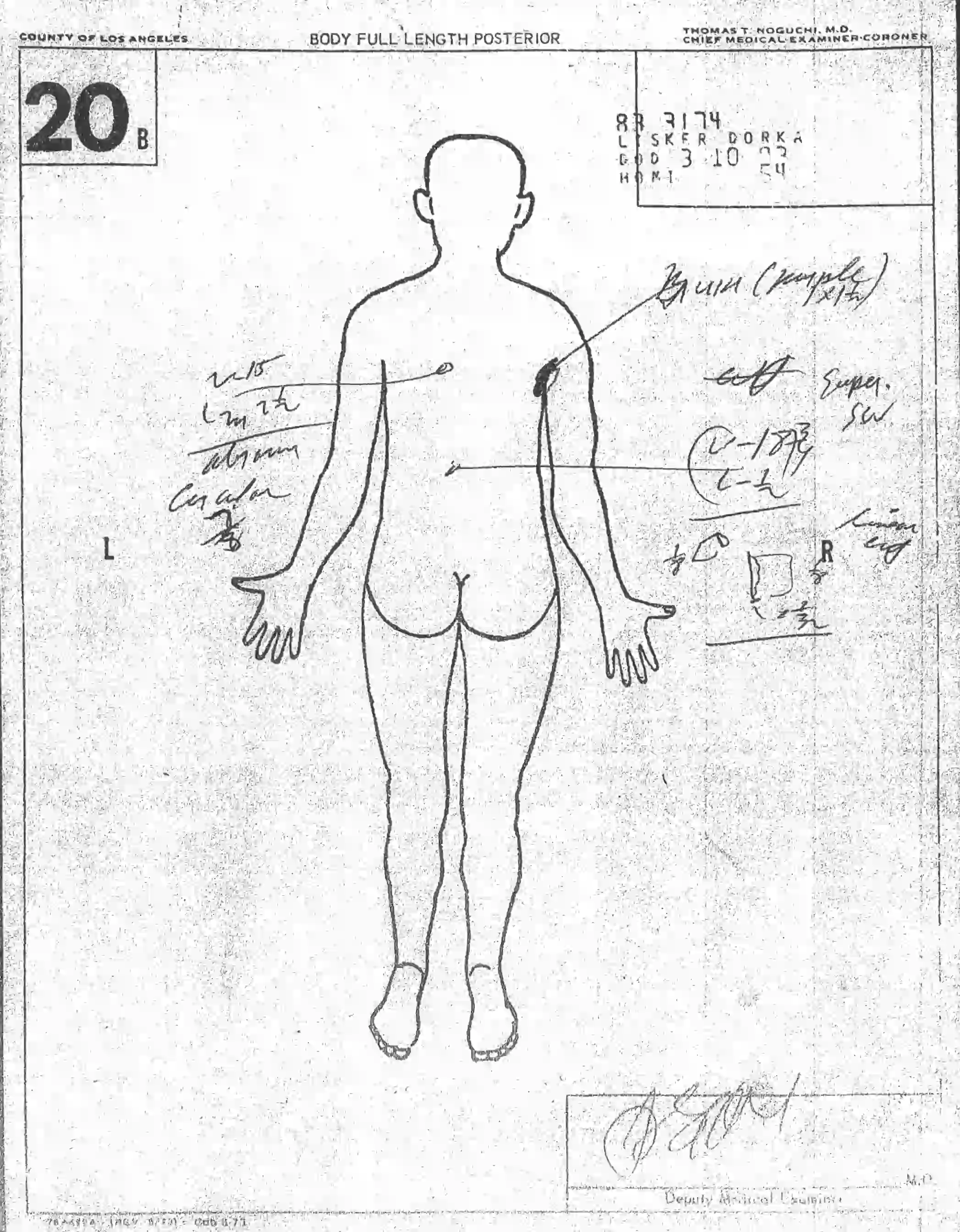
a) Deputy Medical Examiner Irwin L. Golden told detectives that a single heavy blow, such as from the exercise bar, could account for both my mother's fractured right arm and the damage to her face.357 The defensive slash wounds358 appear only on the left hand360 of my right-handed359 mother. Her dominant arm was already broken and immobile when the knives came out. The knives were not used before the bar.
b) Hughes said I "GETS SOME STEAK KNIVES AND CATCHES HER IN THE HALL AND WHAM, HE STABS HER WITH THE STEAK KNIVES."356 “Catches her” — after only an unarmed struggle — requires that she be upright. But she had two pinpoint non-penetrating hesitation marks: one on her upper back,361 one on her left flank.362 Those, in my judgment, are not made on an upright fighter. From the size and depth of wounds #3 and #4361, 362 I infer that they were made by resting a knife tip against a face-down, motionless body and pressing in. She was mostly face down, turned slightly onto her left side, when I found her, and remained face down when paramedic Jay Lovato saw her minutes later.602 Golden added that the frontal skull fracture — the heavy blow that, in his theory, could also account for the broken arm — would have caused immediate unconsciousness.698 The knives were not used before the bar.
c) Had the struggle begun near her purse in the living room, my mother would not have waited politely while her killer walked to the kitchen for knives and came back. Adrenaline drives the attacked out of the house, or to a phone. Not to the spot the attacker just left to arm up. The shirt-ripping struggle could not have come first.
d) Each weapon lived in a different corner of the house: knives in the kitchen (southeast), trophy in my old bedroom (northwest), bar in my parents' bedroom (southwest). The RKTB sequence requires my mother to remain passively in place while her killer made three separate weapon-fetching trips around the house. No order really fits.
Hughes did not describe an attack. He recited a list.
If the order is impossible, where did Hughes get it?
From Detective Monsue's Follow-Up Report — the one I have always acknowledged Hughes conned me into sharing.365 The ripped shirt, steak knives, trophy, and exercise bar appear in that report364 in exactly that order.363 The police never claimed the listing order described the attack sequence366 — it was just the order in which detectives found the items in the house. With four weapons there are 24 possible orderings; the odds of two independent witnesses landing on the same RKTB by chance are 1 in 24. Hughes didn't beat the odds. He copied the list. [Cf. § V (3) (a) (b) (c) and (d)]
Hughes and the police painted a close-in, hand-to-hand, five-weapon battle for my mother's life: stab wounds to her back,650 deep slashes to her left hand,576 at least ten head-blows with a hand-held574 marble-based trophy571 and extensive scalp bleeding,573 a smashed arm584 and forehead647 from a heavy bat-like exercise bar, and a yellow cord pulled around her neck hard enough to leave visible ligature marks.609 Investigators called it a "PARTICULARLY BRUTAL" attack.371
And then look at me. At the unclothed body search after interrogation,372 I had no injuries anywhere.373 No obvious or large drops of blood on my clothing or person.54, 55, 66 No shirt fibers under my mother's fingernails. No marks consistent with shirt-ripping on her hands at autopsy.565 Not a single broken fingernail.566 My fingernails were collected for analysis582 and showed no skin scrapings consistent with a struggle.582A One button was missing from my plaid outer shirt;384 the button was never found at the scene, and the shirt was the old work shirt I wore to fix my car —200 and Linhart himself logged dark, textured non-blood stains on my pants,201 apparently automotive grease.
A teenager who fought a five-weapon, ten-plus-blow battle to the death with a grown woman comes out marked. I did not.
Hughes said I "WHALED ON HER WITH THAT FOR A LITTLE WHILE" with the exercise bar.374
Dr. Golden theorized that a single heavy blow, such as from the exercise bar, could account for both the fractured right arm584 and the frontal skull fracture.647, 357 At most, then, the bar accounts for two injuries. The other blunt-force injuries came from the trophy, used in a stamping motion. Two blows is not a “whaling.” But a whaling sells better on the stand. Having read about the bar in the police reports, Hughes simply amplified.
Hughes claimed that after the attack I had noticed blood had spattered onto my clothing375 and told him I had "FUCKED UP"376 by not changing before the police arrived.
The eight tiny droplets Linhart eventually found70 were nearly invisible. Trained officers watched me at close range for ninety minutes and missed them entirely.54, 55, 66 Linhart only resolved them under a microscope.379 By every account, including Hughes's own — "BLOWING IT"380 — I was hysterical that morning.224 The notion that, in the middle of a five-weapon meltdown, I was also performing the "CAREFUL OBSERVATION"381 required to spot specks invisible to seasoned cops is absurd. I did not see the droplets land — whether they came from expiration, [§ III (6)] from lifting my mother's arm, [§ III (2) (a) (i)] or from her head. [§ III (2) (a) (ii)] I first heard of them when Monsue announced them at my April 4 detention hearing.
Hughes claimed I panicked and wanted to make sure my mother "WOULDN'T, YOU KNOW, BE ABLE TO TELL ON [me]."386
An attacker afraid of being identified does not call paramedics. He doesn't try first aid. He doesn't call his father. He leaves. Between my 11:26 a.m. call to paramedics and their 11:34 arrival, I had eight minutes alone in the house with my mother. If silencing her had been the motive, that was the moment. Better still, do nothing: leave, return to my job search in Panorama City, walk away clean. The neighbors heard nothing unusual, including my arrival.460 Instead I tried first aid, called my father, and searched the house for whoever had done it.
Hughes told Monsue I confessed because the crime had "REALLY GOT HIS CONSCIENCE ABOUT WHAT HE DID, STARTED EATING HIM UP A LITTLE BIT. SO HE BROKE DOWN AND RAN HIS CASE DOWN TO ME."388
He also told Monsue I was so cold that "HE'D GIVE ME THE CHILLS."392 Hughes wanted both: the crisis of conscience that explained how the confession came out, and the icy remorselessness that made it monstrous. He cannot have both. The snitch had no trouble tailoring the performance to whichever beat the prosecution needed next.
Hughes was willing to testify that his fellow snitches Michael Dowtu and Sherman Wallace were lying about my confessing to them.404
How could Hughes possibly know — if I had really confessed to him? Only one way: if he had written the confession himself, compared notes with the other two, and cut them out of the payoff to become the State's star snitch. Which is exactly what he did. If his motive had been moral,405 a thousand corroborating voices would have helped, not hurt. Only a man who knows the script knows the other actors are reciting wrong.
Hughes told Monsue that none of the snitches around me had been working me at all: "NONE OF US [snitches] WAS TALKING TO HIM AND JUST WANTED NOTHING TO DO WITH ..."406
If “none of us was talking to him,” the single half-hour conversation Hughes claims produced my confession338 didn't happen. The warm letters — predicting my freedom,397, 398 telling me I had a good heart399 — flatly contradict “wanting nothing to do with him.” [Cf. § V (1)] And Hughes told Monsue he could tell Dowtu was lying by the way Dowtu had approached him in the showers407 — an approach that, per Hughes here, never happened. [Cf. § V (10)] Hughes also admitted he had assured my father that Dowtu and Wallace were lying404 and had told me he would testify on my behalf.410 My father testified that Hughes told him he knew I was innocent404 — a remark Hughes, by 1989, did not remember making.411 He was in fact the one who told my father and me about Dowtu's and Wallace's lies.410 A man not talking to me did all of that.
Hughes offered another reason he knew Dowtu and Wallace were lying: "THEY DIDN'T KNOW HIM."412 No killer, Hughes implied, would pick an absolute stranger as his confessor — let alone in the first conversation they ever had.
Which is exactly what he claimed I had done with him. Confessed in our first conversation,339 before we knew each other's names,413 in under thirty minutes.340 Hughes's own rule, applied to Hughes.
Hughes told Monsue my father had called him out for a jail visit and "PLAYS THE OLD PERRY MASON PART,"414 supposedly saying, "HE DID, BUT THEY CAN'T PROVE IT" from "AN ATTORNEY'S POINT OF VIEW," and adding "SHIT, MAN, WHAT KIND OF FAMILY IS THIS[?]"416
In 1989, Hughes told an investigator my father had hired that after he saw my father at trial, "HE KNEW RIGHT THEN AND THERE THAT ALL OF THE THINGS THAT [Bruce] SAID ABOUT HIS PARENTS WERE DEFINITELY NOT TRUE."418 Hughes also conceded he had assured my father at that same jail visit that Dowtu and Wallace were lying.404 My father confirmed Hughes told him he knew I was innocent.409
A glimpse across a courtroom does not erase the contempt Hughes pretended to feel for “the Perry Mason father.” The two 1983 jail visits would have done so far more thoroughly.419 And Hughes had no business attending those visits at all, if he genuinely believed I had confessed to him.
Hughes claimed I had a roommate; that we were "LIVING IT UP"420 on PCP423 heavily as of March 10;421 and that I had murdered my mother trying to get money for more.
Every piece of that is false. Mike Ryan, the only roommate I ever had, had moved out several months before my mother's murder.422 I have never used PCP. My father had given me ten dollars the night before.520 Minutes before finding my mother, I had “squandered” money on nuts and washers198 still sitting in my car199 alongside the Builder's Emporium bag on the driveway. When I needed money I usually asked my father, the breadwinner — only rarely my mother.520
Hughes claimed to be a Born-Again Christian425 who approached me only to “minister”426 — with no ulterior motive429 — because I looked frail and upset337 and had a “suicidal juvenile” tag on my cell door.427
On the stand, this supposed Christian could not produce a single Bible scripture428 from the very faith he claimed had moved him to “serve”429 a juvenile stranger in the snitch tank. All he could manage was “Jesus is the savior.” Hughes's wife was the Christian. Her attempts to bring him along supplied the vocabulary.
- The same supposed Christian took the Lord's name in vain on the witness stand.430 Like a world-class sinner. Like a world-class liar.
Hughes first told police he had heard I was a suicidal juvenile “or something.”431 Three months later he testified he had actually seen the tag on my cell door.432
I never carried a “suicidal” designation at the county jail. I had been on one-on-one status433 at Sylmar Juvenile Hall — and Detective Monsue was the only link between Sylmar (where he visited me on April Fool's Day and I told him about Mike Ryan)460A and the county jail (where he later gave Hughes his first taped interview on July 6). Hughes's first session with Van Nuys police, two weeks earlier, was neither taped nor transcribed. The detail that “upgraded” between Hughes's two accounts is exactly the detail Monsue could have fed him.
Hughes explained that he had been careful with my defense investigator because he didn't want to "BLOW MY COVER, BECAUSE WE STILL DON'T [KNOW] IF I'M GONNA."435
“Cover.” Hughes's own word. An undercover State agent — cultivating confessions in the highest-stakes cases prosecutors carry, and counting on a sentence reduction for the service. I was Hughes's fifth homicide or attempted-homicide defendant. The previous four: (1) Richard James Crowell, Orange County Case No. C-47061; (2) Ernest Owen McCoy, L.A. County Case No. A561270; (3) Bernard Dean Milberger, same case number as McCoy, separate trial; and (4) the defendant in the Beverly Hills “police shooting” case Hughes's information reportedly cracked. A serial liar with a serial-State-customer.
Hughes told Monsue: "IT'S NOT MY STYLE TO GET UP THERE ON THE STAND AND LIE, BUT * THIS IS SOME PRETTY HEAVY SHIT, WHEN IT COMES TO A MURDER CASE."436
Not his style — but. How heavy does something have to be before Hughes will lie about it? His 1993 bankruptcy was heavy enough: he hid assets and was caught.673 His own freedom was heavy enough;436A he openly admitted he would snitch for it once his five-year sentence came down.330 He lies for money. He lies for freedom. He lied for the State.
* Two transcripts of the July 6 interview exist in the murder book. The version with page numbers at the top — the apparent 'police' version — omits the word "BUT." For the same reasons Monsue's hand-transcription of my interrogation is suspect, that secondary transcript should be read with caution [Cf. § IV (4) (f)]. The conversation at that point concerned Dowtu and Wallace's lying, so Hughes may have been asserting his difference from them — a difference that did not exist.Hughes said he was careful in approaching me, not wanting to seem as if he were questioning me: "WHEN THEY SAY † HE WAS PRETTY SMART."437
Who is “they”? Hughes stated unequivocally that I was the first person he had spoken to about my case.438 So “they” can only be the police. The same police whose hand is everywhere else around this snitching: my unauthorized transfer from juvenile hall into the adult county jail days after a court ordered against it; Detective Landgren's un-taped, un-transcribed visit with Hughes two weeks before the July 6 interview;459 my placement in the 7000 Module in direct contact with Hughes. That's not coincidence. That's coordination. [Cf. § VI. "JAIL HOUSE INFORMANTS: POLICE COMPLICITY"]
† Again, the page-numbered 'police' transcript reads "LIKE I SAID, HE WAS PRETTY SMART," and Hughes had earlier referenced my intelligence. For the same reasons as the Monsue hand-transcription [Cf. § IV (4) (f)], that alternate transcript is probably not representative of what Hughes actually said.In the July 6 interview, Hughes incorrectly called the exercise bar a "BOWL WORKER." ‡439 Three months later he was calling it, correctly, a "BULL WORKER."440 Someone corrected him. Detective Landgren's un-taped, un-transcribed visit with Hughes two weeks before the very first taped interview459 is exactly when that correction could have been delivered.
‡ Once again, the 'police' transcript records the word properly as "BULL WORKER." For the same reasons, that transcription may not be accurate.Hughes claimed the stabbing happened all at once — "WHAM"441 — near the outset of the attack.442
The body says otherwise. The defensive slashes appear only on my right-handed359 mother's left hand,360 meaning the heavy blow that broke her right arm — per Dr. Golden, possibly from the exercise bar357 — had already done its work before the knives came out. The knives came after the bar, not at the outset. [Cf. § V (3) (a)] And the pinpoint hesitation marks near her stab wounds mean she was not upright when the knives were used. [Cf. § V (3) (b)] “Wham” is good theater. It is not what happened.
Hughes claimed I committed the murder, then staged the scene — rigging the kitchen window after the attack, hands covered in my mother's blood.187
No blood on the window panes. None on the sill. None on the screen. None on the red-handled pliers.298 Hughes's scenario requires me to have bloodied my hands; washed them; dried them; disassembled a louvered window; carried the panes out and laid them on the east walkway; somehow re-bloodied them; and done all of it in roughly ten minutes, before police arrived — without leaving a trace on a single doorknob along the way. [Cf. § IV (4) (1)] That is not a scenario. That is a fantasy.
Hughes first said he had seen Dowtu and Wallace approach me in the shower fishing for information.446
He later testified to a very different sequence: the pair had instead noticed him talking with me, after which Dowtu approached him with a proposition to combine and jointly fabricate testimony.447 Truth has one advantage Hughes couldn't use. It's easier to recall what actually happened than to consistently remember a lie.
Hughes said he had ministered to me out of pure compassion for someone who looked frail and upset,337 and never asked me for anything in return.448
Confronted with his own letters, Hughes admitted he had asked me for money and, “possibly,” a razor.449 So much for nothing in return.
Before testifying, Hughes was seen in the hallway outside the courtroom reading a thick sheaf of papers. He said it was the transcript of his July 6 interview,452 and that he had had about ten days to review it.
You don't memorize what happened. You memorize what you're saying happened.
Hughes reported, with certainty, that I had called my father first that morning and the paramedics second.453
Backwards. Paramedics: 11:26 a.m.454 My father: 11:29.455 A man who'd actually heard my confession would have heard which call came first.
Footnotes
Summarizing Linhart's findings [Notes #53, 57, 61, 62, 63], he found: On my flannel shirt, six droplets; On my right Pacer tennis shoe, one droplet approximately 1 x 2 millimeters in diameter; and on the left Pacer tennis shoe, one droplet approximately 2 x 3 millimeters.
↩I put on these worn out clothes for the repair precisely because of their poor condition.
↩Three months before Hughes ran his jailhouse-Christian-conversion con on me in a County Jail cell, I weighed 97 pounds. Hughes was a former combat Marine and a career criminal whose entire adult life had been spent cycling through jails and prisons. He told a jury he had been afraid of me. Afraid of a 97-pound teenager. The fear was theater. The conversion was a fiction. Both were sold to a credulous prosecution in exchange for a discount on the sentence his record had earned many times over. He wasn't afraid. He was working a con. The State bought it.
Located at 441 Bauchet Street, in Los Angeles.
↩Born March 7, 1954 as Robert Donald Campeau, his surname was changed at approximately age five to that of his step-father, Hughes.
↩This is Robert Donald Hughes’s criminal record as of October 6, 1983 — the day he took the stand at my preliminary hearing and admitted he was already on his third snitch case. Deuel Vocational Institution (Tracy State Prison) prepared it and sent it to Detective Monsue at his request. Monsue knew exactly who Hughes was. Fourteen years of arrests, plea deals, and prison sentences, newest first. Dates and charges are in bold; handed-down sentences are underlined.
The State put the man behind this record on the witness stand as a credible source in a murder case:
1.On June 8, 1981 he is arrested by Santa Ana police for: 459 Penal Code (PC) Burglary; 484-487.1 PC Grand Theft Property; 484-487.3 PC Grand Theft Misc./Auto; 496 PC Receiving Stolen Property; 459 PC Arson*; 12021 PC Felon Addict in Possession of a Firearm; and 10851 Vehicle Code (VC) Taking Automobile Without Owner's Consent;
* PC 459 is Burglary, not Arson — the rap sheet has it mislabeled. This list is reproduced verbatim, errors included.
2.On June 4, 1981 he is arrested by Huntington Beach police for: 496.1 PC Possession of Stolen Property; 487/3 PC Auto Theft (2 Counts); 12021 PC Illegal Possession of a Firearm; 240 PC Assault; and 245(a) PC Assault With a Deadly Weapon;
3.On March 3, 1980 he is charged with 4350(b) PC Prison Escape Without Force;
4.On March 22, 1978 he is sentenced to 4 years, 8 months in State Prison for 664 211 PC Attempted Robbery With 12022 PC Use of a Firearm and 664 211 PC Attempted Robbery;
5.On November 29, 1977 he is arrested by Santa Ana police on a Bench Warrant (#76 CMO 6735) issued on October 8, 1977 for 11550 Health & Safety Code (HSC) Use or Under the Influence of a Controlled Substance;
6.On November 21, 1977 he is arrested by Santa Ana police for 211 PC Robbery (after being detained by Anaheim police), and on March 2, 1978 a 245 PC Robbery charge is dismissed when he PLEADS GUILTY TO TWO COUNTS OF 211 PC ROBBERY. He is sentenced to an unspecified term in State Prison;
7.On October 18, 1977 he is arrested by Santa Ana police for 11550 HSC Use or Under the Influence of a Controlled Substance (after being detained by Westminster police);
8.On October 8, 1977 he is arrested by South Santa Ana police for: 11550 HSC Use or Under the Influence of a Controlled Substance; 488 PC Violation of Probation; 11550 HSC Violation of Probation; and 23105(a) VC Misdemeanor Drunk Driving Under the Influence of Drugs on the Highway;
9.On October 3, 1977 he is arrested by South Santa Ana police, and on October 11, 1977 he PLEADS GUILTY TO 11550 HSC USE OR UNDER THE INFLUENCE OF A CONTROLLED SUBSTANCE and on a Warrant for 23103 VC Reckless Driving, and is sentenced to 11 months in jail and 36 months probation;
10.On June 25, 1977 he is arrested by Santa Ana police for 488 PC;
11.On May 14, 1977 he is arrested by South Santa Ana police for 23102(a) VC Driving Under the Influence (Drugs) and is held for the Central Orange County Court;
12.On April 28, 1977 he is arrested by South Santa Ana police, and is either FOUND OR PLEADS GUILTY TO 487 PC GRAND THEFT, and is sentenced to 30 days in jail and 12 months of probation;
13.On April 20, 1977 he is arrested by South Santa Ana police for 11550 HSC Use or Under the Influence of a Controlled Substance, and on June 24, 1977 he PLEADS GUILTY TO 231054 VC and is sentenced to 24 months probation;
14.On February 24, 1977 he is arrested by South Santa Ana police for 459 PC Residential Burglary and is held for Costa Mesa police;
15.On September 19, 1976 he is arrested by South Santa Ana police for 11550 HSC Use or Under the Influence of a Controlled Substance and 484-488 PC. On October 29, 1976 he PLEADS GUILTY TO 11550 HSC USE OR UNDER THE INFLUENCE OF A CONTROLLED SUBSTANCE and is sentenced to 90 days in jail and 36 months suspended sentence;
16.On July 4, 1974 he is arrested by South Los Angeles police for 11550 HSC Use or Under the Influence of a Controlled Substance;
17.On September 9, 1970 he is arrested by Long Beach police for 211 PC Strong-Arm Robbery; 487.3 PC Grand Theft Purse; and Leading a Lewd and Dissolute Life and is referred to the Juvenile Justice Bureau;
18.On November 11, 1969 he is arrested by Los Angeles police for 602 Welfare & Institutions Code (WIC) 10851 VC and is released to his parents;
19.On July 17, 1969 he is arrested by Los Angeles police for 602 WIC 10851 VC and is released to his parents;
20.On March 21, 1969 he is arrested by Los Angeles police for 602 WIC 10851 VC (Delinquent), is counseled and released to his parents.
Not every line is a conviction. Some are arrests, and a few are old warrants logged as fresh “arrests” while he was already locked up. The underlined sentences are the convictions: robbery, attempted armed robbery, grand theft, narcotics. They are more than enough.
Robert Donald Hughes was a career criminal, fourteen years deep and unbroken, when he sat down across from a 17-year-old in jail and started talking about Jesus. By April 1983 he had pled guilty to multiple counts of robbery, been sentenced to four years, eight months for attempted armed robbery, been charged with escaping from prison, and been arrested by police in five different cities. He took every plea deal offered and was back in court before the ink dried. He stole for a living and lied his way out when he was caught. Then he found a better racket: lying for the State. Selling a teenager’s life to shave nine months off his own sentence was the most expensive thing he ever stole.
This is the man on whose word the State of California asked twelve jurors to put me away for the rest of my natural life.
Before Hughes ever met me, he was already a practiced repeat operator. He had testified, or agreed to testify, as an informant in at least two prior murder prosecutions: People v. Richard Crowell (Orange County Superior Court Case No. C-47061; prosecuted by DDA Patty Manoukian, investigated by DA Investigator Wayne Harver) and People v. Bernard Milberger (Los Angeles County Superior Court Case No. A561270; prosecuted by DDA Greg Denton, investigated by Sheriff's Homicide Sergeant Frank Salerno and Detective Peter Finnegan). He admitted as much, on the stand, in my own preliminary hearing:
By the time Hughes was done he had testified against four homicide defendants in three cases: Crowell; both defendants in the Milberger case; and me. He also informed against a defendant in a Beverly Hills police-shooting case (Hughes's only attempted-murder case), but never testified in that case.
Three cases, four defendants. Three times a prosecutor decided a serial liar was their best shot.
Citation to be added.
↩Hughes without question claims the supposed confession happened during our first conversation.
ON APRIL 30, 1981, HUGHES TOOK A VOLKSWAGON AUTOMOBILE BELONGING TO ██████████ WITHOUT HER PERMISSION.
ON MAY 1, 1981, HUGHES SOLD THE VICTIM'S RING AT A JEWELRY STORE IN HUNTINGTON BEACH, CALIFORNIA.
ON MAY 25, 1981, HUGHES CONTACTED A JEWELRY STORE IN NEWPORT BEACH AND ATTEMPTED TO SELL SOME JEWELRY. THE MAN AT THE JEWELRY STORE REFUSED TO PURCHASE THE JEWELRY. HUGHES PULLED A STEEL REVOLVER FROM HIS PERSON AND STARTED HITTING THE VICTIM IN THE HEAD. HUGHES LATER ADMITTED THAT THE GUN HAD BEEN STOLEN IN A BURGLARY IN THE ANAHEIM HILLS SECTION OF ORANGE COUNTY.
ON MAY 26, 1981, HUGHES TOOK A PARKED TRUCK IN COSTA MESA, CALIFORNIA. HUGHES WAS SEEN LEAVING A RESIDENCE IN ORANGE COUNTY THAT HAD BEEN BURGLARIZED AND DRIVING OFF IN THE TRUCK THAT HE HAD STOLEN. HUGHES WAS CAUGHT ON JUNE 4, 1981, DRIVING THE STOLEN TRUCK IN LOS ANGELES COUNTY.
AT APPROXIMATELY 7:30 A.M., DEPUTIES OF THE LOS ANGELES SHERIFF'S OFFICE RECEIVED A RADIO CALL WHILE ON ROUTINE PATROL TO CONTACT DETECTIVE ██████████ OF THE HUNTINGTON BEACH POLICE DEPARTMENT AT THE INTERSECTION OF FLOWER STREET AND ARDMORE AVENUE IN THE CITY OF BELLFLOWER. WHILE IN ROUTE, THEY WERE STOPPED BY OFFICER ██████████ WHO SAID HE HAD BEEN FOLLOWING HUGHES AND HIS COMPANION, WHO WERE DRIVING THE STOLEN VEHICLE. THE DEPUTIES ATTEMPTED TO EFFECT A TRAFFIC STOP AT WHICH TIME THE STOLEN VEHICLE TURNED INTO A PARKING LOT. THE VEHICLE WAS BEING DRIVEN BY HUGHES AND HE ACCELERATED TO A HIGH RATE OF SPEED, IN EXCESS OF 60 MILES PER HOUR. IT WENT OVER THE CURB INTO THE DRIVEWAY ON THE WEST SIDE OF ROMONA ELEMENTARY SCHOOL AND NEARLY STRUCK FIVE CHILDREN, WHO IMMEDIATELY SCATTERED. THE VEHICLE THEN DROVE EASTBOUND BEHIND SEVERAL CLASSROOMS AND ABRUPTLY STOPPED, AT WHICH TIME HUGHES AND HIS COMPANION FLED. THE COMPANION, ██████████, WAS IMMEDIATELY APPREHENDED AND STATED THAT HUGHES WAS ARMED AND DANGEROUS.
AT APPROXIMATELY 9:10 A.M. HUGHES WAS FOUND ATTEMPTING TO HIDE UNDER SOME BUSHES OUTSIDE THE RESIDENCE AT ██████████ STREET, BELLFLOWER, CALIFORNIA. HE WAS IMMEDIATELY APPREHENDED. HUGHES' COMPANION HAD BEEN CONTACTED BY OFFICER ██████████ AND WAS GIVEN PERMISSION TO SEARCH HIS RESIDENCE. CONTACT WITH ██████████ AT THIS RESIDENCE ALSO RESULTED IN HER PERMISSION TO SEARCH THE RESIDENCE. OFFICER ██████████ FOUND A DUFFLE BAG IN THE LIVING ROOM, BELONGING TO HUGHES, WHICH CONTAINED A .22 CALIBER AUTOMATIC TARGET PISTOL WHICH HAD BEEN STOLEN IN A PREVIOUS BURGLARY. THAT BURGLARY WAS COMMITTED AT THE RESIDENCE OF ██████████ IN THE CITY OF CERRITOS, SOME TIME BETWEEN MAY 23, 1981 AND MAY 29, 1981.
TAKEN FROM THAT BURGLARY WAS A .22 CALIBER TARGET PISTOL ALONG WITH SEVERAL OTHER HANDGUNS, HOLSTERS, AMMUNITION FOR THE HANDGUNS, SOME KNIVES, JEWELRY AND MISCELLANEOUS SPORTING BAGS.
HUGHES BEGAN HIS CRIMINAL JUSTICE INVOLVEMENT IN 1969 WITH A WELFARE AND INSTITUTIONS CODE DELINQUENCY OF A JUVENILE. HIS HISTORY THEN PROGRESSED WITH MULTIPLE ARRESTS FOR DRUGS AND AN ARMED ROBBERY.
HE WAS SUBSEQUENTLY COMMITTED IN 1978 TO THE DEPARTMENT OF CORRECTIONS FOR ATTEMPTED ROBBERY WITH THE USE OF A FIREARM FOR WHICH HE RECEIVED FOUR YEARS AND EIGHT MONTHS.
HE IS PRESENTLY A PAROLE VIOLATOR WITH A NEW TERM."
One of a dozen cases the Grand Jury laid out. In every one, the same pattern: a brief encounter, an elaborate “confession,” details that don't match the actual crime, a jury that bought it anyway. Hughes worked from that playbook because it worked. Read the full report. The 1980s jailhouse-snitch perjury scandal in Los Angeles was not a few bad apples. It was the business model.
↩In 1988, jailhouse informant Leslie Vernon White stopped pretending. He sat down in front of the LA County Sheriff's Department and demonstrated, step by step, how he and his fellow snitches manufactured confessions out of nothing. The scandal that demonstration cracked open was too large to ignore. A Grand Jury was empaneled. This is how they described what they were forced to investigate:
"In an effort to examine the causes of the problem internally and assess the impact upon of the criminal justice system, high-ranking District Attorney officials announced efforts to review case files and memoranda from deputies who had encountered or who had involved such informants in their cases.
"On December 15, 1988, California Attorneys for Criminal Justice and the Los Angeles Criminal Courts Bar Association filed application with the Presiding Judge of the Superior Court requesting a Grand Jury investigation into the jail house informants matter. The application further called for appointment of special counsel to advise the Grand Jury in its investigation. A supplement to the application was filed in February, 1989. Pursuant to Section 936 of the Penal Code of the State of California, the Attorney General formally appointed the first Special Counsel in May, 1989, and the second Special Counsel in December, 1989.
--------
"[1] From October 29, 1988, through December 17, 1988, the Los Angeles Times alone published at least 15 articles (editorials excluded in the count) on the subject of the disclosures and issues related to jail house informants. ";
OF THE INVESTIGATION."This report of the 1989-1990 Los Angeles County Grand Jury is the result of an intensive investigation and the presentation of evidence by Special Counsel. One hundred twenty witnesses testified before the Grand Jury and 147 exhibits were introduced into evidence.
"Witnesses included jail house informants, public officials, judges, prosecutors from the Los Angeles County District Attorney’s Office and the California Attorney General's Office, county and state public defenders, members of the Bar, including representatives of defense bar organizations, law enforcement officials from the Los Angeles County Sheriff's Department, the Los Angeles Police Department, and other police agencies within the county, custodial officers at both the local and state level, and private citizens.";
"Regardless of how this testimony is evaluated, it cannot be ignored. But for one informant's public exposure of these practices the Special Counsel would probably not have been appointed to investigate and present evidence before the Grand Jury and the extent of this problem within Los Angeles County would not have been examined by the Grand Jury."
This is exactly the script Hughes ran on me. He opened with God, salvation, and hope — the language of the home I'd lost. He worked his way into my trust until he could safely ask about the charges I was facing. When rumors began circulating that Dowtu and Wallace were fabricating a confession against me, Hughes was right there with reassurance: he would defend me, challenge them, testify on my behalf if it came to it.404,407,411 Every word of it was rehearsal. The Grand Jury's “wily informant” preying on a juvenile's “naiveté” was not a hypothetical. It was Hughes. It was me.
↩* “We know the defendant did it.” Police and others in law enforcement who somehow "know the defendant did it" are not a rare or recent development. They are the very reason for due-process jurisprudence — the reason we do not lock people up, or summarily execute them, on mere suspicion, "gut feeling," or whim. They are why we demand a higher standard of justice. The fact that even those more stringent safeguards sometimes fail is why we have courts of appeal and a two-tiered (state and federal) legal system to hear petitions for redress. It is why Habeas Corpus — the so-called "prisoner's last chance" — not only exists but was incorporated by the Framers into the most important document in the land: the Constitution of the United States. This is no small afterthought and no trifling matter of "legal technicality." It is an essential component of all our freedom.
Van Nuys police probably would have reported that they also "knew the defendant did it" after encountering me disheveled, long-haired and bloody-handed, hysterical and ranting outside the home in which my mom — with whom I'd had a history of disagreements — lay beaten, stabbed, unconscious, and near death. And in remarkable accord with the Grand Jury's report, law enforcement in my case did, in fact, find that "sooner or later those [snitch] statements become available" to them.
A senior officer in the Los Angeles District Attorney's Office, under oath, admitted that he assumed every jailhouse informant was a liar — and used them anyway. Not as deterrents. As tools. The State's own management knew the men it was putting on the witness stand could not be believed. They used them in my case all the same.
↩Citation to be added.
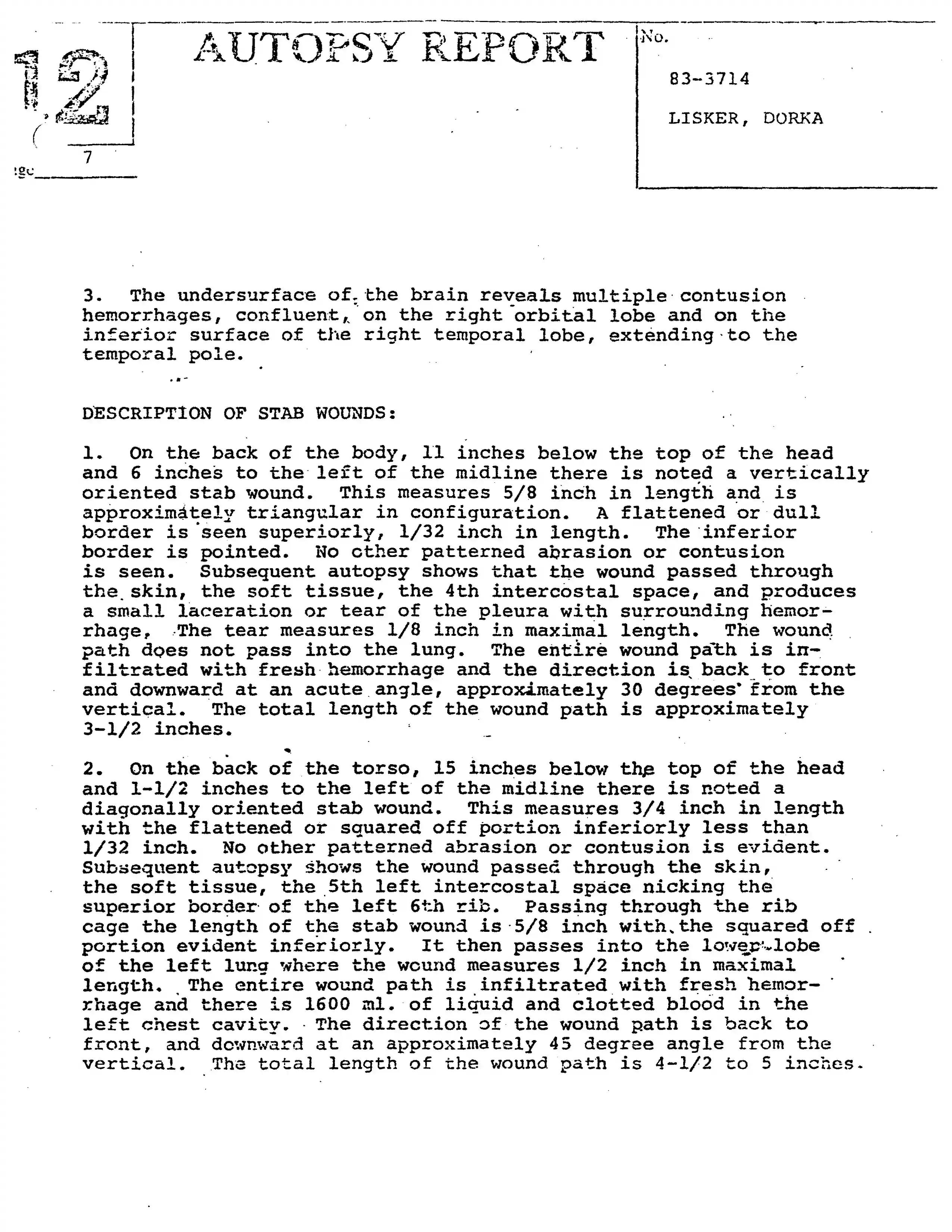
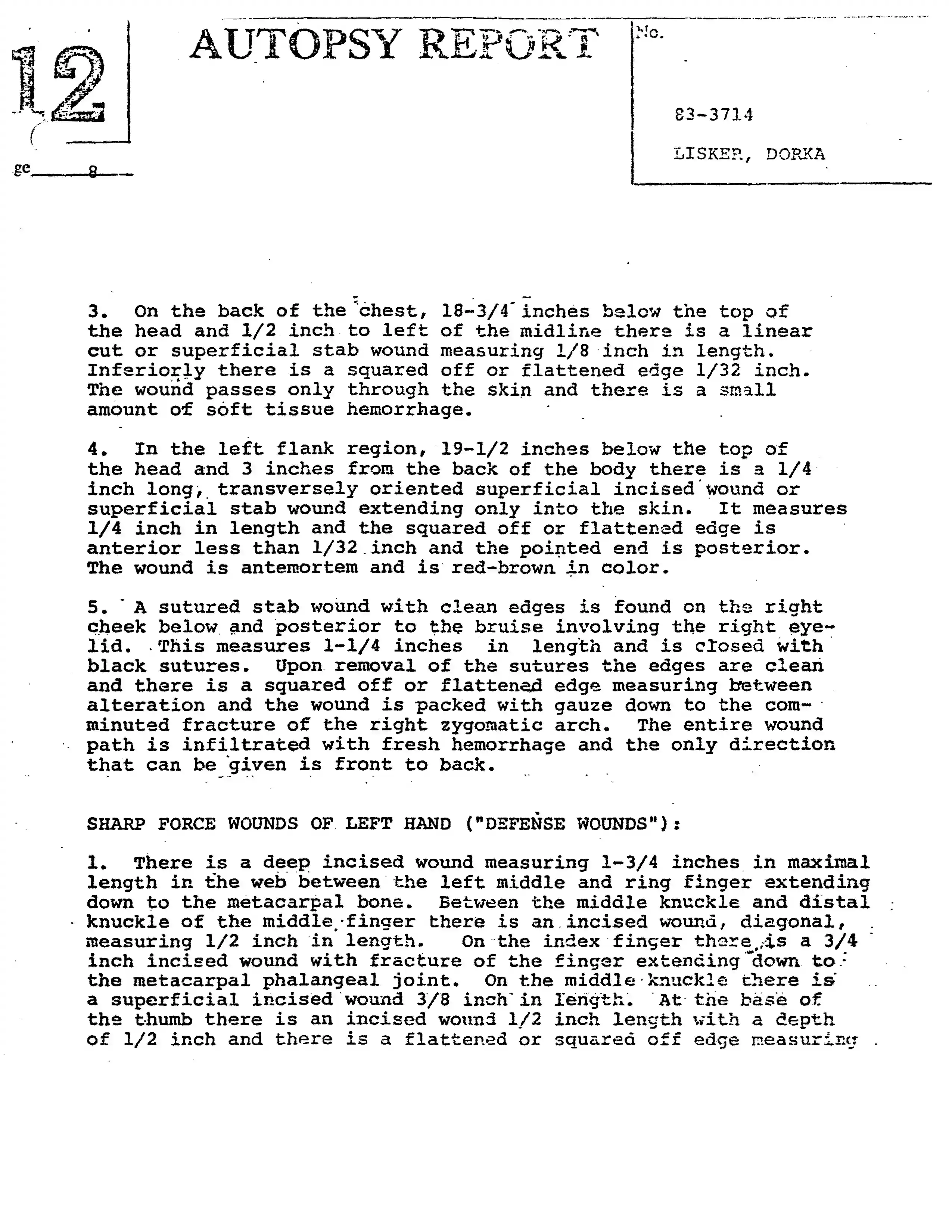
↩Defense wounds are injuries appearing primarily on the extremities (hands; forearms, legs and feet) and sometimes the face and chest, which are caused when a victim fights back or defends against an attacker's thrusts or stabs with a sharp object. The fact that a number of these wounds were present on my mother’s left hand only is highly suggestive of her killer having stabbed and thrust at her with the steak knives numerous times after her right upper arm had been shattered by being hit with the exercise bar.
↩Los Angeles Count Autopsy Report No. 83-3174 (Lisker, Dorka G.)
There was a total absence of slashes or cuts on the right hand.
[View Autopsy Diagrams]
↩Reading the LAPD Follow-Up Investigation report from beginning towards end, the following passages are encountered, in the sequence indicated:
Well before Hughes would crawl out of the muck and start singing for his supper, Det. Monsue had stitched me into my mother's murder. Here is the choreography: Trophy, supposed shirt-Rip, Knives, exercise Bar — TRKB. A sequence reverse-engineered from what he needed to prove. Note the R. The shirt-ripping never happened. That was a greasy old work shirt — torn already, threadbare already — that I had on that morning because I needed to crawl under my car and fix the shock. Monsue invented the rip because his choreography required one.
Immediately following my interrogation at Van Nuys police station, I was ordered to disrobe and surrender all the clothing I wore, down to and including my boxer shorts and socks, so they could be subjected to forensic testing. This decloaking took place under the watchful eyes of Monsue and his colleagues.
↩Citation to be added.
↩See note #363.
↩See Note #379.
↩Because Hughes claimed that the supposed confession had occurred during our very first conversation, and that we'd never met prior to that conversation, these letters were written by him at a point in time after the initial conversation --and the supposed confession,
↩Court Reporter's notation, in trial transcript
Preliminary Hearing, November 14, 1983, page 265
Hughes threatened to withdraw his testimony in my case because his earlier snitching efforts had not bore sentence-reduction fruit, and he was reportedly losing time credits testifying in my case. Then DDA Rabichow told Hughes he would do all he could to 'look into' the snitch's premature release, and Hughes decided to resume his testimony, commenting on his decision:
"WELL, THE MAIN THING THAT MADE ME CHANGE MY MIND FROM THE TIME I CALLED YOU [and threatened to withdraw] AND WHY I'M FINISHING THE CROSS-EXAMINATION WAS MORALS. THERE'S A LITTLE PERSONAL BENEFIT THERE, I STILL GOT A HOPE THAT I'M GOING TO GET A TIME CUT BUT THERE'S MORALS INVOLVED IN WHAT BRUCE DID."
See Note #404.
↩John Michael Ryan, Jr., on his living arrangements during his trip to Los Angeles near the time of the murder
Phencyclidine, also called PCP, is an inexpensive street drug popular mostly in the 1970's and 80's, widely known to drug users and substance abuse experts -- and lying jail house snitches -- as a cause of aberrant, unpredictable and even violent outbursts on the part of its users. Because Hughes knew it was impossible for me and my attorney to prove a negative, that I'd never used the drug before, and, obviously because of the drug's notorious reputation, this position represented a win-win situation for Hughes. It provided an acceptable motive for this violent, otherwise motiveless suburban murder, it was unable to be effectively contested, and it appeared to link the missing cash with me by virtue of the sophistic claim that I needed it to buy more of the drug. And consider:
MAJOR DRUG OF ABUSE BECAUSE OF ITS POTENT PSYCHOLOGICAL AND
BEHAVIORAL EFFECTS. INTRODUCED IN THE 1950'S AS A RELATIVELY NON-TOXIC ANIMAL ANESTHETIC, PCP HAS HARSH SIDE EFFECTS THAT MAKE IT UNSUITABLE FOR ANESTHESIA IN HUMANS. WITHIN A FEW YEARS, HOWEVER, ILLEGAL PCP WAS SOLD AS A SUBSTITUTE AND ADULTERANT FOR SUCH HALLUCINOGENS AS LYSERGIC ACID DIETHYLAMIDE (LSD), MESCALINE, AND TETRAHYDROCANNABINOL (THC). CUSTOMARY USERS OF OTHER HALLUCINOGENS USUALLY DID NOT LIKE THE SEVERE PSYCHOLOGICAL EFFECTS OF PCP; IT BECAME POPULAR AMONG TEENAGERS IN THE 1970'S, HOWEVER, UNDER SUCH STREET NAMES AS 'ANGEL DUST' AND 'HOG.' USERS HAVE MORE SHARPLY CONTRASTING RESPONSES TO PCP THAN TO OTHER DRUGS OF ABUSE. IT HAS PROFOUND EFFECTS ON THINKING, TIME PERCEPTION, SENSE OF REALITY, AND MOOD; DREAMLIKE STATES, EUPHORIC OR DEPRESSED MOODS, AND BIZARRE PERCEPTUAL EXPERIENCES ARE REPORTED. NEGATIVE ASPECTS OF PCP INGESTION INCLUDE DISORIENTATION, CONFUSION, ANXIETY, IRRITABILITY, PARANOID STATES, AND DANGEROUSLY VIOLENT BEHAVIOR. HOSTILITY AND BELLIGERENCE CAN REMAIN LONG AFTER THE DRUG IS NO LONGER MEASURABLE IN THE BLOOD. CHRONIC USERS MAY ALSO EXPERIENCE DEPRESSION OR A SCHIZOPHRENIA-LIKE STATE THAT CAN LAST MONTHS AFTER DISCONTINUATION. DEATH CAN RESULT FROM ACUTE EFFECTS SUCH AS DEPRESSION OF BREATHING AND DISTURBED HEART FUNCTION. PCP ABUSE CONTINUED IN THE 1980'S AND 1990'S, AND IT REMAINS A SERIOUS PUBLIC HEALTH PROBLEM." [emphasis added]
Christianity is a branch of the Christian faith founded in the belief that one's soul must be "saved" by a process of invitation and "acceptance" of Jesus Christ into one's heart, to be one's savior and Lord. This process, according to Born-Again doctrine, is in accord with several passages in the Holy Bible: Holy Bible (NKV), at John 3:3 "JESUS ANSWERED HIM AND SAID TO HIM, 'MOST ASSUREDLY I SAY TO YOU, UNLESS ONE IS BORN AGAIN, HE CANNOT SEE THE KINGDOM OF GOD.' "; and Id. at John 3:7 "DO NOT MARVEL THAT I SAY TO YOU, 'YOU MUST BE BORN AGAIN.' "; and Id. at John 3:16 "FOR GOD SO LOVED THE WORLD THAT HE GAVE HIS ONLY BEGOTTEN SON, THAT WHOEVER BELIEVES IN HIM SHOULD NOT PERISH BUT HAVE EVERLASTING LIFE. FOR GOD DID NOT SEND HIS SON INTO THE WORLD TO CONDEMN THE WORLD, BUT THAT THE WORLD THROUGH HIM MIGHT BE SAVED. HE WHO BELIEVES IN HIM IS NOT CONDEMNED; BUT HE WHO DOES NOT BELIEVE IS CONDEMNED ALREADY, BECAUSE HE HAS NOT BELIEVED IN THE NAME OF THE ONLY BEGOTTEN SON OF GOD."; and Id. at Ephesians 2:4-7 "BUT GOD, WHO IS RICH IN MERCY, BECAUSE OF HIS GREAT LOVE WITH WHICH HE LOVED US, EVEN WHEN WE WERE DEAD IN TRESPASSES, MADE US ALIVE TOGETHER, AND MADE US TO SIT TOGETHER IN THE HEAVENLY PLACES IN CHRIST JESUS..."; and Id. at Ephesians 2:7 "BY GRACE YOU HAVE BEEN SAVED THROUGH FAITH."
↩And consider the testimony heard by the Grand Jury, wherein a certain inmate was placed in the jail's "hospital section" (i.e., the 7000 Module, where I met Hughes), and said to be suicidal so that jail staff could place a snitch in his cell, ostensibly to alert jailers if he attempted to harm himself. But of course the snitch presented almost immediately with an alleged confession:
See Note #428 (Trial November 6, 1985 – Page 580).
↩One-On-One is essentially a suicide or self-harm prevention measure, where staff maintain direct and constant, twenty-four hour a day supervision on a juvenile detainee. While only precautionary in my case, it is practically routine when a minor is arrested on serious charges, the school of though]: being 'better safe that sorry'; to watch a kid- who doesn't need it is better,, than losing a suicidal kid who went undetected.
↩Informants will collaborate in an effort to "book" an unsuspecting inmate:
; Dowtu and Wallace were. doubtless hoping Hughes would participate in the common practice of informants sharing information in order to 'book' a targeted inmate:
Informants will even 'book' another informant if they are able, and even such a targeted snitch may not be able to detect the plot against hint:
See Note #428 (Trial November 6, 1985 – Page 580).
↩While our March, 1983 home telephone bill remains in my possession, I will release its contents only to a court examining this matter because many persons, including members of my own family, still have the same numbers, and I do not wish to invade anyone's privacy. However, I give my word that any representations I make about the bill's contents are true and correct.
↩✓ WITH APRIL, SAME AS STEPHANIE
✓ WITH IRA AT PALMER.
✓ MICHAEL PARENTS LIVE IN SIMI VALLEY, (PARENTS SAME LAST NAME)
- JOHN SCAPICCHIO -- LIVED AT TROPICA MOTEL ON VENTURA BLVD (VENTURA &
VINELAND)
Citation to be added.
↩Citation to be added.
↩LAPD Property Report, dated 3-10-83 1500 hours, indicating that my fingernail clippings were collected "BY SHB [i.e., S. H. Bassett] AT VALLEY CRIME LAB FROM SUSPECT BRUCE LISKER IN THE PRESENCE OF DET. MONSUE VNYS DET. BOOKED VNYS TO TRANSFER TO CENT. PROP.";
Citation to be added.
↩Los Angeles County Autopsy Report No. 83-3174 (Lisker, Dorka G.), Detail 20F featuring Dr. Golden's handwritten notation indicating that "ROPE MARKS" were found on the back and left side of Mrs. Lisker's throat.
[View Autopsy Diagrams]
↩
Citation to be added.
↩Citation to be added.
↩Citation to be added.
↩