Bruce Lisker
← The Lisker Case Analysis
Lisker Case Analysis
Section IV

Sixty-Three Police Lies and Distortions

When police arrived at our family home on the morning of March 10, 1983, they found my 66-year-old mother brutally beaten, stabbed, and dying from a five-weapon assault — and me, the only uninjured person on the premises.

Initial scrutiny was reasonable. Violent crime most often originates within the victim’s immediate circle. 244 Neighbors told arriving officers that my mother and I argued frequently; 245 detectives were briefed. 247 I was hysterical, in a torn shirt, blood on my hands. 187 The house showed no forced entry 250 apart from the window I had described using; 257 nothing was ransacked; 256 my mother’s car keys lay on a dresser in my former bedroom; 254 a bloodied Little League trophy lay beside a stain on the master-bedroom floor. 255 The headlong rush to judgment that followed — foreclosing every other explanation within minutes — was not.

Within minutes, Monsue and his partner used their bare hands to touch every doorknob and closure at every exit, 185 destroying any latent fingerprints. 186 Though officially a “possible witness,” I was handcuffed in a guarded patrol car 261 and driven to Van Nuys station. 264 Monsue refused my father’s request to take me to the hospital, 262 refused mine to be interviewed there, 265 refused to let me wash my mother’s dried blood off my hands, 267 refused to call the hospital for an update. 266 He later admitted he had considered me a suspect well before transport 260 and would have stopped me had I tried to leave 263 — both facts he had earlier denied. The accusatory looks during the drive 659 confirmed what I already understood: I was their suspect from the moment they arrived.

Across the entire investigation, detectives suppressed, mischaracterized, destroyed, and fabricated evidence in service of a single objective: convicting me, at whatever cost to the truth.

  1. Monsue perjured himself in his signed, sworn application for a warrant to search my car.
    1. He swore that the discrepancies between my account and the physical evidence had not been identified until “AT THE CONCLUSION OF THE INTERVIEW.127

      At a later proceeding he testified that it was “ABOUT HALFWAY THROUGH THE INTERVIEW, WHEN I REACHED THE POINT IN THE INTERVIEW WHERE I CONSIDERED HIM A SUSPECT.128 The Appellate Court ultimately ruled that Miranda should have been delivered before the interview began at all. 268 The warrant application contains no hint of this timing problem.

    2. He also swore that my car was possessed “BY A PERSON WITH THE INTENT TO USE IT AS A MEANS OF COMMITTING A PUBLIC OFFENSE OR IS POSSESSED BY ANOTHER TO WHOM HE MAY HAVE DELIVERED IT FOR THE PURPOSE OF CONCEALING IT OR PREVENTING ITS DISCOVERY.127

      False on its face. Police had impounded the car before noon on March 10. No civilian ever possessed it; I could not have delivered it to anyone — I was in police custody.

    3. Monsue’s Follow-Up report was attached to his Statement of Probable Cause and incorporated “AS IF FULLY SET FORTH HEREIN” into his sworn Affidavit. By taking that oath, he swore that every inaccuracy, misstatement, and fabrication in that report was the truth. [Cf. §§ III (3), (7); §§ IV (2) (a) through (y), (3) (a), (4) (b) (e) (g) (k) (l), (7), (8), (9), (11) (a), (14), (15); §§ VIII (1); §§ IX (1) through (5)]
  2. Monsue’s Follow-Up report is riddled with factual errors, misstatements, and fabrications. The following are listed in the order they appear in the report, not in order of significance.
    1. The report states that Prado and Derousseau arrived to find me “RUNNING AROUND IN THE DRIVEWAY OF THE LOCATION.129 Both officers testified on cross that they had seen me walking hurriedly toward them 270 — not running, not moving “around” anything.
    2. The report states: “DETECTIVES ENTERED THE CRIME SCENE AND OBSERVED A LARGE AREA OF BLOOD ON THE FLOOR AT THE END OF THE ENTRY HALLWAY.132

      Shown a crime-scene photograph on the stand, Monsue could substantiate no large area; 84 he conceded he had seen only small areas, 592 and my father observed none. 107 Two working drafts survive in the LAPD Murder Book and document a deliberate softening of the claim, revision by revision. The earliest read:

      DETECTIVES ENTERED THE CRIME SCENE AND OBSERVED THAT THERE WAS A VERY LARGE SPOT”.

      Then, struck and replaced:

      DETECTIVES ENTERED THE CRIME SCENE AND OBSERVED THAT THERE WAS A VERY LARGE SPOT NUMEROUS SPOTS OF BLOOD ON THE FLOOR IN THE ENTRY HALLWAY”.

      Then edited again by hand, in Monsue’s block printing:

      DETECTIVES ENTERED THE CRIME SCENE AND OBSERVED THAT THERE WAS A VERY LARGE SPOT NUMEROUS SPOTS OF BLOOD ON THE FLOOR IN THE ENTRY HALLWAY A LARGE AREA OF BLOOD ON THE FLOOR AT THE END OF THE ENTRY HALLWAY”.

      “A very large spot” to “numerous spots” to “a large area” — each rewording moving the description further from anything a photograph could falsify. Even the final overstates the record: a single blood spot, larger than a quarter coin.

    3. Monsue wrote that he could not see into the house through the rear windows “WITHOUT PLACING HIS FACE UP AGAINST THE GLASS.23 The implication: neither could I. He later conceded I could “conceivably” have seen inside without touching the glass, 24 exactly as I described. Landgren, 28 LAPD photographer Wilson, 5 and attorney Johnson 3, 4 all testified they’d been able to see inside.
    4. He wrote that the sunshade awning above the living-room window forced “SOMEONE LOOKING INTO THE WINDOW TO BEND DOWN AND CLIMB UNDER IT.31 He later admitted he could look under the awning by bending down on the sidewalk — without entering the planter, without climbing under anything. 32 Landgren confirmed the same. 33
    5. The report says “DETECTIVES OBSERVED SEVERAL FOOTPRINTS IN THE MUD ALONG THE EAST SIDE OF THE HOUSE. THE FOOTPRINTS LED IN THE DIRECTION OF THE KITCHEN WINDOW SUBJECT USED TO ENTER THE HOUSE.135 Monsue later clarified that “several” meant two or three partial prints. 36 North-facing footprints may be visible * in People’s Exhibits 29 and 31. 37 Monsue himself acknowledges three prints in Exhibit 29 and another two or three in Exhibit 31 38 — five or six total, where he had previously claimed two or three. SID was never asked to examine them; 39 no casts or impressions were taken. 205
      * It should be noted that due to the wording of Monsue’s testimony it is unclear whether it was the footprints or the directionality indicator which faced north. Re-examination of the photographs in question appears the only way to resolve the issue.

      His characterization of the soil as “MUD” is, at best, an exaggeration. [Cf. § VIII (2)]

    6. Monsue wrote that I had “USED THAT [kitchen] WINDOW MAYBE 4 OR 5 TIMES OVER THE LAST YEAR OR TWO TO BREAK INTO THE HOUSE.136

      The interrogation tape — in his custody as he wrote — records me saying I had used the window exactly three times over two years, all during the period I lived at home. 138 My father’s account confirmed it. 137

    7. After I tearfully described removing the steak knives from my mother’s back, Monsue wrote that I had “EXPLAINED IN DETAIL HOW HE GRABBED THE KNIVES WITH HIS FOREFINGERS AND THUMB, SO THE KNIVES WOULD NOT HAVE HIS PRINTS ON THEM,” and repeated the claim at my April 4 hearing. 139

      He later conceded I had told him I removed the knives that way to preserve the killer’s fingerprints, 140 not to keep my own off them. The distinction is not subtle: one is civic instinct under shock; the other is premeditation. My actual words: “I TRIED TO TOUCH THEM THE LEAST I COULD, BUT AT THE MOMENT I WASN’T THINKING ABOUT YOUR INVESTIGATION, I WAS THINKING ABOUT MY MOTHER.141

    8. Monsue wrote that I “STATED HE CHECKED HIS FATHER’S SAFE IN THE MASTER BEDROOM.145 I never said that. What I told him from the patrol car was that the safe had occurred to me as a possible motive, and I asked police to check on it and told them where it was. 146
    9. The report has me saying I “HELD HER IN [my] ARMS,147 a characterization contradicted by the absence of soaked-in blood on either shirt. 80

      I used the word “hugged” — describing how I stayed with my mother, cradled her head, 79 and raised her arm to take her pulse. I clarified almost immediately: “YEAH, I WAS HUGGING, HOLDING HER.660 Monsue built a full-body embrace from a single imprecise word spoken by a traumatized 17-year-old, ignoring my repeated statements that the blood had horrified me. 89, 90, 91

    10. Monsue wrote: “I/O RECALLED THAT WHILE AT THE HOUSE HE OBSERVED THE TELEPHONE AND NOTED THAT THERE WAS NO BLOOD ON THE HANDLE OF THE PHONE BUT THERE WAS A SMALL SMEAR OF BLOOD ON THE PHONE CRADLE.148 The implication — never explained — was that the smear somehow undermined my account. The supposed stain was never photographed, 211 never tested to confirm it was blood, 212 and the phone was never taken into evidence. 213
    11. On the supposedly one-way footprints, Monsue wrote: “THE FOOTPRINTS IN THE MUD ONLY LED TOWARD THE KITCHEN WINDOW AND THERE WERE NO FOOTPRINTS LEADING AWAY FROM THE SIDE OF THE HOUSE.150

      Two-way footprints may, in fact, be present. [Cf. § VIII (1)] The “mud” characterization is suspect. [Cf. § VIII (2)]

    12. Monsue wrote: “SUBJECT STATED HE HAD GONE THROUGH THE PURSE, REMOVING THE WALLET, TO CHECK IF THE MONEY IN THERE WAS GONE.151

      I never said that. Monsue’s own transcription records me describing how I had leaned over the open purse and nudged the wallet to see the empty cash section. 661 Where the transcript reads “PICK IT UP, EVENT,” my actual words were “I DIDN’T PICK IT UP, EVEN.” Without the audio tape to verify — and given his track record — his hand-transcription cannot be treated as authoritative.

    13. Monsue wrote that I “WAS CONSTANTLY MAKING STATEMENTS LIKE, ‘IF I WOULD HAVE KILLED HER, DO YOU THINK I WOULD HAVE CALLED THE PARAMEDICS AND STAYED AROUND?’153 If I had made such statements “constantly,” at least one would appear in the fifty-two-page transcript. None does. [See § I, “In Support of My Account,” for the supporting analysis.]
    14. Monsue wrote that I “APPEARED TO HAVE AN UNUSUAL KNOWLEDGE OF PROCEDURES CONCERNING THE COLLECTION OF EVIDENCE AND LEGAL PROCEDURES IN CONDUCTING AN INVESTIGATION.154 A subjective characterization, from a dishonest detective, of an articulate teenager whose father was an attorney and who had grown up watching Dragnet, Perry Mason, and Adam-12. No statement from the interrogation is offered in support.
    15. Monsue wrote that I “STATED THE VICTIMS IN THE BOOK [Helter Skelter] WERE KILLED WITH TWO KNIVES AND A ROPE AND COMPARED THESE FACTS TO HIS MOTHER’S DEATH.156

      No statement in the transcript supports the claim. When Monsue asked my former roommate — the likely killer — Mike Ryan about my supposed “FASCINATION WITH THIS HELTER SKELTER,” Ryan could not substantiate it despite every incentive to cast me in a damning light. 663 I owned the paperback; framing that as “fascination” was a deliberate attempt to drag my case into proximity with the most incendiary murder case in twentieth-century Los Angeles.

    16. Monsue wrote that my father “STATED THAT FINALLY, HE HAD MOVED SUBJECT OUT OF THE HOME IN MAY 1982 BECAUSE OF THE PROBLEM BETWEEN HIM AND HIS MOTHER.160

      Not accurate. When I dropped out of high school in May 1982, my father decided — in answer to my long-standing requests, and as a lesson in self-sufficiency — that I should support myself. He offered to cover rent until I found work; I found a $210-a-month bachelor apartment and moved in. His testimony confirms it. 161 During my interrogation, Monsue yelled, “THEN WHY IN THE FUCK AIN’T YOU LIVING WITH HER THERE[?]” I answered, “BECAUSE WE COULDN’T GET ALONG LIVING TOGETHER.662 Those words were the rationale I had used months earlier to persuade my father to let me have the apartment — a habit of speech, not a confession.

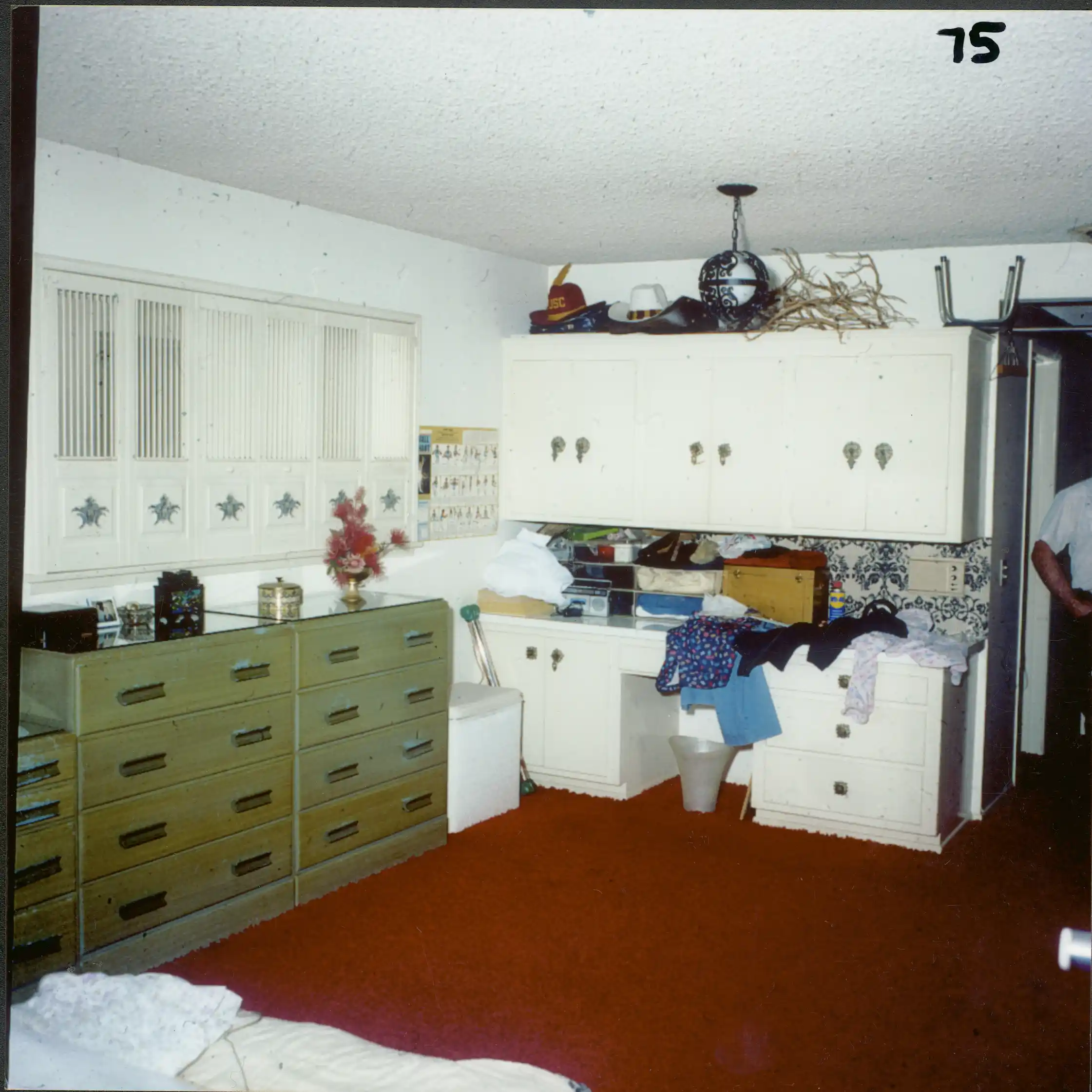
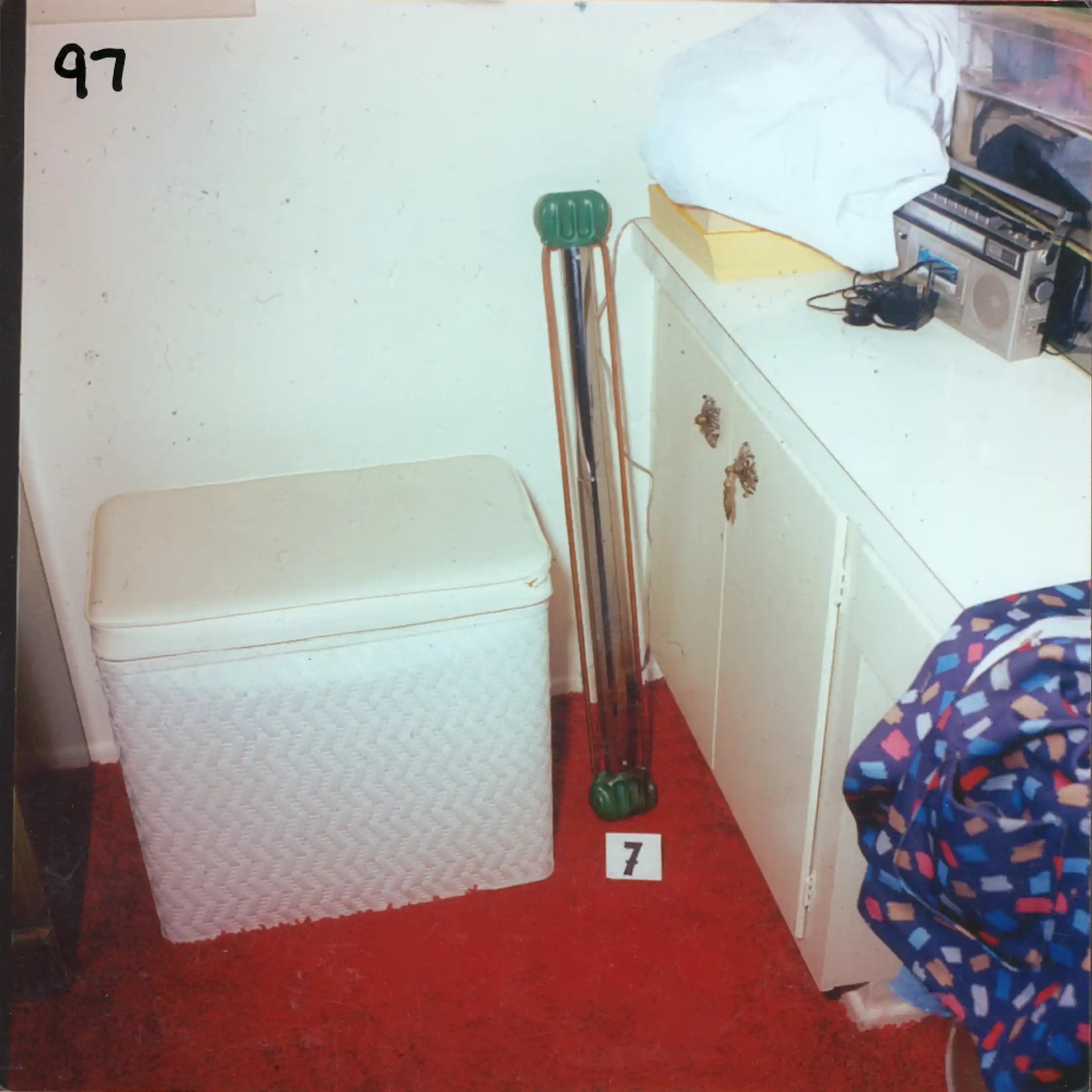
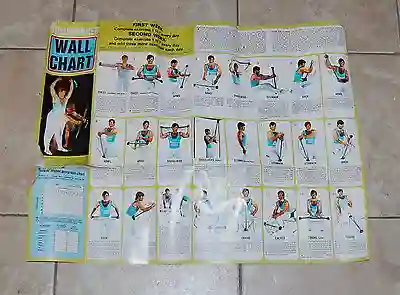
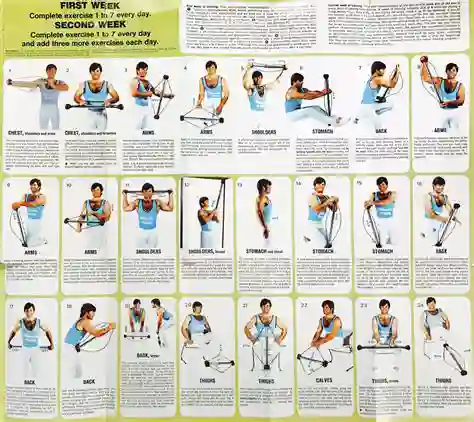
    17. Monsue wrote that my father had given me the exercise bar, and that I had put it in my old bedroom or taken it to my apartment. 162

      The bar was never given to me. It belonged to my father — a Christmas gift from the late 1970s — and its ordinary location was the master bedroom, where police found it. 273 Even Mike Ryan, with every reason to implicate me in his place, told Monsue he had never seen the bar in my apartment or in my room. 664

    18. Monsue wrote that I “ATTEMPTED TO RE-ENTER THE LOCATION SEVERAL TIMES AFTER HAVING BEEN TOLD TO REMAIN WITH THE OFFICER129 and “BECAME COMBATIVE WITH THE OFFICERS.129

      Prado and Derousseau told me to stay outside during their two- to three-minute search, 311 and I complied 312 — never crossing the threshold, never stepping onto the porch. 313 Prado testified I never pushed past either officer. 314 After one officer put me in a chokehold from behind, I instinctively resisted. No one, trained or otherwise, fails to react to that — moments after discovering a brutalized parent.

    19. The report states that upon arriving at my parents’ house, I “REALIZED [I] NEEDED A JACK” to repair my car. 197

      The jack in my mother’s car was the reason I drove over. I had my own tools in the back seat; 202 only the jack was missing.

    20. Monsue wrote: “SUBJECT STATED . . . SHE HAD A HOLE IN THE HEAD.136

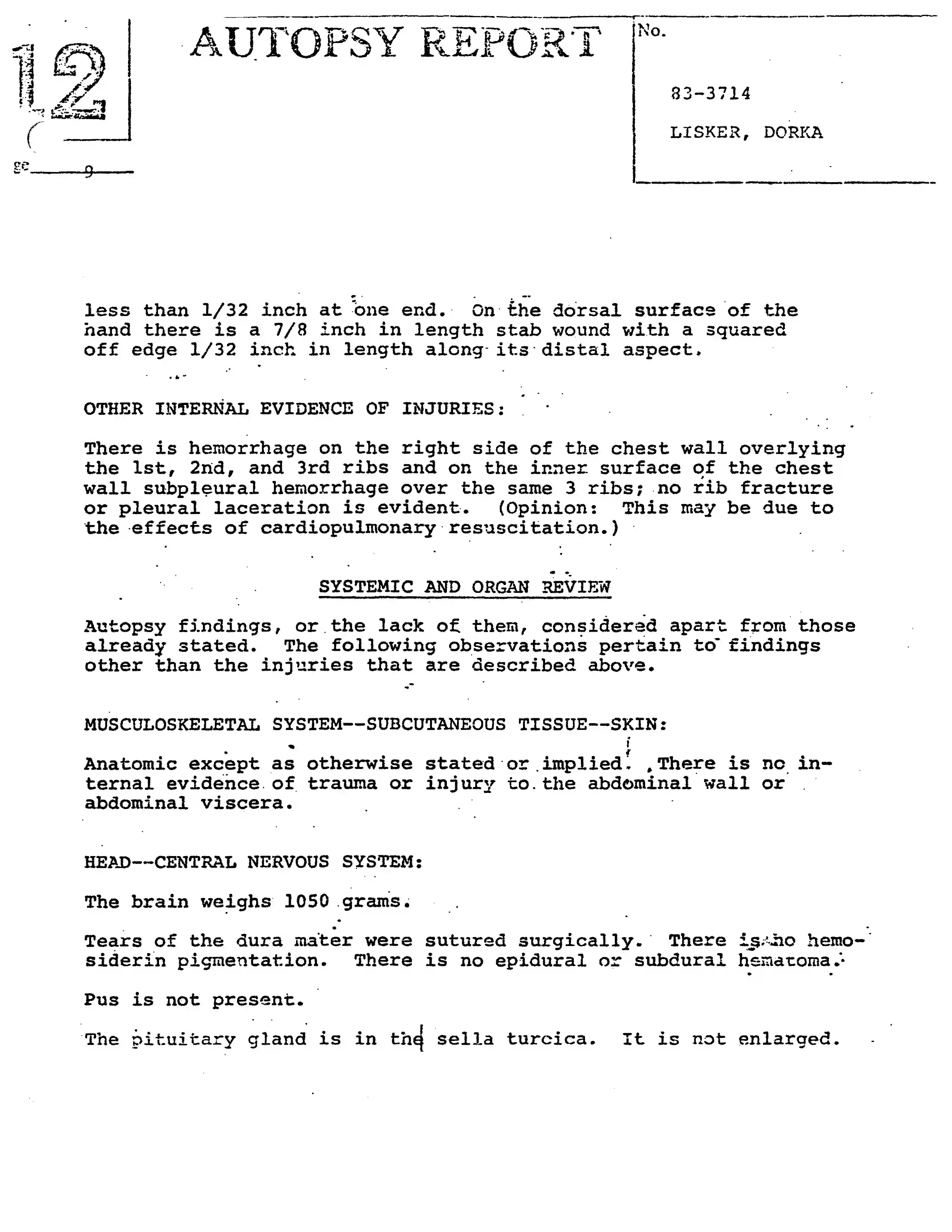
      I never said that. The transcript: “HER WHOLE HEAD WAS DARK RED, I COULD NOT SEE HER FACE. I THOUGHT THAT CUT THAT WAS OVER HER EYE WAS HER EYE.666 No “hole” existed in my mother’s head when I last saw her — that opening did not exist until Encino emergency surgeons removed pieces of her fractured frontal skull. It was, however, visible to Monsue at her autopsy on March 11 — three days before he issued the Follow-Up report.

    21. Monsue wrote: “SUBJECT STATED HE WAS SCREAMING AT THE TOP OF HIS LUNGS AT THIS TIME, YELLING AS LOUD AS POSSIBLE.136

      The transcript contains no such statement. My only remarks were that after removing the knives I “STARTED SCREAMING, OH MY GOD! OH MY GOD! TO NOBODY.666

    22. Monsue wrote that after removing the knives, I “GRABBED TWO LARGE KITCHEN BUTCHER KNIVES, THEN RAN THROUGH THE HOUSE SEARCHING FOR THE PERSON WHO HAD DONE THIS TO HIS MOTHER.136

      The very next words I spoke were: “[I] CALLED THE PARAMEDICS RIGHT THEN.” The call came first — not the search. I plainly described that order at the time.

    23. Monsue’s report concedes that during interrogation, “DETECTIVE MONSUE ASKED IF SUBJECT REMEMBERED SEEING ANY KEYS INSIDE THE DOOR TO HIS ROOM ON THE DESK. SUBJECT STATED, NO.148

      The passage sets up a fabricated discrepancy. Monsue wrote that after the interrogation, I asked him and Landgren, “WHY WOULD I LEAVE MY MOTHER’S KEYS ON MY DRESSER?167 — cited as “guilty knowledge.” 168 But the passage itself concedes — and the transcript confirms — that Monsue had first introduced the keys by asking, “HOW DID YOUR MOTHER’S CAR KEYS GET INTO YOUR BEDROOM?668

    24. Monsue claimed: “SUBJECT STATED THAT HIS MOTHER SHOULD HAVE HAD A $150.00 IN [her] WALLET. HE EXPLAINED THAT SHE ALWAYS KEPT ABOUT THAT MUCH MONEY IN HER PURSE.152

      I did not know how much money my mother habitually carried, and not a single statement in the transcript supports the claim. Monsue alleged I had been at the house the evening before when my father gave my mother her weekly $150 allowance. My father testified: “THE $150.00 GIVEN TO MRS. LISKER THE AFTERNOON OF MARCH 9, 1983, WAS GIVEN TO HER BY ME RIGHT AFTER I CAME HOME THAT AFTERNOON. BRUCE LISKER WAS NOT AT HOME WHEN I DID THIS.667

  3. Monsue attributed several suspicious statements to me — statements either fabricated outright or stripped of the context that made them innocent.
    1. Monsue claimed I told Officer Douglas Johnson, while seated in the patrol car at the curb, “ARE THEY GOING TO ARREST ME? THIS IS SO BAD.169

      Neither Johnson’s written report nor his trial testimony — in which he read his complete notes into the record 170 — contains any trace of the statement. 172

    2. During interrogation I drew a pencil diagram of our house for Monsue. A line began at the kitchen window and ended in an arrow positioned beside a figure representing where my mother lay; the arrow did not touch the figure’s head. 173, 174 As I drew the final segment I said I “FELL FROM HERE TO HERE ON MY KNEES AND LANDED RIGHT HERE.175

      Monsue denied the line had any connection to what I said, insisting it represented only my path — and that when I said “landed right here” I had been pointing, not drawing, to the spot near my mother’s head. He had to deny its meaning, because so much of his accusation rested on the claim that I had knelt in direct contact with her — a claim the absence of soaked-in stains on my pant knees flatly contradicted. The line, in my own hand, placed me a slight distance from her head.

  4. Police systematically mishandled the physical evidence.
    1. On arrival, detectives were told that nothing inside the house had been disturbed. 184 Monsue and Landgren nevertheless went to every door and window leading out and, with their bare hands, touched every knob and closure “to see if they were locked.” 185 Latent fingerprints are among the most fragile evidence in forensic work; once carelessly handled, they are destroyed permanently. 186 These were trained homicide detectives, not patrol officers. The only explanation for their immediate destruction of exit-point prints is that they had already concluded the attacker was on the premises — handcuffed, in the back of a patrol car out front. That bias is legible in nearly every decision that followed.
    2. Having destroyed any fingerprint evidence on the exit points, the same detectives then claimed every door and window apart from the one I had described was “LOCKED FROM THE INSIDE.188 No photographs were taken to substantiate the claim. The uncorroborated assertions of the two detectives who had just rendered those exit points uninvestigable are the entirety of the evidence for it.
    3. Monsue denied having done anything with the bloodstained entry-hall rug on which my mother lay. 189, 190 It was Monsue himself who, that evening, helped my father roll up the rug and discard it in a trash can on the east side of our property. 191
    4. Police took no photographs of my car — though it sat in the driveway 192 throughout the investigation. The red-handled pliers I had used to remove window panes came from it; 35 a broken rear shock absorber 193 was the reason I had driven over. A photograph could have established each of the following:
      1. The broken rear shock absorber; 193
      2. The “automobile repair tools” Monsue admitted finding in the rear seat; 202
      3. Job application forms in the back seat, consistent with the job-hunt 195 funded by the ten dollars my father had given me; 194
      4. The car backed in, 196 consistent with preparing to jack the rear end up using my mother’s bumper jack; 197, 519
      5. Nuts and washers on the center console, 198, 199 bought en route;
      6. The gas gauge, which would have shown the money 194 had reached the tank.

      My worn work clothes, 200 covered in “numerous dark, textured, non-blood stains” 201 consistent with grease, corroborated it further. Monsue never investigated whether the shock absorber was broken, 203 never confirmed the dark stains were grease, never compared the nuts and washers to the shock absorber, never verified the morning purchase at Van Nuys Builder’s Emporium, 204 and never impounded the repair tools. 202 He halted every investigation that, pursued, would have corroborated my account. [Cf. § IV (5)]

    5. No casts or impressions were taken 205 of the supposedly one-way, 206 north-facing 34 footprints behind the garage. SID was never asked to examine them. 39

      North-facing footprints may be visible in People’s Exhibits 29 and 31. 37 Monsue himself acknowledges three prints in Exhibit 29 and another two or three in Exhibit 31 38 — five or six total, against his earlier claim of two or three.

      It should be noted that due to the wording of Monsue’s testimony it is unclear whether it was the footprints or the directionality indicator which faced north. Re-examination of the photographs in question appears the only way to resolve the issue.
    6. Monsue took the cassette recording of my ninety-minute interrogation 208 and “transcribed” it by hand — writing out his rendering in longhand and having his secretary prepare the official police transcript from those notes, not the tape. 209 Every error in his notes flowed unedited into the official record. Given his documented bias, that transcript deserves deep skepticism.
    7. The “suspicious pattern of blood” detectives claimed to have found on the telephone I used to call for help 210 was never photographed, 211 never tested to confirm it was blood, 212 and the phone was never taken into evidence. 213
    8. No blood testing was performed on the kitchen sink 214 — even though detectives insisted the faint footprint that “LED TO THE KITCHEN SINK122 proved I had gone there for some guilty reason.
    9. Both police and jailhouse informant Robert Donald Hughes claimed that my mother and I had engaged in a hand-to-hand struggle and that she had torn my shirt in the process. 564

      Police nevertheless took no photographs of my unclothed body 216 or my hands, 215 which would have documented my complete absence of injury 217 — the kind of injury close-quarters struggle invariably produces. No shirt fibers were found under my mother’s fingernails. 565 Her hands showed no marks consistent with gripping fabric, and not one fingernail was broken.

    10. Monsue claimed gestures I made during interrogation demonstrated I had held my mother’s body tightly off the floor in my arms, 218 and that he could synchronize those gestures precisely with statements in the transcript. 219

      The evolution of the account exposes it. At interrogation I had told him: “I DIDN’T WANT TO PICK HER UP,89I DIDN’T WANT TO MOVE HER OR TOUCH HER,90 and “I DIDN’T REALLY WANT TO GET ALL THAT, YOU KNOW, ON MY BODY.91 Three days later his report had me “HELD HER IN [my] ARMS.136 At my April 4 hearing he retreated, conceding I had only indicated reaching for her. 81 By October 1983, I had “BENT DOWN AND CRADLED HER IN [my] ARM.80 By 1985, at trial, he offered a courtroom demonstration with a precise 45-degree arm angle. 218 The escalating specificity across four proceedings is its own refutation.

    11. Police never investigated the pre-March 10 condition of the shirt they alleged my mother had torn during the struggle. Monsue could have asked my father at any time — he never did. 226 The absence of shirt fibers under her fingernails, 227 the absence of gripping marks on her hands, 228 the absence of broken fingernails, and the complete absence of injury on my body 229 together establish that the “torn shirt struggle” narrative has no physical support whatsoever.
    12. Monsue implied that a bloody footprint “facing” the kitchen sink 230 proved I had returned there for some culpable purpose.

      The impression consisted only of the ball portion of a shoe; 124 police could not determine the foot, size, or any other identifying characteristic. No evidence-quality photographs were taken. 231 SID never examined or collected it, and none of the chemical or physical development techniques available in 1983 233 was applied. 234 The path from the hallway to the knife drawer required a wide right turn around which the sink sat on the outer arc; in mid-stride, centrifugal force could have canted my foot toward the sink rather than the drawer. The two guilty theories both collapse. That I washed blood from my hands at the sink: the blood from my first-aid attempt was still on my hands when police arrived, 187 and officers saw no water in or near the sink. That I went to the window to stage a fake break-in: the blood on my hands would have transferred to the panes, sill, screen, or pliers — none of which carried any. 298 This may be why the kitchen footprint was barely raised at trial.

    13. On the order of the phone calls I placed after finding my mother, Monsue conceded under oath that he would have wanted to know what the telephone records showed. 235 He never checked them. The call sequence, placed in exactly the order I described, would have corroborated my account. A 10:22 a.m. call placed from our house — roughly forty minutes before my arrival — went to a number differing from Mike Ryan’s mother’s phone by a single final digit. [Cf. § VII (3)]
    14. My mother’s purse was altered between Landgren’s initial observation of it and the police photographs taken of it. Landgren testified its contents had not been removed or scattered when he first saw it. 316 Though he denied police had gone through it at the scene, 317 the crime-scene photographs show papers removed and spread across the love seat. 318
  5. In the course of my job search that morning, I had collected three application forms. 236 Monsue claimed he had recovered two from my car 237 and that they did not match the businesses I had named.

    Three forms were found 238 and later produced at trial. 239 Two were generic forms with no company identification — they could not “match” any business. The third was from the International House of Pancakes, one of the businesses I had named. 241 Monsue acknowledged that the two generic forms had handwritten notes 240 — my own notations identifying which store each had come from. He never attempted to contact the owners. I had long, distinctive hair — which police felt compelled to describe as an “AFRO242 — and weighed ninety-seven pounds. 277 Identifying me would have been straightforward.

  6. To justify proceeding without Miranda warnings, Monsue claimed I had not been a suspect prior to transport — that it was only midway through the interview that he first considered me one.

    The Appellate Court later found I had been in custody well before we left the scene, and that Miranda should have been delivered before any questioning. 268 Most of what Monsue claimed to have learned during interrogation, he already knew at the scene: that I was the victim’s son, that we argued often, 245 and what I had told arriving officers. 247 He had seen me agitated, in a torn shirt, with blood on my hands, locked in a guarded patrol car. 187 He had noted the “suspicious” smear on the phone. 249 He saw no forced entry apart from the window I had described, 250, 251, 257 no ransacking, 256 all other exits supposedly locked. 258 He had looked for and claimed to have found one-way footprints; 253 had tried and supposedly failed to see through the rear windows. 252 Detectives had seen the car keys on my old dresser 254 and the bloody trophy by the master-bedroom stain. 255 Monsue ultimately admitted on cross that I had been a suspect before transport. 260 The “material witness” framing was a transparent attempt to evade Miranda.

  7. I told Monsue I had been distraught after finding my mother — screaming and crying inside the house. He challenged that, claiming it was impossible because our neighbors to the east heard nothing unusual. 460

    Prado and Derousseau observed me yelling loudly in the open driveway as they arrived 270 — and even that less-obstructed outburst was apparently not heard by neighbors. 271 More to the point, the field-interview notes misidentify our actual next-door neighbors. They list “Robert Griffith and his wife” our neighbors were the Kaufmans. Thirteen-year-old Brooke Kaufman and her mother Carol were held at our common property line after emergency vehicles arrived — the people I looked at, first handcuffed by the front wheel of my car, then again from the patrol car. Substituting a fictitious name raises a direct question: what did the Kaufmans actually say that made it necessary to obscure their identity?

  8. Monsue claimed my parents had given me the exercise bar used in the attack, and that I had taken it to my former bedroom or my apartment. 272 The bar was a Christmas gift to my father, purchased by my mother in the late 1970s. It was never given to me. Its ordinary location was the master bedroom, where police found it. 273 Even Mike Ryan — my mother’s probable killer, with every reason to implicate me — told Monsue he had never seen the bar in my apartment or in my room. 664
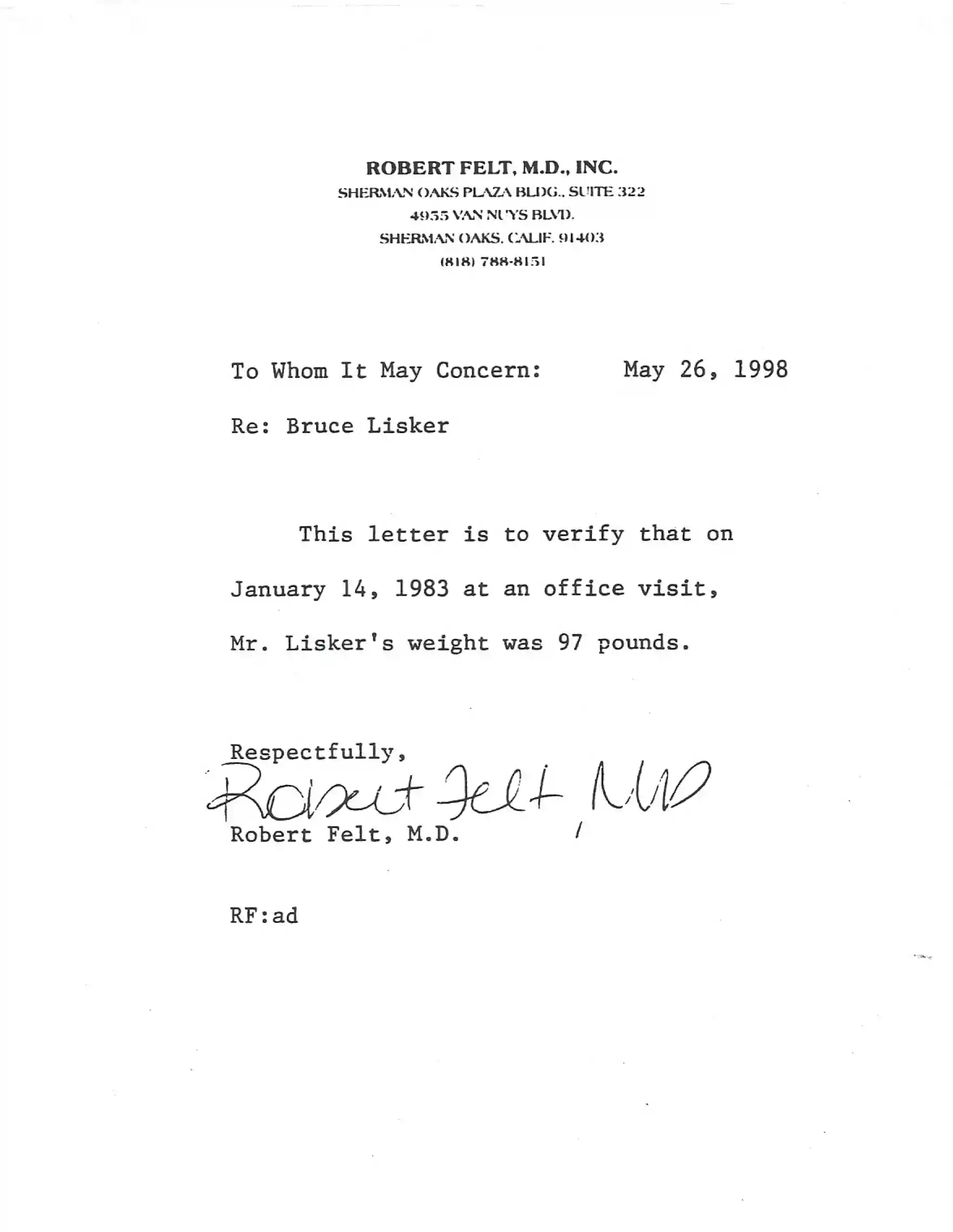
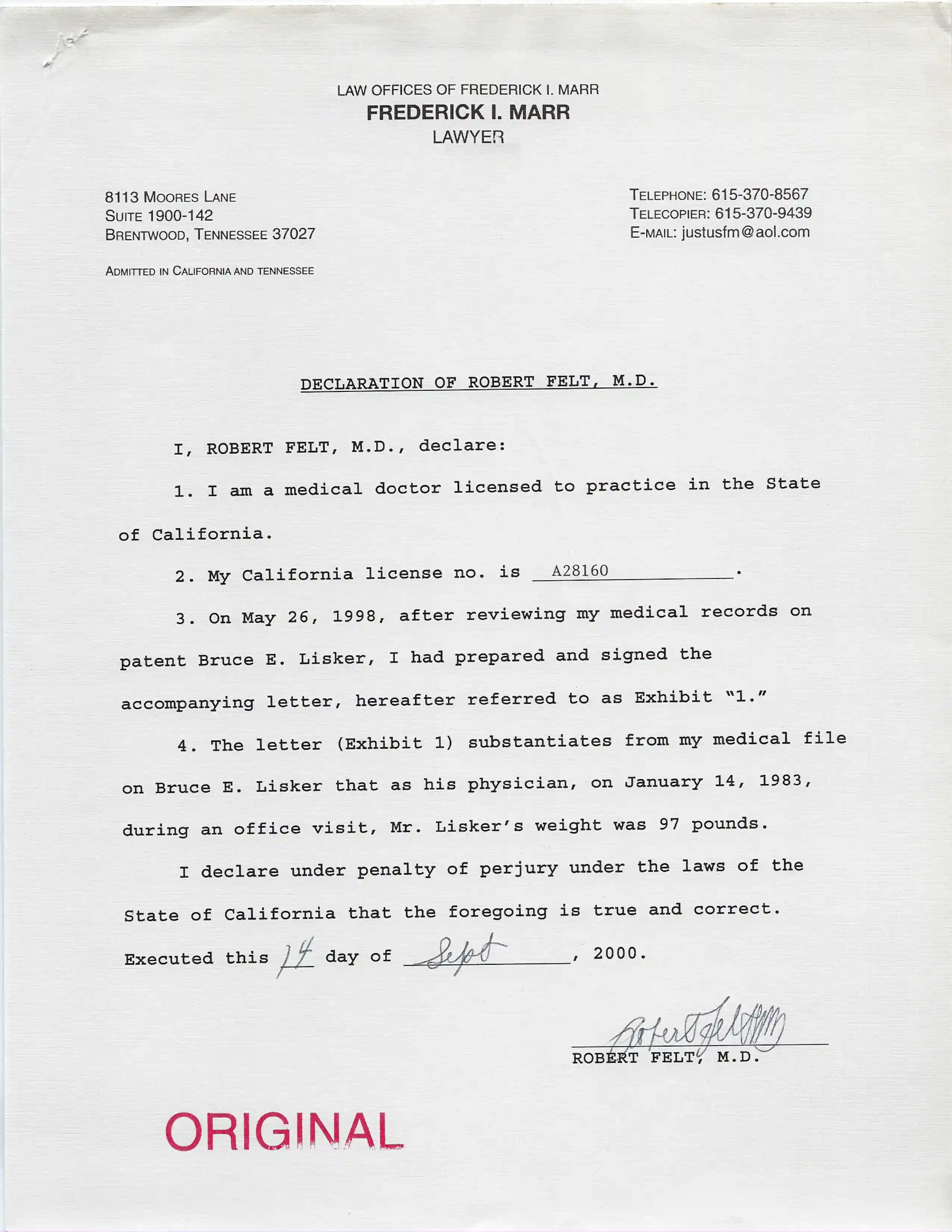
  9. Monsue’s reports falsely characterized the physical disparity between my mother and me in a way consistently favorable to his theory. The reports listed my height as 5’6” and my weight as 165 pounds, 274 and my mother as 5’2” and 140 pounds. 275 At autopsy, my mother was confirmed at 5’4” and 170 pounds. 276 At my last medical visit, on January 14, 1983, I weighed 97 pounds. 277

    The reports have me outweighing my mother by 25 pounds. The actual figures have her outweighing me by 73 — a 98-pound discrepancy. The errors appear in both sets of data, in both height and weight, and they do not affect any other statistical entry. Each is consistently helpful to the theory the same detective was simultaneously building.

  10. Four knives were associated with the crime scene. Two small steak-type knives were used in the attack, both embedded in my mother’s back when I found her; I removed them in shock, trying to help her. I then retrieved two larger kitchen knives to search the house, fearing the attacker might still be inside. These carried my left index fingerprint 279 and a small blood smear on the blade beside the handle 298 — both almost certainly deposited by the same finger that had become bloody removing the steak knives moments earlier.

    If police could link the larger “search” knives to any of my mother’s injuries, the case would be substantially stronger. Monsue invented the link. He testified that Deputy Medical Examiner Dr. Irwin L. Golden had concluded a wound on my mother’s cheek had “A CONSISTENT SHAPE COMPARABLE TO THE TWO [larger] KNIVES THAT [I] INDICATED [I] HAD PICKED OUT OF THE DRAWERS.280

    A fabrication. Golden never concluded the cheek wound matched any characteristic of the larger knives. He stated only that because the wound was wider than the search-knife blades, he could not rule them out. The larger knives were explicitly ruled out as the cause of every other penetrating stab wound. 281 The cheek wound had been surgically enlarged during emergency treatment — opened, packed, and sutured closed 283 — making its dimensions unreliable as any guide to weapon characteristics. Dr. Golden was visibly reluctant to characterize it as a stab wound at all. 282 And the underlying premise is absurd: why would I retrieve two kitchen knives to construct an alibi that I had searched the house — only to then stab my mother with them, fouling the alibi and incriminating myself?

  11. Monsue distorted the chronology of events whenever doing so served his narrative.
    1. His Follow-Up report states that on arriving he “OBSERVED THE SUBJECT IN THE BACK SEAT OF A POLICE UNIT . . . [and] OBSERVED THAT SUBJECT HAD WHAT APPEARED TO BE DRY BLOOD ON BOTH OF HIS HANDS.284

      Physically impossible at the moment claimed. I was handcuffed behind my back. 285 Monsue did not approach the car until after surveying the scene. 286 Johnson had stood directly over me and seen no blood on my clothing or person, and could not see my hands below the forearms. 285

    2. Monsue testified that prior to interrogation, neighbors had told police only that I was the household’s son and had once lived there. 289 They had told him substantially more — including that my relationship with my mother was troubled and we argued often. 290 [See also § IV (7), where police falsely record those same neighbors’ names.]
    3. Monsue claimed he had arrived simultaneously with Landgren. 291 The LAPD Chronological Log shows him arriving at 12:15 p.m. and Landgren at 12:30. 293 When Landgren arrived, Monsue was already inside the house. 292
    4. Monsue claimed he had realized — back at Van Nuys station — that I could not have seen through the rear windows the way I described. By his own testimony, while at the house he had not yet known I claimed to have looked through them at all. 295 His check was an apparent afterthought; 294 the conclusion that I was lying rested on a casual glance taken before he knew the glance was relevant. Wilson, 5 Landgren, 28, 33 and attorney Johnson 3, 4 all later testified they could see in without difficulty. Monsue ultimately conceded I could “conceivably” have done so after all. 24
  12. I told Monsue that after seeing my mother through the window, I retrieved a magnetic Hide-A-Key from a cabinet on the back patio, found the spare key missing, threw the case down near the living-room window, 296 and circled back toward the kitchen window I ultimately used to enter. Monsue mentioned no Hide-A-Key in any police report 297 — another item of physical evidence that corroborated my account, omitted.
  13. When the Hide-A-Key was raised in court, Monsue claimed he had found it in our back yard on March 10. 299 False. On March 11, attorney Robert Johnson found the case in the pea gravel outside the living-room window 300 — exactly where I had said I threw it. My father witnessed the discovery. 301
  14. Monsue denied seeing my mother’s car keys on the dresser in my former bedroom 302 and testified under oath that he had done nothing with them. 303 He later admitted he had seen them. 304 Landgren testified that Monsue had not only seen them — he took them to the garage and tested them in my mother’s car. 305
  15. Prado and Derousseau testified that I had been uncontrollable, 306 had repeatedly tried to re-enter the house, 307 had interfered with paramedics treating my mother, 308 and had actually disturbed the crime scene. Paramedic Lovato claimed I had re-entered and positioned myself in their way. 309, 310

    The record tells a different story. Prado and Derousseau observed me walking hurriedly toward them and told me to wait outside. I complied — on the driveway, 312 north of the porch, for two or three minutes 311 while they searched for “other possible suspects.” I never stepped onto the porch, never crossed the threshold, 313 and never pushed past either officer. 314 Their own cross-examination cuts directly against the accusation that I had just committed a five-weapon, out-of-control assault: I was hysterical 224 — but I consistently did what they told me to do.

  16. During my first jury trial, Monsue discussed my case in the presence of a sitting juror, requiring that juror’s dismissal. Judge Kolostian counseled the detective, though mildly. 315 Unaware of the extent of Monsue’s dishonesty in this case, the judge likely extended to him the deference many of us instinctively give to police.
  17. One hundred fifty dollars was stolen from my mother’s purse during her murder. 545 Despite more than five and a half hours of continuous police presence, 548 the money was never found. 549 I had only pocket change when police detained me. 544 There was no interval in which I could have left the scene, concealed the money, and returned. 547 My car was impounded and searched; the money was not there. Monsue conceded he had not thoroughly searched my old bedroom 550 — though finding the money there would have been the most straightforward evidence he could have asked for against the only suspect he ever considered. 164 Ryan, meanwhile, had claimed to have spent more during his Los Angeles visit than he actually had, and had been at the house asking my mother for money the day before. [See § VII, “The Probable Killer: John Michael Ryan, Jr.”]
  18. On April 7, 1998, Monsue wrote to the California Board of Prison Terms urging it to deny my parole. He claimed subsequent owners of our house had told him they found the missing $150, along with other items, hidden in the attic above my old bedroom — confirming, he said, that I had robbed my mother, hidden the money before police arrived, and remained at the scene. 669

    He was lying. I retained Paul H. Ingels — a well-regarded former homicide detective — to investigate. Ingels contacted both subsequent owners; both were unequivocal: no money had ever been found in the house. 670, 671 The first owner had actually contacted Monsue himself after learning a homicide had occurred there. Both were explicit that Monsue had never been told any money was found.

    The physical scenario is also implausible. The only attic access was a ceiling opening in the hallway, six feet from my bedroom door, requiring a freestanding ladder from the garage. The attic itself was unfinished, dirty, full of cobwebs. Anyone who climbed in would have come back down visibly filthy. Police reported no dirt or cobwebs on me, my clothing, the access panel, or either ladder. Paramedics arrived eight minutes after my call — in which interval Monsue’s theory requires that I stole the money, washed and dried my hands, retrieved the ladder, opened the panel, hid the cash, climbed down, returned the ladder, closed the panel, removed every trace of attic debris from my clothing and skin, and re-bloodied my hands before police arrived. Monsue appears to have assumed a direct attic access inside my bedroom. He was wrong about that too.

Footnotes

3.
Testimony of Robert F. Johnson
Trial
November 13, 1985 – Page 884
Q:"NOW, WHEN YOU LOOKED INTO THE RESIDENCE ON MARCH 11, 1983, WHEN YOU WERE STANDING IN THE SIDEWALK, DID YOU HAVE ANY DIFFICULTY SEEING INTO THE WINDOW?"
A:"NO."
4.
Testimony of Robert F. Johnson
Trial
November 13, 1985 – Page 887
Q:"NOW, AT THAT POINT IN TIME WHEN YOU LOOKED IN [the Living Room window from the rear yard], COULD YOU SEE MR. LISKER?"
A:"I COULD SEE THE LOWER PORTION OF HIS BODY, HIS LOWER PORTION OF HIS LEGS AND HIS FEET."
5.
Trial
November 14, 1985 – Page 979
Q:"WHEN YOU SHADOWED YOUR EYES [with your hands] ON THE OUTSIDE, THERE WAS ENOUGH FOR YOU TO SEE IN WITH THE HUMAN NAKED EYE WITHOUT ANY DIFFICULTY?..."
A:"THAT IS CORRECT."
and:
Trial
November 14, 1985 – Page 988-989
Q:"AT ANY TIME ON MARCH 23, 1983, WHEN YOU TOOK THE TWO PHOTOGRAPHS [of the Living Room window] THAT ARE DEPICTED IN PEOPLE'S 18 AND 19, DID YOU SQUAT DOWN AND COVER YOUR EYES AND LOOK INTO THAT WINDOW?"
A:"ONLY AS DEMONSTRATED IN PEOPLE'S 21 AND 22."
Q:"I DON'T UNDERSTAND YOUR ANSWER WHERE YOU SAID ONLY [as] DEMONSTRATED IN PEOPLE'S 21 AND 22. WHAT DID YOU MEAN?"
A:"I HAD LOOKED THROUGH. I DON'T REMEMBER SQUATING [sic] DOWN TO TAKE PICTURES THAT DAY. I REMEMBER HOLDING MY HANDS UP TO SEE INSIDE."
Q:"HOW DID YOU HOLD YOUR HANDS? JUST TO THE SIDES OF YOUR EYES?'' A: "
Q:"DID YOU EVER HOLD YOUR HAND ON TOP OF YOUR FOREHEAD?"
A:"COULD BE, SIR. I DON'T REMEMBER. I BLOCKED OUT THE SUNLIGHT SO I COULD SEE IN. I MIGHT HAVE USED DIFFERENT METHODS AT DIFFERENT TIMES, MAYBE."
Q:"UPON BLOCKING IT OUT, YOU HAD THE CLEAR VISION THAT WAS DEPICTED IN PEOPLE'S 21 AND 22?"
A:"YES, THAT IS APPROXIMATELY WHAT I COULD SEE."
and:
Trial
November 14, 1985 – Page 978
Q:"WHAT COULD YOU SEE [looking into the Dining Room window]?"
A:"BY HOLDING MY HANDS UP, I COULD SEE INTO THE HOME."
and:
Trial
November 14, 1985 – Page 979
Q:"WHEN YOU SHADOWED YOUR EYES ON THE OUTSIDE, THERE WAS ENOUGH [light inside] FOR YOU TO SEE IN WITH THE HUMAN NAKED EYE, WITHOUT ANY DIFFICULTY? YOU DIDN'T HAVE TO GO INSIDE AND INCREASE ANY LIGHT TO SEE INSIDE; IS THAT CORRECT?"
A:"THAT IS CORRECT."
23.
LAPD Follow-Up Investigation
Page 7
"DETECTIVES ATTEMPTED TO LOOK INTO ALL THE WINDOWS IN THE REAR OF THE LOCATION, BUT COULD NOT SEE INSIDE THE HOUSE, WITHOUT PLACING HIS FACE UP AGAINST THE GLASS . ...DETECTIVES ALSO EXAMINED THE LARGE WINDOW OF THE DINING ROOM AND ALSO NOTED THAT SOMEONE LOOKING THROUGH THE WINDOW WOULD BE REQUIRED TO GET VERY CLOSE AND TOUCH THE WINDOW IN ORDER TO SEE INTO THE HOUSE. THE GLARE FROM THE SUN, COUPLED WITH THE PATIO BEING PARTIALLY COVERED WITH A ROLL-UP CANVAS COVER."
24.
Testimony of LAPD detective Andrew R. Monsue (No. 20927)
Trial, November 6s 1984
Page 99
Q:"SO ARE YOU SAYING THAT IF HE HAD GOTTEN UP CLOSE TO THE WINDOW THAT HE MIGHT HAVE BEEN ABLE TO SEE IN IT?
A:"IT IS CONCEIVABLE, YES, SIR, IN MY MIND. I PROBABLY COULD HAVE SEEN INSIDE THE RESIDENCE IF I HAD PUT MY FACE UP TO EACH WINDOW AND LOOKED IN. THAT IS CORRECT."
28.
Testimony of LAPD detective Howard W. Landgren (No. 13668)
Preliminary Hearing
October 6, 1983 – Page 68-69
Q:"SO, YOU HAD NO DIFFICULTY WHEN YOU LOOKED THROUGH AND MOVED A LITTLE TO THE WEST, YOU COULD SEE THE FLOOR RIGHT NEXT TO THE PLANTER?"
A:"YES."
31.
LAPD Follow-Up Investigation
Page 4
32.
Testimony of LAPD detective Andrew R. Monsue (No. 20927)
Trial
November 4, 1985 – Page 446
A:"... IN BETWEEN THAT WINDOW AND THE SIDEWALK IS A PLANTER AND I BENT DOWN SO I COULD LOOK UP UNDERNEATH THE AWNING WHILE I STOOD ON THE SIDEWALK. I BENT AT THE WAIST AND BENT MY KNEES AND LOWERED MYSELF DOWN SO I WAS CAPABLE OF LOOKING UP UNDERNEATH THAT AWNING."
33.
Testimony of LAPD detective Howard W. Landgren (No. 13668)
Preliminary Hearing
October 5, 1983 – Page 40-41
Q:"AT THE TIME THAT YOU MADE THOSE OBSERVATIONS, DID YOU MAKE ANY OF THOSE OBSERVATIONS BY SQUATTING DOWN AND ATTEMPTING TO LOOK INTO THAT WINDOW?"
A:"THE ONLY TIME THAT I SQUATTED DOWN TO LOOK INTO THE WINDOW WOULD BE ON THE WINDOW LOOKING INTO THE LIVING ROOM AREA. THERE IS AN AWNING OVER THAT WINDOW WHICH WAS BROKEN AND HANGING DOWN. STANDING UPWARD AND LOOKING DIRECTLY INTO IT, YOU COULDN'T SEE INTO IT. SQUATTING DOWN TO LOOK UNDER THE AWNING WOULD BE THE ONLY TIME THAT I WAS SQUATTING."
Q:"AND DID YOU DO THAT FROM VERY CLOSE TO THE WINDOW?"
A:"NO."
Q:"HOW FAR AWAY WERE YOU FROM THE WINDOW AT THE POINT WHERE YOU LOOKING [sic] UNDER THE PART OF THE BROKEN AWNING TO LOOK INTO THE WINDOW?"
A:"THERE IS A PLANTER WHICH I WOULD ESTIMATE AT APPROXIMATELY FOUR TO FIVE FEET COMING OUT FROM THE WINDOW. THE PLANTS ARE ON THE GROUND AND THEN ADJACENT TO THE PLANTS THERE IS A SIDEWALK WHICH I WAS STANDING ON."
34.
LAPD Follow-Up Investigation
Page 4
"DETECTIVES ... OBSERVED SEVERAL FOOTPRINTS IN THE MUD ALONG THE EAST SIDE OF THE HOUSE. THE FOOTPRINTS LED IN THE DIRECTION OF THE KITCHEN WINDOW SUBJECT USED TO ENTER THE HOUSE."
35.
LAPD Follow-Up Investigation
Page 8
"SUBJECT STATED HE RAN AS FAST AS HE COULD [from the kitchen window] TO HIS CAR ALONG THE GARAGE SIDE OF THE HOUSE, THROUGH THE FRONT YARD PLANTERS AND GOT THE PLIERS. HE RAN BACK THE SAME ROUTE TO THE KITCHEN WINDOW."
36.
Testimony of LAPD detective Andrew R. Monsue (No. 20927)
Dennis H./William M. Juvenile Detention Hearing
April 4, 1983 – Page 11
Q:"... APPROXIMATELY HOW MANY FOOTPRINTS DID YOU FIND IN THE WET MUD?"
A:"THERE POSSIBLY COULD HAVE BEEN MORE, BUT I DISTINCTLY REMEMBER TWO.";
and:
Testimony of LAPD detective Howard W. Landgren (No. 13668)
Preliminary Hearing
October 6, 1983 – Page 53
Q:"HOW MANY FOOTPRINTS DID YOU FIND ON THE OUTSIDE PORTION OF THE HOUSE?"
A:"I BELIEVE THERE WERE TWO OR THREE. TWO OR THREE, I BELIEVE."
Q:"WERE THEY FULL PRINTS OR PARTIAL FOOTPRINTS?"
A:"NO, PARTIAL."

These "TWO OR THREE" footprints were depicted in three People's Exhibits (photographs) 26, 29, and 31. Each purported to show a footprint in the moist earth at the northeast corner of the house, behind the garage.

37.
Testimony of LAPD detective Andrew R. Monsue (No. 20927)
Trial
November 4, 1985 – Page 424
Q:"CAN YOU TELL WHICH WAY ... [the footprints in the photos] ... ARE POINTING?"
A:"I CAN BY VIRTUE OF THE HEEL IN THIS PORTION AND THE DIRECTIONAL AREA INDICATING NORTH ON THE PHOTOGRAPH, YES."
38.
Testimony of LAPD detective Andrew R. Monsue (No. 20927), examining People's Exhibit 29, a photograph purporting to show a single footprint in the dirt
Trial
November 4, 1985 – Page 421
Q:"SHOWING YOU PEOPLE'S NO. 29, DO YOU RECOGNIZE 29?"
A:"IT IS A PICTURE OF A FOOTPRINT."
Q:"HOW MANY FOOTPRINTS CAN YOU SEE IN THAT PHOTOGRAPH?"
A:"I CAN SEE PORTIONS OF THREE.";
and:
Testimony of LAPD detective Andrew R. Monsue (No. 20927), examining People's Exhibit 31, a photograph purporting to show a single footprint in the dirt Id. at page 423-424
Q:"PEOPLE'S NO. 31, WOULD YOU TAKE A LOOK AT THAT. THAT APPEARS TO BE SOMETHING THAT PURPORTS TO BE A FOOTPRINT WITH SOLE MARKS OF A FOOT ON THE GROUND AND A RULER AND A STONE AND A PIECE OF PAPER. HAVE YOU SEEN THAT BEFORE?"
A:"YES, I HAVE."
Q:"DOES THAT LOOK LIKE ONE FOOTPRINT TO YOU?"
A:"NO, IT LOOKS LIKE IT COULD POSSIBLY BE TWO."
Q:"ARE YOU SURE?"
A:"YOU ASKED ME MY OPINION. THAT IS WHAT I AM GIVING YOU."
Q:"COULD IT BE MORE THAN TWO?"
A:"IT COULD BE MORE THAN TWO DEPICTED HERE OR PORTIONS THEREOF." ...
Q:"YOU CAN SEE A HEEL IN ONE FOOTPRINT; IS THAT CORRECT?"
A:"THAT IS CORRECT."
Q:"CAN YOU SEE THE HEEL IN ALL THREE OF THE INDIVIDUAL FOOTPRINTS IN THIS PHOTOGRAPH?"
A:"NO..."
39.
Testimony of LAPD detective Andrew R. Monsue (No. 20927)
Trial
November 5, 1985 – Page 424-425
Q:"DID YOU HAVE ANYBODY FROM SID GO OUT THERE AND TAKE A LOOK AT THOSE PRINTS?"
A:"I DID NOT, NO."
79.
Trial, December 3, 1984
Page 485
Q:"LET ME JUST ASK YOU THIS: IF A PERSON IS DOWN ON THEIR KNEES JUST SO YOU CAN SEE IT AND THEY PICK UP THE PERSON'S HEAD WITH THEIR HAND AND THE HEAD GOES DOWN T00 FAST, THEY ARE TRYING TO BE CAREFUL OR THEY ARE SHIFTING WITH THE BODY AND THERE IS BLOOD UNDERNEATH, THERE IS A POOL OF BLOOD AND BLOOD UNDERNEATH THE HEAD, AND IF THE HEAD LANDS WILL IT SPLASH UP BLOOD ALSO?"
A:"YES, IT COULD."
Q:"COULD THAT ALSO BE THE TYPE OF BLOOD THAT IS ON THE SLEEVE?"
A:"THAT COULD CONCEIVABLY PRODUCE STAINS SUCH AS APPEAR HERE."
and:
Trial, December 3, 1984
Page 480-481
Q:"IF SOMEBODY WAS LAYING ON THE GROUND IN SOME BLOOD ... AND YOU PICKED UP THEIR HEAD WITH THE PALM OF YOUR HAND ... AND CRADLED THEIR HEAD IN YOUR HAND, WOULD YOU EXPECT TO FIND A LOT OF BLOOD ON THIS SHIRT?"
A:"IF THAT IS THE TOTALITY OF THE EXERCISE AND THE SHIRT CUFF WAS NOT DOWN INTO THE AREA IN CONTACT WITH THE HEAD, NO, THAT WOULD NOT BE EXPECTED TO TRANSFER A LOT OF BLOOD TO THE SHIRT."
80.
Testimony of LAPD detective Andrew R. Monsue (No. 20927)
Preliminary Hearing (Clerk's Transcript -- Supplemental), December 7, 1 _983
Page 317-318
A:"... ONE OF THE THINGS THAT I NOTED PARTICULARLY ABOUT HIS CLOTHING, ALTHOUGH THERE WAS SOME BLOOD ON THE SHIRT SLEEVES ON THE SHIRT, BASED UPON HIS DESCRIPTION OF HER INJURIES AND THE AMOUNT OF BLOOD THAT HE SAW, IF HE HAD IN FACT BENT DOWN AND CRADLED HER IN HIS ARM, IT WOULD MAKE ME BELIEVE THAT THERE SHOULD HAVE BEEN A GREAT DEAL MORE BLOOD ON THE ARMS AND EVEN THE CHEST PORTION OF HIS SHIRT, WHICH THERE WAS NOT."

Here, Monsue claims the quantity of blood which I supposedly reported seeing on my mom's shirt didn't accord with the lack of blood on my own. But why would he rely on my account of the bloodiness of my mom's shirt when the shirt remained in evidence throughout my trials. Have the shirt itself examined! And I'd never indicated to Monsue or anyone else that I'd "cradled" my mom in my arms. Yet because it buoyed his false case to trumpet the claim, he did so ceaselessly throughout my case.

81.
Testimony of LAPD detective Andrew R.Monsue (No. 20927)
Dennis H./William M. Juvenile Detention Hearing
April 4, 1983 – Page 42
Q:"ALL RIGHT, DID HE TELL YOU HOW HE WENT ABOUT HOLDING HER?"
A:“HE DIDN'T - HE JUST SAID, 'HOLD HER,' AND HE INDICATED HE REACHED FOR HER AS WE TALKED."
84.
Testimony of LAPD detective Andrew R. Monsue (No. 20927), examining People's 10-A, a photograph of the entry hall planter and floor area where my mother lay before being transported to Encino Hospital
Q:"DO YOU SEE LARGE AMOUNTS OF BLOOD ON THE FLOOR [in] THAT PHOTOGRAPH?"
A:"COULD YOU DEFINE LARGE FOR ME?"
Q:"BIGGER THAN A QUARTER?"
A:"THERE ARE TWO OR THREE HERE THAT I COULD SEE."
Q:"WHEN YOU SAY THERE ARE TWO OR THREE THAT YOU COULD SEE, WOULD YOU POINT TO THE AREAS IN THE PHOTOGRAPH THAT YOU WERE TALKING ABOUT?"
A:"ONE IS ON THE PLANTER." [Prosecutor Rabichow interrupts to request a description of the spot, on the record]
Q:"WHEN YOU ARE POINTING TO THE FIRST ONE, YOU ARE TALKING ABOUT A SPOT THAT YOU SEE ON THE BRICK TYPE AREA THAT YOU DESCRIBED AS THE PLANTER?"
A:"THAT IS CORRECT."
Q:"SO THAT SPOT IS NOT ON THE FLOOR. IT IS ON THE PLANTER; IS THAT CORRECT?"
A:"THAT IS CORRECT." [Prosecutor Rabichow describes the location of the first spot in the photograph as "in the lower-right corner approximately half inch, three quarters of an inch from the right-hand border"]
Q:"WOULD YOU POINT TO THE NEXT SPOT THAT YOU SAY IS ON THAT PHOTOGRAPH THAT IS LARGER THAN A QUARTER?"
A:"I CAN SEE DIRECTLY BELOW THE NUMERAL 8 THERE APPEARS ON THE PHOTOGRAPH RIGHT BELOW IT A SPOT THAT APPEARS TO BE APPROXIMATELY THAT SIZE OR LARGER, RIGHT HERE."
Q:"OKAY. ARE THERE ANY OTHER SPOTS?"
A:"THERE ARE ADDITIONAL BLOOD SPOTS ON THE FLOOR."
Q:"BUT NONE LARGER THAN A QUARTER; IS THAT CORRECT?"
A:"NOT THAT WOULD BE VISIBLE IN THE PHOTOGRAPH."

So, only one blood spot larger than a quarter was visible in the photo of the entry hall — near where my mother lay when I discovered her and knelt at her side — in sharp contrast with Monsue's claim of large spots in the entry hall [Cf. § IV (2) (b)].

89.

Monsue/Lisker Interrogation, March 10, 1983, page 10

90.

Monsue/Lisker Interrogation, March 10, 1983, page 16

91.

Monsue/Lisker Interrogation, March 10, 1983, page 10

107.
Testimony of Robert B. Lisker
Trial
November 13, 1985 – Page 919
Q:"AND DID [the entry hall carpet] APPEAR TO HAVE BLOOD ALL OVER IT?"
A:"NO. IT HAD BLOOD IN ONE CORNER."
and:
Testimony of Robert B. Lisker
Trial
November 14, 1985 – Page 947
Q:". . . DID YOU SEE ANY DROPS OF BLOOD ON ANY OTHER PART OF THE CARPET?"
A:"NONE."
and:
Testimony of LAPD detective Andrew R. Monsue (No. 20927)
Dennis H./William M. Juvenile Detention Hearing
April 4, 1983 – Page 13
A:"…AND ON THE SOUTHWEST CORNER OF THAT RUG THERE WAS A BLUISH-GREEN TOWEL AND A LARGE QUANTITY OF BLOOD…"
122.
Testimony of LAPD detective Andrew R. Monsue (No. 20927), Dennis H./William M. Juvenile Detention Hearing, April 4, 1983
Page 44-45
Q:"NOW, WITH REGARD TO THE MINOR'S STORY ABOUT GOING TO THE KNIFE CABINET, WAS THAT CONSISTENT WITH WHAT YOU HAD SEEN IN THE BLOODY FOOTPRINTS [sic] IN THE KITCHEN?"
A:"IT APPEARED TO ME, WHEN I LOOKED AT PARTICULARLY THIS NUMBER '11' FOOTPRINT HERE, IT WAS LINED UP PERFECTLY WITH THE SINK AS IF SOMEONE EITHER STEPPED TOWARD THE SINK OR WAS STANDING RIGHT DIRECTLY IN FRONT OF IT. THE FRONT OF THE SHOE WAS POINTED DIRECTLY TO THE SINK AND THE WINDOW, AND JUST ABOUT A FOOT AND A HALF OR SO AWAY FROM THE CABINET BY THE SINK."
124.
Testimony of LAPD detective Howard W. Landgren (No. 13668), Preliminary Hearing, October 5, 1983
Page 44-45
Q:"THIS IS ONE FOOTPRINT THAT YOU FOUND IN THE KITCHEN IN FRONT OF THE SINK?"
A:"YES."
Q:"THAT WAS POINTED IN THE DIRECTION OF THE SINK?"
A:"YES."
Q:"WAS THAT THE LEFT FOOT OR RIGHT FOOT OR COULD YOU TELL?"
A:"I WAS UNABLE TO DETERMINE."
Q:"... HOW MUCH OF A FOOTPRINT WAS IT THAT YOU OBSERVED IN FRONT OF THE SINK?"
A:"IT WOULD APPEAR TO BE THE BALL OR THE, FOR LACK OF A BETTER WORD, THE BALL PORTION OF THE FOOT. THE REAR OF THE TOES AND IN FRONT OF THE ARCH."
and:
Testimony of LAPD detective Howard W. Landgren (No. 13668), Preliminary Hearing, October 5, 1983
Page 45
Q:"FROM WHAT YOU OBSERVED OF THE FOOTPRINT IN THE KITCHEN, YOU COULDN'T REALLY TELL WHAT SIZE THE FOOT WAS?"
A:"NO."
and:
Testimony of LAPD detective Howard W. Landgren (No. 13668), Preliminary Hearing, October 5, 1983
Page 46
Q:"AND THE FOOTPRINT IN THE KITCHEN THAT YOU OBSERVED, DID YOU SEE ANY RIDGES IN THAT FOOTPRINT?"
A:"THERE WAS A WAVY PATTERN."
Q:"HOW MANY WAVY PATTERNS DO YOU RECALL OBSERVING ON THAT PARTICULAR FOOTPRINT IN FRONT OF THE KITCHEN SINK?"
A:"I DON'T RECALL."
127.
Affidavit in support of Search Warrant Application, dated March 11, 1983, to Judge J.M. Coleman, signed and sworn by detective Andrew R. Monsue.
128.
Testimony of LAPD detective Andrew R. Monsue (No. 20927)
Dennis H./William M. Juvenile Detention Hearing, April 4, 1983, page 72
[emphasis added]
129.
LAPD Follow-Up Investigation
Page 2
132.
LAPD Follow-Up Investigation
Page 2
135.
LAPD Follow-Up Investigation
Page 4
136.
LAPD Follow-Up Investigation
Page 6
137.
Testimony of Robert B. Lisker
Trial
November 14, 1985 – Page 953-954
Q:"WERE YOU AWARE THAT HE WOULD BREAK INTO THE HOUSE FROM TIME TO TIME?"
A:"HE HAD DONE THIS IN THE PAST, WHEN HE HAD BEEN OUT LATE, HE WOULD COME IN THROUGH THE KITCHEN WINDOW."
Q:"AND I TAKE IT YOU HAD DISCUSSIONS WITH HIM ABOUT IT?"
A:"ABSOLUTELY."
138.
Monsue/Lisker Interrogation Transcript
March 10, 1983 – Page 25
LISKER:"THEN I SAID, YOU KNOW, I, I REMEMBER THIS [the kitchen window] IS THE WAY I HAVE ALWAYS GOTTEN IN THE PAST BECAUSE THEIR BEDROOM OUT HERE LATE AT NIGHT DIDN'T WANT TO WAKE THEM UP."
MONSUE:"UH HUH."
LISKER:"I COME IN THERE. AND THE"
MONSUE:"HOW MANY TIMES HAVE YOU GONE IN THE HOUSE BEFORE WITHOUT THEM KNOWING IT, OR UNDISTURBING THEM, LET'S PUT IT THAT WAY?
LISKER:"I USED TO GO OUT AND STAY OUT REALLY LATE. AND THEN, WHEN I WOULDN'T WANT TO OPEN THE FRONT DOOR TO AND WAKE THEM UP, YOU KNOW, I'D GO IN THAT WAY. BE REALLY QUIET ABOUT IT."
MONSUE:"HOW MANY TIMES DO YOU THINK YOU DID THAT ALTOGETHER IN THE LAST TWO YEARS, LET'S SAY?"
LISKER:"OH, MAYBE, 3 THAT I REALLY, THAT EITHER MY MOM OR DAD WAS SICK, 3 NIGHTS I DIDN'T WANT TO WAKE THEM UP."
MONSUE:"OK"
LISKER:"DID NOT DISTURB THEM OR ANYTHING?"
MONSUE:"IN THAT TWO YEARS, HOW MANY TIMES HAVE YOU GONE THROUGH THAT WINDOW TO GET INTO THE HOUSE FOR WHATEVER REASON?"
LISKER:"THREE, PLUS TODAY, FOUR."
MONSUE:"FOUR TIMES, OK, OK..."
139.
LAPD Follow-Up Investigation
Page 6;

Monsue repeated this false claim in response to a leading question by the prosecutor at the:

Testimony of LAPD detective Andrew R. Monsue (No. 20927)
Dennis H./William M. Juvenile Detention Hearing
April 4, 1983 – Page 57
Q:"DID YOU ASK HIM ABOUT HIS CARE IN WITHDRAWING THE KNIVES SO AS TO AVOID PUTTING HIS PRINTS ON THEM?"
A:"YES, I DID. I ASKED HIM ABOUT THAT AND HE WAS VERY ARTICULATE IN EXPLAINING TO ME ABOUT THE FACT THAT HE DID NOT WANT HIS FINGERPRINTS ON THOSE PARTICULAR ITEMS BECAUSE THAT WOULD INDICATE TO THE POLICE THAT HE WAS INVOLVED AND HE WAS VERY CONCERNED ABOUT THAT FACT..." [emphasis added];
and:
Id. at page 39
A:"... THERE WERE TWO KNIVES STICKING OUT OF HER BACK ... HE INDICATED THAT HE USED HIS FOREFINGERS AND THUMB TO REMOVE THE KNIVES, IN THIS MANNER, SO THAT THE POLICE WOULDN'T FIND FINGERPRINTS ON THE KNIVES." [emphasis added]
140.
Testimony of LAPD detective Andrew R. Monsue (No. 20927)
Preliminary Hearing
December 7, 1983 – Page 248
Q:"YOU'RE TALKING AS IF HE LIFTED UP THE VERY ENDS OF THE HANDLE?"
A:"THAT'S CORRECT. THE THING THAT INTERESTED ME ABOUT THAT PARTICULAR POINT WAS THAT HE DESCRIBED TO ME THE REASONS WHY HE HAD CHOSE TO REMOVE THOSE KNIVES IN SUCH A MANNER, HE DISCUSSED IN DETAIL WHY HE WANTED TO PRESERVE THOSE KNIVES AS EVIDENCE FOR FINGERPRINTS AND HE WENT TO A GREAT DEAL OF LENGTH TO EXPLAIN THAT TO ME." [emphasis added]
141.

All of the taped statements which I made concerning fingerprints and knives are as follows:

Monsue/Lisker Interrogation Transcript
March 10, 1983 – Page 14
LISKER:"AND, I WAS SAYING MOM, IT'S GOING TO BE OKAY . . . AND SO I, I PULLED IT [a knife] OUT. AND I COULD FEEL THESE THINGS [the blade's serrations, which I drew on paper for Monsue] RUBBING AGAINST SOMETHING, AND IT WAS, I CAN'T REMEMBER, YEAH, I DID PULL OUT TWO, BECAUSE THERE WAS TWO [knives in her back] WHEN I CAME IN.";
and:
Id. at page 15
LISKER:". . . AND I SET THE KNIVES RIGHT THERE. OK. I TRIED TO TOUCH THEM THE LEAST I COULD, BUT AT THE MOMENT I WASN'T THINKING ABOUT YOUR INVESTIGATION, I WAS THINKING ABOUT MY MOTHER."
MONSUE:"SUR[e], I CAN UNDERSTAND, THAT'S NO PROBLEM.";
and:
Id. at page 5
LISKER:". . . I TOOK THE (UNINTELLIGIBLE WORD) OUT OF HER. I TAKE THE BODY OUT OF THE TWO FIGURES, AND (UNINTELLIGIBLE PHRASE) STARTED SCREAMING, 'OH MY GOD! OH MY GOD!' "

No other statements are found anywhere in the transcript concerning fingerprints and knives. Unless I'd conveyed this supposed fear, that my fingerprints on the knives would implicate me in the murder, to detective Monsue telepathically, he's caught himself in yet another lie.

145.
LAPD Follow-Up Investigation
Page 6
146.
Monsue/Lisker Interrogation Transcript
March 10, 1983 – Page 35
MONSUE:"LET ME, YUH, WHEN YOU RAN IN HERE, DID YOU ACTUALLY CHECK THIS SAFE?"
LISKER:"NO, I, YUH, I DIDN'T CHECK THE SAFE. THAT'S WHY--"
MONSUE:"HUM."
LISKER:"--I ASKED YOU GUYS TO."

This deception had a clear purpose: To subtly fashion my account into an ever more implausible tale which the detective could 'debunk.' Yet no support for Monsue's lie appears in the interrogation transcript, which makes him the liar.

147.
LAPD Follow-Up Investigation
Page 6
148.
LAPD Follow-Up Investigation
Page 7
150.
LAPD Follow-Up Investigation
Page 8 [emphasis added]
151.
LAPD Follow-Up Investigation
Page 8 [emphasis added]
152.
LAPD Follow-Up Investigation
Page 8
153.
LAPD Follow-Up Investigation
Page 8
154.
LAPD Follow-Up Investigation
Page 8
156.
LAPD Follow-Up Investigation
Page 9
160.
LAPD Follow-Up Investigation
Page 10
161.
Testimony of Robert B. Lisker
Trial
November 14, 1985 – Page 952
A:"THE REASON I ASKED HIM TO LEAVE [i.e., move out of the family home] IS HE HAD DECIDED HE DIDN'T WANT TO GO TO SCHOOL ANY LONGER, AND I TOLD HIM VERY FRANKLY IT WAS TIME IF HE DIDN'T WANT TO GO TO SCHOOL THAT HE GO OUT ON HIS OWN AND I WOULD PAY HIS RENT UNTIL HE WAS 18 OR UNTIL HE GOT A JOB AND THAT IT WAS UP TO HIM TO FIND A JOB AND SUPPORT HIMSELF." [emphasis added]
162.
LAPD Follow-Up Investigation
Page 10
164.
Testimony of LAPD detective Andrew R. Monsue (No. 20927)
Preliminary Hearing
December 7, 1983 – Page 278-279
Q:"DID YOU INTERVIEW ANOTHER SUSPECT CONCERNING THIS CRIME?"
A:"I INTERVIEWED NUMEROUS PEOPLE, BUT NEVER ANOTHER SUSPECT."
167.
LAPD Follow-Up Investigation
Page 9
168.
LAPD Follow-Up Investigation
Page 7 t
169.
LAPD Follow-Up Investigation
Page 8
"OFFICER D.R. JOHNSON, #12878, 9XL69 HAD BEEN ASSIGNED TO WATCH SUBJECT IN THE POLICE UNIT, WHILE SUBJECT REMAINED AT THE SCENE. DURING THIS PERIOD OF TIME, SUBJECT MADE NUMEROUS STATEMENTS, NOT DIRECTING ANY OF THE STATEMENTS TO ANYONE IN PARTICULAR, BUT JUST TALKING EXCESSIVELY. ONE OF THE STATEMENTS, JOHNSON OVERHEARD WAS, 'ARE THEY GOING TO ARREST ME? THIS IS SO BAD.' SEE OFFICER'S STATEMENTS FOR ADDITIONAL STATEMENTS OF SUBJECT."
170.
Testimony of LAPD officer Douglas R. Johnson (No. 12878)
Trial
November 13, 1985 – Page 822
Q:"IS THERE ANYTHING IN THE NOTEBOOK THAT IS NOT REFLECTED IN THE STATEMENT?"
A:"NO.";
and:
Id. at page 816 Q: "AND THE TESTIMONY THAT YOU READ, DID IT ACCURATELY REFLECT THE NOTES THAT YOU TOOK ON THE DAY IN QUESTION?" A: "YES." and [Note #171].
172.
Testimony of LAPD officer Douglas R. Johnson (No. 12878)
Trial
November 13, 1985 – Page 812
Q:"DESCRIBE TO ME BRUCE'S CONDITION AND DEMEANOR WHEN YOU FIRST APPROACHED TO TALK TO HIM?"
A:"VERY EXCITED. ALMOST TO THE POINT OF HYSTERICALAT TIMES. DEMANDING AS FAR AS HE WANTED TO KNOW WHY HE WAS THERE."
173.
Testimony of LAPD detective Andrew R. Monsue (No. 20927)
Trial
November 4, 1985 – Page 432
Q:"DID HE DRAW A LINE AND AN ARROW TO WHERE HE CAME TO HIS KNEES?"
A:"IF I RECALL CORRECTLY, HE POINTED TO WHERE HE CAME NEXT TO HER HEAD. HE DID NOT DRAW AN ARROW."
Q:"YOU SEE A LINE AND AN ARROW COMING FROM THE KITCHEN WINDOW ALLEGEDLY ACCORDING TO PEOPLE'S NO. 53 TOWARDS THE LOCATION WHERE THE STICK FIGURE IS; IS THAT CORRECT?"
A:"YES, THERE IS A LINE."

(People's 53 – the diagram I drew at interrogation, describing my movements through the house after arriving and finding my mother.)

174.
Testimony of LAPD detective Andrew R. Monsue (No. 20927)
Trial
November 4, 1985 – Page 432-433
Q:"AND WHAT DID HE TELL YOU ABOUT THAT WHEN HE DREW THAT LINE IN THERE?"
A:"HE WAS INDICATING HIS DIRECTION OF TRAVEL FROM THE KITCHEN SINK INTO THAT AREA OF THE ENTRYWAY." ...
Q:"AND THEN HE DREW AN ARROW TO THE END WHERE HE STOPPED; IS THAT CORRECT?"
A:"WELL, I DON'T KNOW WHETHER THAT WAS EXACTLY WHERE HE STOPPED OR NOT. BUT HE INDICATED THAT WAS THE DIRECTION OF HIS TRAVEL."
Q:"TELL ME WHAT HE SAID WHEN HE DREW THIS. WHAT DID HE TELL YOU?"
A:"I DON'T RECALL SPECIFICALLY WHAT HE SAID AT THAT OCCASION..."
Q:"THAT [arrow] APPEARS TO BE SOME DISTANCE AWAY FROM THE STICK PERSON AT LESS THAN AN INCH OR SO IN A NOT TO SCALE DIAGRAM; IS THAT CORRECT?"
A:"WELL, THE TIP OF THE ARROW DOES NOT TOUCH THE STICK PERSON." ... "THE HEAD OF THE ARROW IS CLOSER TO THE NORTHEASTERN END OF THE PLANTER."
Q:"AND THE HEAD OF THE VICTIM IS CLOSER TO WHAT END OF THE PLANTER?"
A:"THAT WOULD BE THE NORTHWESTERN END OF THE PLANTER."
Q:"AND THE PLANTER IS APPROXIMATELY HOW WIDE?"
A:"I BELIEVE IT WAS APPROXIMATELY FOUR FEET WIDE."

Though it is clear from Lovato's testimony that my mom's head was nearer, and in fact extended several inches beyond, the planter's northeastern edge (and I can confirm her having been in this position when I arrived) it is further illustrative of our respective positions that I placed the arrowhead representing were I fell to my knees a distance from her head.

175.
Testimony of LAPD detective Andrew R. Monsue (No. 20927)
Trial
November 4, 1985 – Page 354-355
Q:"[Bruce] IS POINTING OR DRAWING SOMETHING ON THE DIAGRAM?"
A:"YES, UNDER THIS LAST PARAGRAPH UNDER 'LISKER' ABOUT ONE, TWO, THE THIRD LINE ABOUT HALFWAY OVER INTO THE LINE WHERE IT BEGINS, 'FELL FROM HERE TO HERE ON MY KNEES AND LANDED RIGHT HERE.' AS HE WAS SAYING THIS, HE WAS POINTING ON THE DIAGRAM FROM WHICH POINT HE SUPPOSEDLY LEFT HIS FEET TO THE POINT THAT HE LANDED AND SHOWED ME AGAIN POINTING TO THE HEAD OF THIS STICK FIGURE THAT HE DREW, THAT THAT IS WHERE HE LANDED."
184.
LAPD Follow-Up Investigation
Page 2
"THE OFFICERS FURTHER ADVISED THE DETECTIVES THAT THE PARAMEDICS AND THEMSELVES WERE THE ONLY PERSONS WHO HAD ENTERED THE SCENE. THE PARAMEDICS HAD ONLY GONE INTO THE HALLWAY WHERE THE VICTIM HAD BEEN LAYING AND THEY (OFFICERS) CONDUCTED A QUICK SEARCH OF THE ENTIRE RESIDENCE TO INSURE THAT NO ONE ELSE WAS IN THE RESIDENCE. THE OFFICERS FURTHER STATED THAT THEY HAD NOT TOUCHED ANYTHING INSIDE THE RESIDENCE WHILE SEARCHING." [emphasis added]
185.
Testimony of LAPD detective Howard W. Landgren (No. 13668)
Preliminary Hearing
October 6, 1983 – Page 58
Q:"IN TESTING ALL OF THESE DOORS TO SEE IF THEY WERE LOCKED, DID YOU GO AROUND PRIOR TO THE SCIENTIFIC INVESTIGATION PEOPLE ARRIVING AND PLACE YOUR HANDS ON EACH OF THE DOOR KNOBS AND CHECK TO SEE IF YOU COULD OPEN OR CLOSE THESE DOORS?"
A:"WITH THE EXCEPTION OF THE SLIDING GLASS DOOR ON THE PATIO, YES."
Q:"AND WHEN YOU DID THAT, DID YOU USE YOUR BARE HAND OR HOW DID YOU GO ABOUT DOING THAT TO TEST THOSE DOORS?"
A:"WITH MY HAND."
Q:"YOU PLACED YOUR HAND ON THE DOORKNOB AND TURNED?"
A:"YES.";
and:
Id. at page 43
Preliminary Hearing
October 5, 1983 – Page 43
Q:"OKAY, YOU SAID YOU CHECKED THE WINDOWS OF THIS PARTICULAR RESIDENCE. DID YOU GO AROUND AND CHECK EACH ONE AND PERSONALLY TOUCH THE LOCKS TO SEE THAT THEY WERE LOCKED?"
A:"YES. AND IN ADDITION I CHECKED THE OUTSIDE. AS I RECALL, THE SCREENS THAT WERE ON THE WINDOWS WERE SECURED WITH NAILS.";
and:
Testimony of LAPD detective Andrew R. Monsue (No. 20927)
Trial
November 5, 1984 – Page 44
A:"... I PHYSICALLY CHECKED THE DOORS AND THE WINDOWS TO SEE IF THEY WERE SECURED BY PUTTING MY HANDS ON THEM AND TESTING THEM TO SEE IF THEY WOULD OPEN, AND THEY WERE ALL SECURED WITH THE EXCEPTION OF THE KITCHEN WINDOW."
186.

Fingerprints are fragile evidence, and great care must be taken to preserve these so-called "latent prints" prior to their being recorded and preserved for later evaluation. Consider:

Bloodstain Pattern Analysis, by Tom Bevel & Ross Gardner, CRC Press, 1997
Page 29
"TRANSITORY EFFECTS INCLUDE THOSE THINGS WHICH ARE FLEETING. IF UNRECOGNIZED, THEY MAY WELL BE LOST FOREVER. OFTEN REFERRED TO AS FRAGILE EVIDENCE, A FAILURE TO RECOGNIZE AND RECORD THEIR CONDITION COULD ALSO BE DISASTROUS."
187.
LAPD Follow-Up Investigation
Page 3 - Just prior to touching all of the doors and windows with their bare hands, "DETECTIVES OBSERVED THE SUBJECT IN THE BACK SEAT OF A PATROL UNIT. HE APPEARED TO BE HIGHLY EXCITED AS HE WAS TALKING VERY LOUDLY BUT WAS NOT DIRECTING HIS CONVERSATION TO ANYBODY IN PARTICULAR. DETECTIVES OBSERVED THATSUBJECT HAD WHAT APPEARED TO BE DRY BLOOD ON BOTH HANDS. DETECTIVES FURTHER NOTED THAT HIS SHIRT WAS TORN IN SEVERAL PLACES."
188.
Testimony of LAPD detective Howard W. Landgren (No. 13668)
Preliminary Hearing
October 5, 1983 – Page 16
Q:"WHEN YOU SAID YOU CHECKED ALL OF THE WINDOWS AND THEY WERE LOCKED, THEY WERE LOCKED FROM THE INSIDE?"
A:"YES."
189.
Testimony of LAPD detective Andrew R. Monsue (No. 20927)
Trial
November 4, 1985 – Page 409
Q:"DID YOU TAKE THAT CARPET INTO EVIDENCE?"
A:"NO, I DID NOT."
Q:"WHAT DID YOU DO WITH THE CARPET?"
A:"I DIDN'T DO ANYTHING WITH IT."
Q:"DID YOU, AT A LATER POINT, DO ANYTHING WITH THE CARPET?"
A:"NO, SIR, I DID NOT."
Q:"DID YOU EVER GO BACK TO THE RESIDENCE AND DO ANYTHING WITH THE CARPET LATER?"
A:"I DID NOT."
190.

Monsue disputed my having knelt beside my mom on what he characterized as the blood-soaked entry hall rug, citing as evidence the fact I had no soaking wet bloodstains on my pant knees [Cf. § III (2) (b)]. Examining rug itself was the only logical way to resolve the issue. But his own actions in helping to throw the rug away prevented that.

191.
Testimony of Robert B. Lisker, Trial
November 13, 1985 – Page 919-920 - Q: "NOW, DID YOU DO ANYTHING WITH THAT CARPET ON MARCH 10, 1983?"
A:"YES, I DID."
Q:"AND DID ANYBODY HELP YOU DO ANYTHING WITH THAT CARPET ON MARCH 10, 1983?"
A:"YES, THEY DID."
Q:"WHO HELPED YOU?"
A:"DETECTIVE MONSUE."
Q:"WAS ANYBODY ELSE PRESENT?"
A:"DETECTIVE LANDGREN." ...
Q:"WHAT WAS DONE WITH THE CARPET?"
A:"THE CARPET WAS ROLLED UP ALONG WITH THE UNDERLINER AND PUT IN THE TRASH CAN."
192.
Testimony of LAPD detective Andrew R. Monsue (No. 20927)
Trial
November 5, 1985 – Page 482
Q:"DID YOU CAUSE ANYBODY TO TAKE ANY PHOTOGRAPHS OF THE MUSTANG, THE MANNER IN WHICH IT WAS PARKED IN THE DRIVEWAY, OR ANYTHING THAT MIGHT HAVE BEEN FOUND AROUND THE MUSTANG?"
A:"NO, I DID NOT."
193.
Testimony of LAPD detective Andrew R. Monsue (No. 20927)
Trial
November 5, 1985 – Page 480
Q:"[Bruce told you] HE WENT OVER TO THE HOUSE TO WORK ON HISMUSTANG?"
A:"YES." . . . I BELIEVE HE INDICATED THERE WAS A PROBLEM WITH ONE OF HIS SHOCKS ON THE CAR AND HE WAS WANTING TO DO SOME WORK ON THAT."
194.

I'd been given ten dollars on the evening of March 9, 1983, the night before my mom's robbery and murder, and could expect that my dad would similarly support me, at least through my eighteenth birthday. Consider:

Testimony of LAPD detective Andrew R. Monsue (No. 20927)
Trial
November 5, 1985 – Page 479
Q:"[Bruce] TOLD YOU HE HAD GOTTEN TEN BUCKS FROM HIS DAD ON MARCH 9, 1983?"
A:"THAT FIGURE SOUNDS RIGHT."
Q:"DID HE TELL YOU THAT IF HE EVER NEEDED MONEY OR ANYTHING, HE WOULD JUST ASK HIS MOM AND DAD FOR THE MONEY?"
A:"YES, HE MADE STATEMENTS LIKE THAT."
Q:"DID YOU EVER ASK HIS FATHER IF HIS FATHER SUPPLIED HIM WITH MONEY AND THE PLACE WHERE HE LIVED...?"
A:"YES, WE HAD CONVERSATIONS DEALING WITH THAT AREA. SPECIFICALLY WHAT WAS SAID I CAN'T RECALL."
Q:"DID YOU MAKE NOTES OF THAT CONVERSATION THAT YOU HAD WITH HIS FATHER ABOUT WHETHER OR NOT HE SUPPLIED MONEY TO BRUCE?"
A:"I DON'T BELIEVE I DID." ...
Q:"DID YOU TALK TO HIS FATHER ABOUT WHO WAS PAYING THE RENT FOR THE RENT AT THAT APARTMENT...?"
A:"I DON'T SPECIFICALLY RECALL ASKING THAT QUESTION. I WAS AWARE THAT HE [i.e., the father] WAS PAYING THE RENT OF THAT APARTMENT.";
and:
Testimony of Robert B. Lisker
Trial
November 14, 1985 – Page 952
A:"THE REASON I ASKED HIM TO LEAVE [i.e., move from the family home] IS HE HAD DECIDED HE DIDN'T WANT TO GO TO SCHOOL ANY LONGER, AND I TOLD HIM VERY FRANKLY IT WAS TIME IF HE DIDN'T WANT TO GO TO SCHOOL THAT HE GO OUT ON HIS OWN AND I WOULD PAY HIS RENT UNTIL HE WAS 18 OR UNTIL HE GOT A JOB AND THAT IT WAS UP TO HIM TO FIND A JOB AND SUPPORT HIMSELF."
A:"[The evening of March 9, Bruce] ASKED ME FOR MONEY FOR GAS AND I SAID, 'WHAT FOR?' AND HE SAID HE WAS GOING TO GO OUT JOB HUNTING AND I SAID, 'YOU BETTER GET A HAIRCUT BEFORE YOU GO JOB HUNTING IF YOU CAN.' "
Q:"AND WHAT DID HE SAY?"
A:"HE SAID HE WOULD IF HE HAD THE TIME, AND IF I WOULD GIVE HIM THE MONEY."
Q:"DID YOU GIVE HIM THE MONEY FOR THAT?"
A:"NO."
Q:"YOU DIDN'T GIVE HIM MONEY FOR GAS?"
A:"I GAVE HIM MONEY FOR GAS."

(emphasis added]; and Id at page 958-959

195.
Testimony of LAPD detective Andrew R. Monsue (No. 20927)
Trial
November 5, 1985 – Page 478-479
Q:"AND IN THE CAR YOU FOUND THREE APPLICATIONS; IS THAT CORRECT?"
A:"IF MY MEMORY SERVES ME RIGHT I FOUND TWO."

Actually, three work application forms were found, exactly as I told police they would. These were later admitted as Defense Exhibits M, N, and 0.

196.
Testimony of LAPD officer George Prado (No. 17603)
Trial
November 13, 1985 – Page 835
Q:"DO YOU RECALL IF THAT MUSTANG, THE GRAY PRIMERED ONE, WAS BACKED INTO THE DRIVEWAY OR PULLED INTO THE DRIVEWAY?"
A:"IT WAS BACKED INTO THE DRIVEWAY."

; and officer Prado, testifying regarding his notes:

And:
Id. at page 837
A:"OKAY. I HAVE WRITTEN DOWN HERE THAT I OBSERVED THE VEHICLE FACING THE STREET. THAT WAS THE '66 PRIMER MUSTANG."
197.
LAPD Follow-Up Investigation
Page 5
"SUBJECT STATED HE WAS AT THE HOUSE FOR APPROXIMATELY FIVE OR TEN MINUTES WHEN HE REALIZED HE NEEDED A JACK, WHICH WAS IN HIS MOTHER'S CADILLAC.IN THE GARAGE."

I didn't somehow realize I needed the jack; it was the exact reason I'd come over that morning.

198.
Testimony of LAPD detective Andrew R. Monsue (No. 20927)
Trial
November 5, 1985 – Page 481
Q:"I THINK AT SOME POINT IN TIME BRUCE TOLD YOU THAT HE BOUGHT A PACKAGE OF WASHERS OR SOMETHING FOR HIS SHOCKS BEFORE HE CAME HOME ON MARCH 10TH TO HIS PARENTS' HOUSE ON MARCH 10, 1983. DO YOU RECALL THAT?"
A:"YES, WE HAD A BRIEF CONVERSATION ABOUT SOME WASHERS THAT HE HAD PURCHASED."
199.
Testimony of LAPD detective Andrew R. Monsue (No. 20927)
Dennis H./William M. Juvenile Detention Hearing
April 4, 1983 – Page 77
Q:"DID YOU SEE ANY ... KIND OF PARTS, NUTS OR BOLTS, WASHERS IN THE AREA OF THE MUSTANG?"
A:"YES, THERE WERE SOME INSIDE." ...
Q:"WHERE WERE THEY LOCATED?"
A:"THEY WERE LAYING ON THE CONSOLE BETWEEN THE FRONT SEATS"
200.
Testimony of LAFD paramedic Jay Lovato, that my clothing appeared generally worn, though apparently not as if torn in an altercation. Preliminary Hearing
October 6, 1983 – Page 101
Q:"DO YOU RECALL ANYTHING ABOUT THE CONDITION OF HIS CLOTHES?"
A:"THEY WERE KIND OF TATTERED, LOOKED WORN, WORN LOOKING."

I put on these worn out clothes for the repair precisely because of their poor condition.

201.
THE BROWN CORDUROY PANTS:
Trial
November 29, 1984 – Page 386, Linhart testifies that stains on the front of the pants are not blood; and Trial, November 12, 1985 – Page 743, A variety of rather dark stains present on the pant legs, testing negative for blood. Some of these have considerable texture. One, near the tag "15" on the left knee, is almost black. [An apt description of automotive grease.] Additional stains on the back of the pants also tested negative for blood.
THE RIGHT 'PACER' TENNIS SHOE:
And:
Testimony of State blood expert Ronald R. Linhart, Trial, November 29, 1984, page 390, A: "MOST OF WHAT YOU SEE IS NOT BLOOD." [emphasis added]; Id. at page 389-390, 440, All stains on the simulated leather are negative for blood; Trial, November 12, 1985, page 734-735, Various large stains on the heel and toe were found not to be blood; Trial, November 29, 1984, Only one location on the shoe
tested positive for blood, measuring approximately 1 x 2 mm.
THE LEFT 'PACER' TENNIS SHOE:
And:
Trial
December 3, 1984 – Page 447; and Trial, November 12, 1985 – Page 737, Stains on the leather-like surface at toe and heel tested negative for blood;
THE PLAID SHIRT:
And:
Trial
November 29, 1984 – Page 385, Some stains on shirt tested negative for blood.
THE YELLOW T-SHIRT:
And:
Trial
December 3, 1984 – Page 448, None of the stains observed and tested were blood; Linhart detected no blood on the shirt.
202.
Testimony of LAPD detective Andrew R. Monsue (No. 20927)
Trial
November 5, 1985 – Page 498-499
A:."... THERE WERE SOME ODD TOOLS IN THE CAR."
Q:"WHEN YOU SAY 'ODD TOOLS' YOU ARE TALKING ABOUT AUTOMOBILE TOOLS, WRENCHES AND THINGS LIKE THAT?"
A:"YES, WRENCHES AND JUST ODD TOOLS. THEY WERE AUTOMOBILE REPAIR TOOLS."
203.
Testimony of LAPD detective Andrew R. Monsue (No. 20927)
Dennis H./William.M. Juvenile Detention Hearing
April 4, 1983 – Page 77
Q:"... DID YOU FIND ANY EVIDENCE THAT THE CAR WAS BEING WORKED ON?"
A:"I'M NOT A MECHANIC, SIR, I COULDN'T ANSWER THAT."
204.

In March 1983, Builder's Emporium stood at 5960 N. Sepulveda Boulevard in Van Nuys — roughly halfway between my apartment at 6500 Sepulveda and the house on Huston Street, in the 15000 block just west of the San Diego Freeway. I stopped at the apartment to change clothes, then drove on to the house to work on my car.

205.
Testimony of LAPD detective Howard W. Landgren (No. 13668)
Preliminary Hearing, October 5, 1983, page 33
Q, "DID YOU TAKE ANY CASTS--" A: "NO." Q: "--OF THESE FOOTPRINTS?" A: "NO."
206.
LAPD Follow-Up Investigation
Page 4
"[Detectives] OBSERVED SEVERAL FOOTPRINTS IN THE MUD ALONG THE EAST SIDE OF THE HOUSE. THE FOOTPRINTS LED IN THE DIRECTION OF THE WINDOW SUBJECT USED TO ENTER THE HOUSE."
208.
Testimony of LAPD detective Andrew R. Monsue (No. 20927), Preliminary Hearing
December 7, 1983 – Page 258
A:"THE INITIAL INTERVIEW I WOULD ESTIMATE TO BE ABOUT AN HOUR AND A HALF..."
209.
Testimony of LAPD detective Andrew R. Monsue (No. 20927)
Trial
November 5, 1984 – Page 64-65
Q:"WHO WAS THE PREPARER OF THE [Lisker interrogation] TRANSCRIPT?"
A:"I TRANSCRIBED THE TAPE."
Q:"YOU TYPED IT."
A:"I DID NOT TYPE IT. TRANSCRIBED IT, THOUGH.”
Q:"WHEN YOU SAY 'TRANSCRIBE,' WHAT DO YOU MEAN BY TRANSCRIBE?"
A:"I TOOK THE TAPE, LISTENED TO IT AND WROTE DOWN WHAT WAS SAID ON THE TAPE."
Q:"YOU WROTE IT LONGHAND AND PROVIDED IT TO SOMEBODY TO TYPE UP?"
A:"YES, MY SECRETARY."
210.
LAPD Follow-Up investigation
Page 7
"I/O RECALLED THAT WHILE AT THE HOUSE HE OBSERVED THE TELEPHONE AND NOTED THAT THERE WAS NO BLOOD ON THE HANDLE OF THE PHONE BUT THERE WAS A SMALL SMEAR OF BLOOD ON THE PHONE CRADLE.";
and:
Trial
October 31, 1985; page 250-251
A:"ON THE TELEPHONE, IT WAS ONE OF THOSE OLD SQUARE TYPE OF TELEPHONES. [Blood] WAS ON THE BASE. IT WAS THE TYPE OF TELEPHONE WHERE THERE -- WHAT I REFER TO AS THE CRADLE PORTION YOU RAISE UP TO YOUR EAR IS REMOVABLE FROM THE BASE OF THE PHONE AND THAT PORTION OF THE PHONE HAD NO EVIDENCE WHATSOEVER OF ANY BLOOD STAINS. 'THERE WERE JUST SOME SMALL SMEARING BLOOD ALONG THE SIDE OF ONE -- ON ONE SIDE OF THE BODY OF THE PHONE ITSELF."
211.

Not in an evidence quality photograph featuring the phone as its subject, which would have allowed for later analysis of this claim. The phone was featured at a distance in a general shot of the porch approaching the front door. Consider:

Testimony of LAPD detective Andrew R. Monsue (No. 20927)
Trial
November 4, 1985 – Page 416
Q:"DID YOU CAUSE CLOSEUP PHOTOGRAPHS TO BE TAKEN OF THE TELEPHONE?"
A:"I KNOW WE HAD PHOTOS OF THE PHONE. WHETHER THEY WERE CLOSEUP IN THE SENSE THAT YOU MEAN, I DON'T KNOW."; and Bloodstain Pattern Analysis, (c) 1997, by Tom Bevel & Ross Gardner, CRC Press, page 205 "FAR TOO OFTEN CRIME SCENE PHOTOGRAPHS OF BLOODSTAIN EVIDENCE IS MEAGER, INSUFFICIENT IN DETAIL, AND GENERALLY LACKING. SIMPLY PUT, PHOTOGRAPHERS SHOOT FROM AFAR NEVER FILLING THEIR FILM PLANE WITH THE IMAGE OF CONCERN. UNFORTUNATELY, MOST OF THE ANALYSIS PROCESS AND CERTAINLY OUTSIDE ANALYSIS REQUIRES DETAILED PHOTOGRAPHS."
212.
Trial, November 12, 1985, page 766-767
Even by the State's inflated stipulation, blood was tested for and found in only the following five locations:
1. On the blade and handle of the narrower of the two large 'search' knives, People's Exhibit "7", which I'd used to search the house. Quantity was insufficient for further testing; 2. On the handle of the wider 'search' knife, People's "6"; 3. On each of my "Pacer" tennis shoes, People's "11-A" and "11-B". Six supposed areas of blood; 4. On my plaid shirt, People's "12". Eight supposed areas of blood; 5. On my corduroy pants, People's "14", Various bloodstains.
213.
Testimony of LAPD detective Andrew R. Monsue (No. 20927)
Trial
November 4, 1985 – Page 416
Q:"DID YOU REMOVE THAT PHONE, UNPLUG THAT PHONE AND TAKE THE PHONE AND ITS CRADLE INTO EVIDENCE AT ANY TIME?"
A:"I DID NOT."
214.
Testimony of LAPD detective Howard W. Landgren (No. 13668)
Preliminary Hearing
October 6, 1983 – Page 58
Q:"DID YOU HAVE THE KITCHEN SINK EXAMINED FOR SUBSTANCES BY THE SCIENTIFIC INVESTIGATIONS PEOPLE?"
A:"AS I RECALL, NO."
215.
Testimony of LAPD detective Andrew R. Monsue (No. 20927)
Trial
November 4, 1985 – Page 414
Q:"DID YOU CAUSE YOUR PHOTOGRAPHER OR ANYONE ELSE TO TAKE A PHOTOGRAPH OF BRUCE'S HANDS?"
A:"NO, I DID NOT.";
and:
Trial
November 5, 1985 – Page 477
Q:"... I BELIEVE YOU INDICATED AT SOME POINT YESTERDAY, YOU HAD BRUCE'S NAILS CLIPPED OR SCRAPINGS TAKEN FROM BRUCE'S NAILS, SOMETHING TO THAT EFFECT; IS THAT CORRECT?"
A:"YES, SIR, I DID."
Q:"WHEN YOU HAD THAT DONE, DID YOU TAKE PICTURES OF HIS HANDS?"
A:"NO, I DIDN'T HAVE ANY PICTURES TAKEN."
216.
Testimony of LAPD detective Andrew R. Monsue (No. 20927)
Trial
November 4, 1985 – Page 414
A:"I KNOW WE TOOK PHOTOS OF HIM. I DON'T BELIEVE WE EVER TOOK A FULL STANDING SHOT, NO.";
and:
Trial
November 5, 1985 – Page 477
Q:"YOU DIDN'T GET AN ENTIRE PICTURE OF BRUCE THAT DAY FROM HEAD TO TOE SHOWING THE CLOTHES AND HIS ENTIRE PHYSICAL CONDITION EITHER PRIOR TO THE INTERVIEW OR JUST AFTER THE INTERVIEW?"
A:"THE ONLY PHOTO THAT I AM PERSONALLY AWARE OF IS A BOOKING PHOTO THAT WAS TAKEN ON THAT DAY WHICH IS APPROXIMATELY FROM THE WAIST UP."
217.

Police claimed I had battled hand to hand with my mom, she grabbing and rippig my shirt in the process of my executing a brutal, five-weapon attack on her life. She was viciously beaten with a trophy and an exercise bar, repeatedly slashed and stabbed with two steak knives, and choked with a length of narrow cord. Had I done all that, I certainly would have bore some evidence of it; a nick, a scratch, a bump or a bruise. Yet none was found, despite Monsue's observation of me as he ordered that I disrobe [Cf. S V (5)];

Testimony of LAPD detective Andrew R. Monsue (No. 20927) after watching me disrobe, down to and including my boxer shorts and socks, and surrender my clothing for forensic analysis in the Van Nuys police station.
Dennis H./William M. Juvenile Detention Hearing
April 4, 1983 – Page 76
Q:"DID YOU FIND ANY WOUNDS OR CUTS ON BRUCE'S BODY?"
A:"I DID NOT SEE ANY VISIBLE, NO."
218.
Testimony of LAPD detective Andrew R. Monsue (No. 20927)
Trial
November 4, 1985 – Page 345
A:"HE INDICATED HE HELD HER UP TO HIM LIKE THIS (DEMONSTRATING)."

Mr. Mulcahy:"MAY THE RECORD REFLECT THAT THE WITNESS IS HOLDING HIS TWO HANDS DIRECTLY STRAIGHT OUT IN FRONT OF HIM AND THEY ARE BENT UP AT THE WRIST SLIGHTLY. PROBABLY A 45-DEGREE ANGLE."

The Court:"I THINK THE 45-DEGREE ANGLE IS FAIRLY ACCURATE."

Mr. Rabichow:"THERE IS ALSO A BEND IN THE ARM AT THE ELBOW PORTION."

The Court:"YES."

219.
Testimony of LAPD detective Andrew R. Monsue (No. 20927)
Trial
November 5, 1985 – Page 516-518
A:"I REMEMBER THOSE [gestures] THAT WERE IMPORTANT OR SEEMED IMPORTANT TO ME ... I WAS ABLE TO RECALL SOME OF THEM BECAUSE THOSE PARTICULAR POINTS STUCK OUT IN MY HEAD."

And then, just before the trial began -- two and a half years after the interrogation, "I SAT DOWN WITH YOU, THE DISTRICT ATTORNEY, AND WE LISTENED TO THE TAPE AND HAD THE TRANSCRIPT IN FRONT OF US. WE WENT THROUGH, AND AS I RECALLED DIFFERENT MOVEMENTS AS THE CONVERSATION OCCURRED, YOU NOTED ON YOUR COPY OF THE TRANSCRIPT THOSE OBSERVATIONS OR REMEMBRANCES OF MINE. YOU HAD ASKED ME TO ALSO NOTE THOSE SAME NOTES.";

and:
Id. at page 254, being questioned by Defense Counsel
Q:"SO WHAT DID YOU DO TO PREPARE THAT IS YOU LISTENED TO THE TAPE. YOU TOOK A COPY OF THE TRANSCRIPT THAT YOU HAD, SAME COPY THE DA HAD. YOU MADE NOTES ON BOTH OF THEM TO CORRELATE, NOT TO WASTE TIME; IS THAT CORRECT?"
A:"YES, THAT IS CORRECT."
Q:"AND THAT IS WHAT YOU USED TO PREPARE THAT [annotated transcript]; IS THAT CORRECT?"
A:"THAT AND MY MEMORY OF WHAT HAPPENED ON THAT DAY."

The day which was over two and a half years in the past at the time of both his examination of the transcript with DDA Rabichow and his trial testimony.

224.
Testimony of LAPD officer George Prado (No. 17603)
Trial
November 5, 1984 – Page 2
A:"HE WAS QUITE HYSTERICAL...";
and:
Testimony of LAPD officer Douglas R. Johnson (No. 12878)
Trial (On Motion)
November 13, 1984 – Page 148
A:"...HE WAS VERY EMOTIONAL. HYSTERICAL...";
and:
Trial, November 29, 1984, page 327
Q"SO WOULD YOU DESCRIBE HIS EMOTIONAL CONDITION AT THAT TIME?" A: "EXTREMELY EMOTIONAL; EXTREMELY HYSTERICAL."
226.
Testimony of LAPD detective Andrew R. Monsue (No. 20927)
Trial
November 5, 1985 – Page 460
Q:"DID YOU OBSERVE THAT BRUCE WAS WEARING A FLANNEL SHIRT WHEN YOU HAD HIM AT VAN NUYS STATION?"
A:"THAT IS CORRECT, HE WAS." ...
Q:"DO YOU RECALL DISCUSSING THE FLANNEL SHIRT WITH HIS FATHER TO SEE IF HIS FATHER KNEW OF THAT SHIRT OR HAD EVER SEEN IT BEFORE?"
A:"I DON'T HAVE ANY INDEPENDENT RECOLLECTION THAT WE DID. IT IS POSSIBLE."
Q:"WOULD YOU HAVE ANY NOTES IN ANY OF YOUR BOOKS THAT YOU HAVE IN FRONT OF YOU WHICH WOULD ASSIST YOU AS TO REFRESHING YOUR MEMORY AS TO WHETHER OR NOT YOU HAD CONVERSATIONS WITH MR. LISKER AS TO THAT FLANNEL SHIRT PRIOR TO THE DATE OF MARCH 10, 1983?"
A:"NONE THAT I AM AWARE OF."
227.

[Footnote 227 is not present in the source Footnotes - 1-719.docx. Bruce — please add the citation here.]
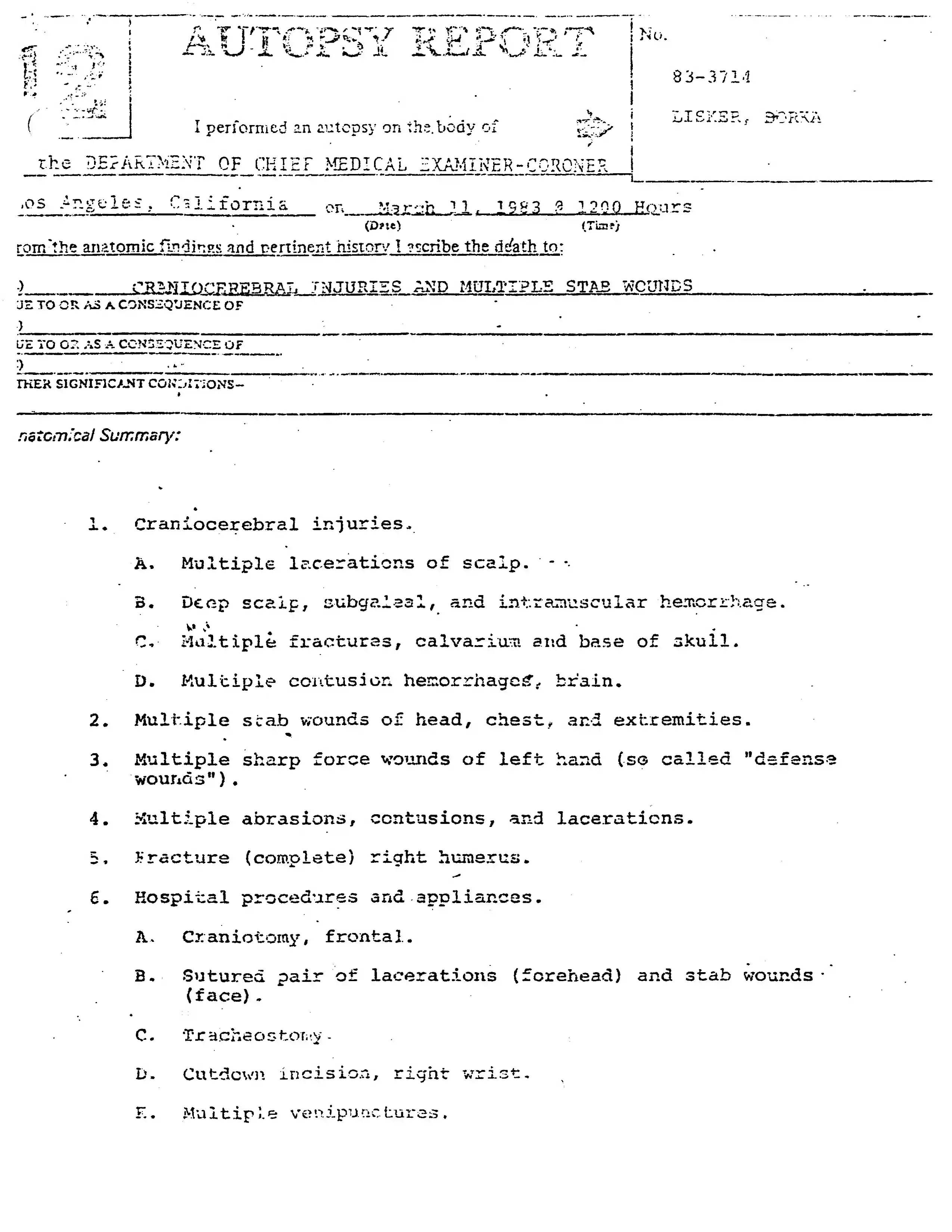
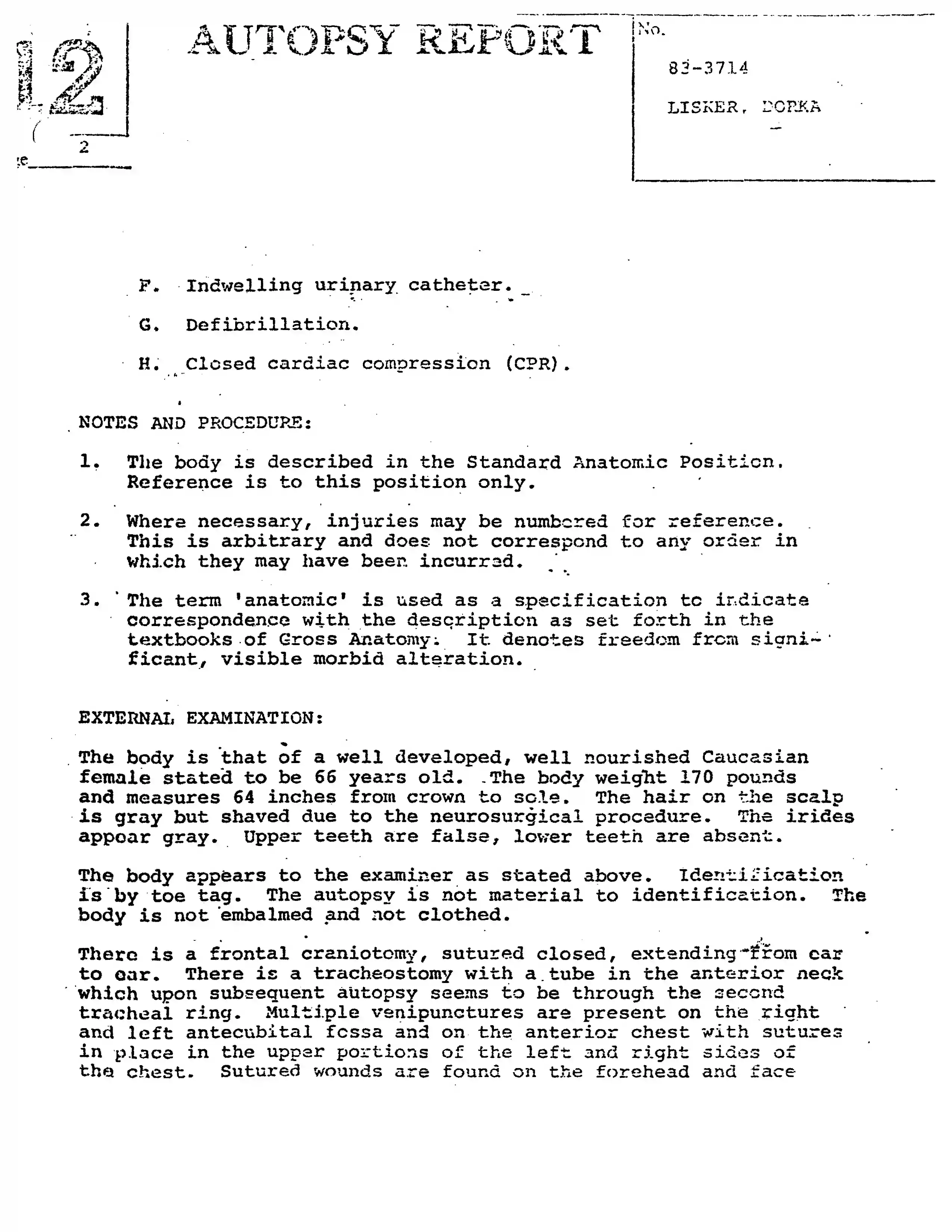
228.
Autopsy Report, page 1
Autopsy Report, page 1.
Autopsy Report, page 2
Autopsy Report, page 2.
Autopsy Report, page 3
Autopsy Report, page 3.
Autopsy Report, page 4
Autopsy Report, page 4.
Autopsy Report, page 5
Autopsy Report, page 5.
Autopsy Report, page 6
Autopsy Report, page 6.
Autopsy Report, page 7
Autopsy Report, page 7.
Autopsy Report, page 8
Autopsy Report, page 8.
Autopsy Report, page 9
Autopsy Report, page 9.
Autopsy Report, page 10
Autopsy Report, page 10.
Autopsy Report, page 11
Autopsy Report, page 11.
Autopsy Report, page 12
Autopsy Report, page 12.
Autopsy Report, page 13
Autopsy Report, page 13.
Autopsy Report, page 14
Autopsy Report, page 14.
229.

[Footnote 229 is not present in the source Footnotes - 1-719.docx. Bruce — please add the citation here.]
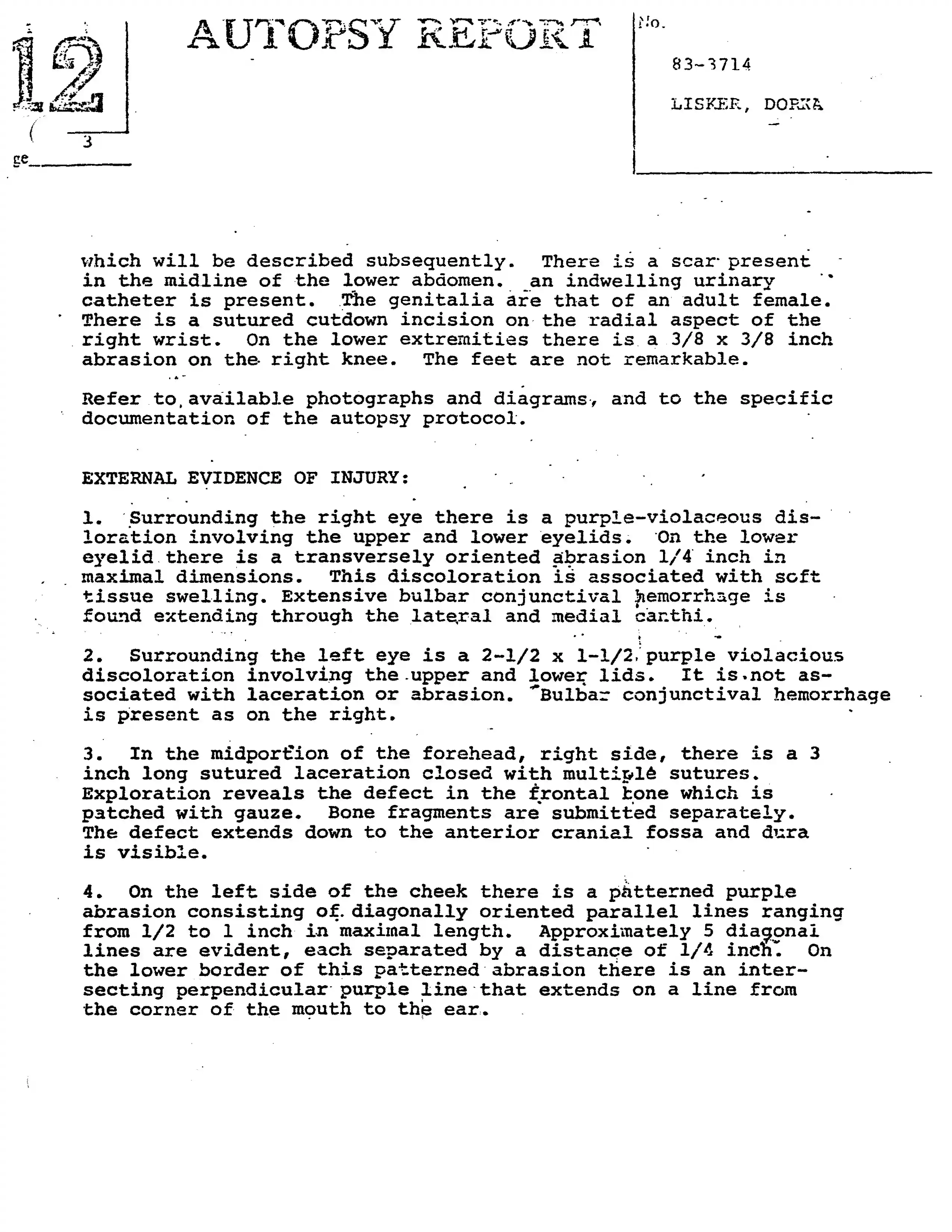
230.
Testimony of LAPD detective Andrew R. Monsue (No. 20927)
Trial
October 31, 1985 – Page 306
Q:"AND YOU SAY THE ONE [footprint] WAS POINTED IN THE DIRECTION OF THE SINK?"
A:"THAT IS CORRECT."
231.
Trial, November 4, 1985, page 304-306
The photo (People's Exhibit 48) featuring the faint, distant footprint, was merely an orientation photograph of the Kitchen, not an "evidence quality" photo featuring the footprint as the subject, in sufficient detail to allow for later analysis.
233.
Footwear Impression Evidence, by William J. Bodziak, CRC Press, 1995
pages 132–160
HIGH-CONTRAST PHOTOGRAPHIC METHODS:
Oblique Light Photography (using high contrast light and/or filters on all types of surfaces); Cross-Polarized Light Photography (employing tr (improves the contrast and allows the gathering of latent footwear impressions in the same manner as fingerprint lifting); Gel and Adhesive Lifting (transfers footwear impressions to surfaces of greater contrast, using gelatin as the transfer medium);
CHEMICAL ENHANCEMENT METHODS:
8-Hydroxyquinoline (reacts with calcium, magnesium, iron, aluminum and other metals, and causes the footweards in fingerprints and blood, turning a color called "Ruhemann's Purple"

A number of methods existed in 1983 which could have revealed details in the footprint(s) lost forever because of the coarse perspective photography police used. These methods include:

HIGH-CONTRAST PHOTOGRAPHIC METHODS: Oblique Light Photography (using high contrast light and/or filters on all types of surfaces); Crosning red); the ever-popular Luminol (reacts to hemoglobin in blood); and Tetramethylbenzidine (TMB) (reacts with blood, turning bluish-green).

CHEMICAL ENHANCEMENT METHODS:8-Hydroxyquinoline (reacts with calcium, magnesium, iron, aluminum and other metals, and causes the footwear impression to fluoresce when exposed to a UV light source); Iodine and 7,8-Benzoflavone (reacts to fatty, oily and other organic materials in footwear impressions, turning yellow-brown); Potassium and Ammonium Thiocyanates (reacts to iron present in footwear impressions, turning reddish brown); Physical Developer (reacts to oily, waxy, or fatty materials in footwear impressions); Small Particle Reagent (SPR) (adheres to fatty materials in latent fingerprints and some footwear impressions); Ninhydrin (reacts with amino acids in fingerprints and blood, turning a color called "Ruhemann's Purple."

234.

[Footnote 234 is not present in the source Footnotes - 1-719.docx. Bruce — please add the citation here.]
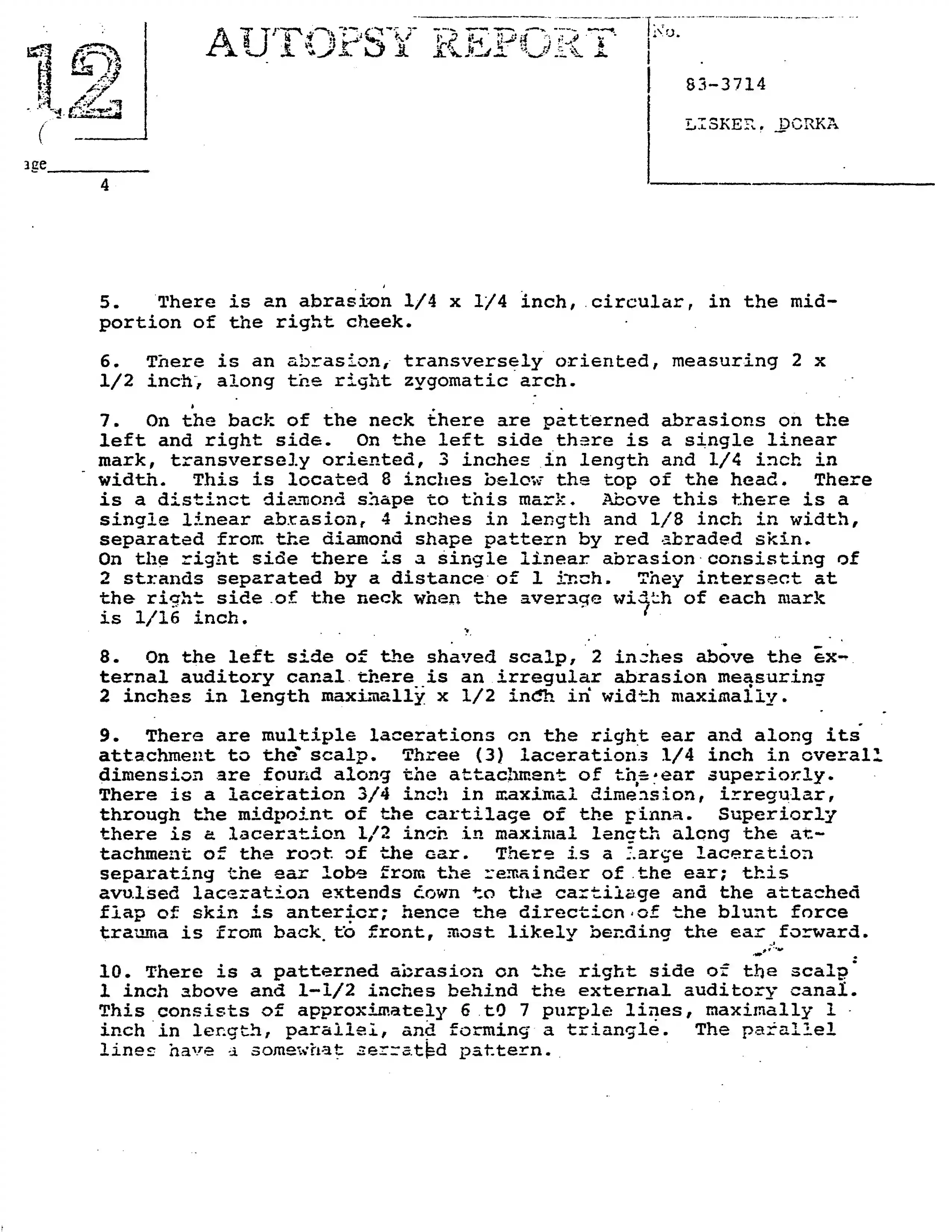
235.
Testimony of LAPD detective Andrew R. Monsue (No: 20927)
Trial
November 5, 1985 – Page 523
Q:"DID YOU DO ANYTHING TO CHECK WITH THE PHONE COMPANY TO VERIFY IF ANY OTHER PHONE CALLS HAD BEEN MADE FROM THAT RESIDENCE?"
A:"NO."
Q:"WAS THE ORDER IN WHICH [Bruce] TOLD YOU HE MADE THE PHONE CALLS IMPORTANT TO YOU?"
A:"I WOULD HAVE LIKED TO HAVE KNOWN IN TERMS. OF THAT BEING IMPORTANT, YES."
Q:"BUT YOU SAW NO IMPORTANCE IN OBTAINING THE PHONE RECORDS; IS THAT CORRECT?"
A:"I SAW NO IMPORTANCE AT ALL."
236.
Testimony of LAPD detective Andrew R. Monsue (No. 20927)
Trial
November 5, 1985 – Page 478
Q:"BY THE WAY, AT SOME POINT IN TIME BRUCE TOLD YOU THAT I BELIEVE YOU SAID HE WENT OVER TO THE IHOP TO MAKE APPLICATION FOR EMPLOYMENT;IS THAT CORRECT?"
A:"THAT IS CORRECT."
Q:"LOOKING AT THE NOTES, THE THREE YELLOW PAGES BEFORE YOU, YOU HAVE SOME INDICATION OF THREE PARTICULAR LOCATIONS BY NAME AS TO THE EMPLOYMENT APPLICATIONS; WOULD THAT BE CORRECT?"
A:"THAT IS CORRECT." [emphasis added]
237.
Testimony of LAPD detective Andrew R. Monsue (No. 20927)
Trial
November 4, 1985 – Page 404
Q:"HOW MANY APPLICATIONS FOR EMPLOYMENT DID YOU FIND IN THE VEHICLE?"
A:"I BELIEVE TWO. I COULD BE MISTAKEN.";
and:
Trial
November 5, 1985 – Page 478-479
Q:"AND IN THE CAR YOU FOUND THREE APPLICATIONS; IS THAT CORRECT?"
A:"IF MY MEMORY SERVES ME RIGHT I FOUND TWO."
238.
LAPD Property Report, dated 3-17-83, 1200 hours
"ON 3-17-83, DETECTIVES EXECUTED A SEARCH WARRANT ON SUSPECT'S VEHICLE, WHICH HAD BEEN IMPOUNDED ON THE DAY OF THE CRIME. THE BELOW LISTED ITEMS WERE RECOVERED ... 40. 1 NOTEBOOK, BLUE SCHOOL TYPE, CONTAINING THREE EMPLOYMENT APPLICATIONS ... MONSUE, A.R. 20927 VNYS HOMI"
239.
Trial, November 5, 1985, page 478
These were admitted as Defense Exhibits M, N, and 0.
240.
Testimony of LAPD detective Andrew R. Monsue (No. 20927)
Trial
November 5, 1985 – Page 479
Q:"DO YOU REMEMBER WHO THOSE APPLICATIONS BELONGED TO? WAS THERE A COMPANY DESIGNATED ON IT, A NAME OF A COMPANY DESIGNATED ON THOSE?"
A:"IN THE CASE OF ONE, THERE WAS IHOP AND I CAN'T BE ABSOLUTELY SURE THERE WAS A COMPANY DESIGNATION ON THE OTHER ONE. I DON'T BELIEVE THERE WAS."
and:
continued at page 501
A:"THERE WERE ONE OR TWO OTHERS [besides IHOP], AND I AM NOT SURE THAT THEY HAD ANY IMPRINTING ON THEM TELLING ME WHERE THEY WERE FROM EXACTLY. THERE WAS SOME HANDWRITTEN NOTES ON TOP OF THEM."
241.
Testimony of LAPD detective Andrew R. Monsue (No. 20927)
Trial
November 4, 1985 – Page 405
Q:"DO YOU REMEMBER WHO THOSE APPLICATIONS FOR EMPLOYMENT, WHAT COMPANY THEY WERE FOR?"
A:"THE ONLY ONE THAT COMES TO MIND IS IHOP. I DON'T KNOW ABOUT THE OTHER.";
and:
Trial
November 5, 1985 – Page 478-479
Q:"... I BELIEVE YOU SAID HE WENT OVER TO THE IHOP TO MAKE APPLICATION FOR EMPLOYMENT; IS THAT CORRECT?"
A:"THAT IS CORRECT."
242.

(Sean in LAPD.Arrest Report, dated 3-10-83)

and LAPD Preliminary Investigation, dated 3-10-83
(Personal Oddities) "AFRO hair"

244.

The premise that violence most often comes from within the victim's own circle is not folk wisdom but a settled finding of federal crime data. As Gavin de Becker put it in The Gift of Fear, "we are most often hurt by those we know."a The Bureau of Justice Statistics confirms the pattern at scale: in 2023, the single largest share of U.S. homicides — 39 percent — was committed by someone outside the family but known to the victim, while strangers accounted for a far smaller share.b The intimate violence figures are more striking still. In 2021, roughly 76 percent of female murder victims and 56 percent of male murder victims were killed by someone they knew; 34 percent of female victims were killed by an intimate partner and another 16 percent by a non-intimate family member — a parent, sibling, or other relative.c Put plainly, when a person is killed in America, the perpetrator is statistically far more likely to be a relative, partner, or acquaintance than a stranger.

a Gavin de Becker, The Gift of Fear: Survival Signals That Protect Us from Violence (New York: Little, Brown, 1997).

b Bureau of Justice Statistics, Homicide Victimization in the United States, 2023 (NCJ 309610, U.S. Dep't of Justice, 2025), https://bjs.ojp.gov/library/publications/homicide-victimization-united-states-2023.

c Bureau of Justice Statistics, Female Murder Victims and Victim-Offender Relationship, 2021 (U.S. Dep't of Justice, 2023), https://bjs.ojp.gov/sites/g/files/xyckuh236/files/media/document/fmvvor21.pdf.

245.
Testimony of LAPD detective Andrew R. Monsue (No. 20927)
Trial
November 5, 1984 – Page 68
Q:"DO YOU REMEMBER TELLING BRUCE THAT SOME OF THE NEIGHBORS SAID THAT 'YOU AND YOUR MOM REALLY DIDN'T GET ALONG VERY WELL AND THAT YOU ARGUED AND FOUGHT A LOT.' DO YOU REMEMBER THAT DURING THE TAPE CONVERSATION?"

Monsue:"YES."

247.
Testimony of LAPD detective Howard W. Landgren (No. 13668)
Preliminary Hearing
October 5, 1983 – Page 38-39
Q:"YOU ARRIVED AT THE LOCATION AT NOON. BEFORE GOING TO THE WINDOW, DID YOU GO INTO THE LOCATION AND MAKE SURVEILLANCE OF THE LOCATION AND LOOK IT OVER?"
A:"YES." ...
Q:"AND THEN YOU WENT TO THE WINDOW TO LOOK INTO THE WINDOW?"
A:"THEN I WENT AROUND THE HOUSE."
Q:"PRIOR TO DOING THAT, DID YOU HAVE A CONVERSATION WITH ANOTHER FELLOW OFFICER CONCERNING A CONVERSATION THAT HE HAD WITH THE DEFENDANT IN THIS CASE?"
A:"YES."
Q:"WHO WAS THAT FELLOW OFFICER?"
A:"I WOULD HAVE TO AGAIN LOOK AT THE HOMICIDE BOOK TO OBTAIN THAT OFFICER'S NAME." [Landgren looks at book] The Witness: "I HAD SPOKEN TO OFFICERS PRADO, P-R-A-D-O), AND DEROUSSEAU, D-E-R-O-U-S-S-E-A-U."
249.
LAPD Follow-Up Investigation
Page 2
"... DETECTIVES NOTED THAT THERE WAS A SMEAR OF BLOOD ON THE TELEPHONE CRADLE BUT NOT ON THE HANDLE PORTION."
and:
Testimony of LAPD detective Andrew R. Monsue (No. 20927)
Trial
October 31, 1985 – Page 250-251
Q:"... NOW, DID YOU MAKE SOME NOTE EITHER THEN OR WHEN YOU CAME BACK TO THE SCENE THAT DAY ABOUT THE TELEPHONE? DID YOU EXAMINE THAT?"
A:"YES, I DID."
Q:"WHAT DID YOU NOTICE ABOUT THE TELEPHONE?"
A:"I NOTICED THAT THERE WAS A SMALL AMOUNT OF BLOOD ON THE ACTUAL BODY." ... "... THERE WAS JUST SOME SMALL SMEARING BLOOD ALONG THE SIDE OF ONE -- ON ONE SIDE OF THAT BODY OF THE PHONE ITSELF.";
and:
Preliminary Hearing
October 5, 1983 – Page 23
Q:"AND WAS ANY BLOOD ON THAT TELEPHONE?"
A:"IT APPEARED TO BE BLOOD ON THE BASE OF THE TELEPHONE BUT NOT ON THE CRADLE OR ON THE HANDLE ITSELF."
Q:"NOT ON THE HANDLE, BY THE HANDLE YOU'RE TALKING ABOUT WHAT ONE ORDINARILY PICKS UP WHEN THEY MAKE A TELEPHONE CALL."
A:"YES."
250.
LAPD Follow-Up Investigation
Page 4
"DETECTIVES OBSERVED THE WINDOW, DIRECTLY ABOVE THE SINK IN THE KITCHEN THAT SUBJECT STATED HE HAD COME THROUGH TO GAIN ACCESS TO THE HOUSE. DETECTIVES NOTED THAT THE BREAK-IN HAD BEEN ACCOMPLISHED WITHOUT DAMAGE TO THE WINDOW GLASS OR THE FRAME OF THE WINDOW.";
and:
Testimony of LAPD detective Andrew R. Monsue (No. 20927)
Trial
October 31, 1985 – Page 275
Q:"AND WHAT DAMAGE, IF ANY, DID YOU SEE TO THE SCREEN?"
A:"I NOTICED NONE."
251.
LAPD Follow-Up Investigation
Page 4
"DETECTIVES EXAMINED THE KITCHEN WINDOW... THERE WERE THREE LOUVERED PANES REMOVED FROM THE WINDOW. DETECTIVES NOTED THE SCREEN HAD BEEN PLACED ON THE GROUND WITH THE LOUVERED PANES LAID VERY ORDERLY ON TOP OF THE SCREEN.";
and:
Testimony of LAPD detective Andrew R. Monsue (No. 20927)
Trial
October 31, 1985 – Page 275
A:"THE PLIERS ARE ON THE GROUND. THE SCREEN IS LAID ON TOP OF THE PLIERS AND THESE I COUNT THREE PANES OF GLASS, ARE LINED UP IN A VERY NEAT ROW ON TOP OF THE SCREEN.";
and:
Trial
November 5, 1985 – Page 456
A:"I INDICATED ON DIRECT EXAMINATION THAT THEY WERE LAID OUT ON TOP OF THE SCREEN IN A NICE ROW."
252.
LAPD Follow-Up Investigation
Page 4
"DETECTIVES ATTEMPTED TO LOOK INTO ALL OF THE WINDOWS IN THE REAR OF THE LOCATION, BUT COULD NOT SEE INSIDE THE HOUSE, WITHOUT PLACING HIS FACE UP AGAINST THE GLASS.";
and:
Trial
October 31, 1985 – Page 269-270
253.
LAPD Follow-Up Investigation
Page 4;
and:
Trial
November 5, 1985 – Page 507
Q:"WHEN YOU WALKED THE OUTSIDE AFTER YOU ARRIVED AT THE SCENE ON MARCH 10, DID YOU SPECIFICALLY LOOK TO SEE IF THERE WERE FOOTPRINTS GOING IN THE OTHER DIRECTION?" (i.e., not one-way]
A:"YES, I DID."
254.
Testimony of LAPD detective Howard W. Landgren (No. 13668)
Preliminary Hearing
October 5, 1983 – Page 11
Q:"DID YOU NOTICE ANYTHING ELSE IN TERMS OF PERSONAL EFFECTS IN BEDROOM #2?"
A:"ON THE DRESSER, WHICH WAS LOCATED AGAINST THE EAST WALL, THERE WAS A SET OF CAR KEYS...";
and:
Id. at page 44
Q:"DID YOU RETRIEVE THE KEYS THAT YOU SAY YOU OBSERVED ON THE DRESSER?"
A:"YES.";
and:
Preliminary Hearing
October 6, 1983 – Page 53
Q:"OTHER THAN THE KEYS THAT YOU STATED THAT YOU FOUND ON THE DRESSER IN THE BEDROOM, DID YOU FIND ANY OTHER SETS OF KEYS WHILE YOU WERE CONDUCTING YOUR INVESTIGATION IN THIS HOUSE?"
A:"NO."
255.
LAPD Follow-Up Investigation
Page 3
"... DETECTIVES NOTED BLOOD SPOTS ON THE WALLS OF THE HALLWAY AND OBSERVED A BASEBALL TROPHY LAYING INSIDE THE MASTER BEDROOM, AGAINST THE CLOSET."
256.
LAPD Follow-Up Investigation
Page 4
"... THERE DIDN'T APPEAR AS IF ANY DRAWER OR CLOSET HAD BEEN GONE THROUGH, AS THE REMAINDER OF THE HOUSE DIDN'T SHOW SIGNS OF RANSACKING OR VANDALISM."
257.
LAPD Follow-Up Investigation
Page 4
"DETECTIVES OBSERVED THE WINDOW, DIRECTLY ABOVE THE SINK IN THE KITCHEN THAT SUBJECT STATED HE HAD COME THROUGH TO GAIN ACCESS TO THE HOUSE. DETECTIVES NOTED THAT THE BREAK-IN HAD BEEN ACCOMPLISHED WITHOUT DAMAGE TO THE WINDOW GLASS OR THE FRAME OF THE WINDOW."
258.
LAPD Follow-Up Investigation
Page 4
"DETECTIVES EXITED THE RESIDENCE AND WALKED AROUND THE RESIDENCE AND OBSERVED ALL THE WINDOWS, AND DOORS, WITH THE EXCEPTION OF THE FRONT DOOR AND THE KITCHEN WINDOW, WERE SECURE FROM THE INSIDE OF THE RESIDENCE."
260.
Testimony of LAPD detective Andrew R. Monsue (No. 20927)
Trial
November 5, 1984 – Page 72
Q:"WELL, WOULD ONE OF THE PURPOSES OF TRYING TO FIND OUT WHAT THE RELATIONSHIP THAT BRUCE HAD WITH HIS MOTHER AT THE TIME OF YOUR INVESTIGATION WAS TO SEE IF BRUCE WAS A POSSIBLE SUSPECT?"
A:"OH, CERTAINLY. EVERYONE ASSOCIATED ON THE HOUSE WOULD HAVE BEEN A SUSPECT AT THAT TIME."
Q:"SO BRUCE WAS A SUSPECT AT THAT TIME BECAUSE HE WAS ASSOCIATED WITH THE HOUSE?"
A:"IN THE SENSE THAT I WOULD LOOK AT HIM IN TERMS OF DOING AN INVESTIGATION, YES."
261.
LAPD Follow-Up Investigation
Page 2;
and:
Testimony of LAPD officer George Prado (No. 17603)
Trial
November 5, 1985 – Page 9
Q:"THE HANDCUFFS WERE BEHIND HIS BACK?"
A:"YES.";
and:
Id. at page 13
Q:"DID YOU ASSIST PLACING THE DEFENDANT IN THE REAR OF OFFICER JOHNSON'S POLICE VEHICLE?"
A:"NO."
Q:"YOU OBSERVED OFFICER JOHNSON DO THAT; IS THAT CORRECT?"
A:"YES."
Q:"WHAT DID YOU OBSERVE OFFICER JOHNSON DO?"
A:"I OBSERVED HIM OPEN THE REAR POLICE VEHICLE DOOR AND PLACE HIM IN THE SEAT AND SHUT THE DOOR. HE [Johnson] WAS STANDING OUTSIDE THE POLICE VEHICLE DOOR WATCHING HIM."
262.
Testimony of Robert B. Lisker, on his arrival at the crime scene, our house, finding me handcuffed in the police car.
Trial (Augmentation - On Motion)
November 6, 1984 – Page 139
Q:"WHEN YOU WALKED OVER TO THE OTHER OFFICER THAT WAS IN THE PATROL UNIT, WHAT DID YOU DO THEN?"
A:"I ASKED IF I COULD TAKE BRUCE WITH ME TO THE HOSPITAL."
Q:"AND WHAT DID THAT OFFICER TELL YOU?"
A:" 'NO.' "; and Id, at page 144
Q:"ALL RIGHT, THEN, YOU WENT OVER TO SEE BRUCE. YOU GAVE HIM A CIGARETTE. YOU ASKED IF YOU COULD TAKE HIM TO THE HOSPITAL AND THE OFFICER SAID 'NO.' DID HE TELL YOU THEY WANTED TO TALK WITH BRUCE?"
A:"HE JUST SORT OF SHOOK HIS HEAD AND DIDN'T REALLY SAY ANYTHING AND THAT'S WHEN I ASKED HIM IF I COULD TALK TO BRUCE. AFTER I ASKED IF I COULD TAKE BRUCE WITH ME, HE JUST SORT OF SHOOK HIS HEAD AND SAID, 'NO' AND THEN I ASKED, 'CAN I TALK TO BRUCE?' "
Q:"AND HE ALLOWED YOU TO DO THAT?"
A:"THAT IS CORRECT."
263.
Testimony of LAPD detective Andrew R. Monsue (No. 20927)
Preliminary Hearing
December 7, 1983 – Page 270
Q:"WHEN YOU TRANSFERRED BRUCE FROM ONE POLICE UNIT TO THE OTHER ONE, WAS HE FREE TO LEAVE?"
A:"AT THAT PARTICULAR TIME, NO."
Q:"WHEN YOU PLACED HIM INTO THE OTHER PATROL UNIT, THE SECOND PATROL UNIT, JUST BEFORE YOU LEFT TO GO TO THE VAN NUYS POLICE STATION, WAS HE FREE TO LEAVE?"
A:"NO."
264.
Testimony of LAPD detective Andrew R. Monsue (No. 20927)
Trial
November 5, 1984 – Page 31
Q:"AT SOME POINT WAS HE TAKEN OUT OF THE HANDCUFFS?"
A:"YES, HE WAS."
Q:"WHERE WAS THAT?"
A:"IT WAS IN THE PARKING LOT OF THE VAN NUYS STATION THE SUBTERRANEAN GARAGE."
265.
Testimony of LAPD detective Andrew R. Monsue (No. 20927)
Preliminary Hearing
December 7, 1983 – Page 264
Q:"DURING THE INTERVIEW THAT YOU CONDUCTED AT THE VAN NUYS STATION, DID BRUCE LISKER EVER ASK YOU IF HE COULD GO HOME?"
A:"YES."
and:
Trial
November 5, 1985 – Page 476
Q:"... WHY DIDN'T YOU TAKE HIM TO THE HOSPITAL AT 1 O'CLOCK IN THE AFTERNOON WHEN HE ASKED IF HE COULD GO SEE HIS MOM?"
A:"BECAUSE I WAS BEGINNING A HOMICIDE INVESTIGATION...";
however, consider:
Preliminary Hearing
December 7, 1983 – Page 278
Q:"COULD YOU POSSIBLY HAVE INTERVIEWED BRUCE LISKER THE NEXT DAY?"
A:"I PROBABLY COULD HAVE. I CHOSE NOT TO."
266.
Testimony of LAPD detective Andrew R. Monsue (No. 20927)
Trial (On Motion)
November 6, 1984 – Page 134
Q:"DID HE INQUIRE SEVERAL TIMES IN THIS TRANSCRIPT HOW HIS MOTHER WAS?"
A:"HE ASKED SEVERAL QUESTIONS ABOUT IT THROUGHOUT THE ENTIRE INTERVIEW AS I RECALL."
Q:"WHAT DID YOU TELL HIM .WHEN HE MADE THOSE INQUIRIES?"
A:"I TOLD HIM I DID NOT KNOW."
Q:" 'WE WILL FIND OUT LATER'?"
A:"THAT IS CORRECT.";
and:
Trial
November 5, 1985 – Page 476
Q:"SO AT THAT POINT IN TIME YOU COULDN'T BE CONCERNED ABOUT HIS QUESTIONS ABOUT HIS MOTHER OR HOW SHE WAS DOING OR ANYTHING LIKE THAT; IS THAT CORRECT?"
A:"THAT IS INCORRECT."
Q:"AT ANY POINT DURING THE ENTIRE INTERVIEW DID YOU CALL ON HIS BEHALF TO SEE HOW HIS MOTHER WAS DOING?"
A:"I PERSONALLY DID NOT."

And contrary to Monsue's apparent implication, neither did anyone else. My dad was the one who told me my mom had died when he came to Van Nuys police station.

and:
Id. at page 491-492
Q:"WHEN HE ASKED YOU AT THAT POINT ON PAGE 32 OF THAT TRANSCRIPT, 'CAN YOU CALL TO SEE IF SHE IS OKAY?' DID YOU ATTEMPT TO SEE HOW HIS MOTHER WAS DOING FOR HIM?"
A:"I DID NOT LEAVE THE ROOM, NO.";
and:
Id. at page 459
Q:"DURING THE COURSE OF THE INTERVIEW AT THE VAN NUYS STATION, DID BRUCE ASK YOU HOW HIS MOTHER WAS?"
A:"I BELIEVE HE DID ONCE, YES."

But recall that Monsue had earlier testified that I'd "ASKED SEVERAL QUESTIONS ABOUT IT THROUGHOUT THE. ENTIRE INTERVIEW". (Nov 6 1984, -above).

267.
Testimony of LAPD detective Andrew R. Monsue (No. 20927)
Trial
November 5, 1985 – Page 477
Q:"WHEN BRUCE ASKED YOU ABOUT WASHING HIS HANDS PRIOR TO COMMENCING THE INTERVIEW, WHY DIDN'T YOU LET HIM GO WASH HIS HANDS?"
A:"BECAUSE I WAS IN THE A PROCESS OF CONDUCTING AN INTERVIEW."
and:
Testimony of LAPD detective Andrew R. Monsue (No. 20927)
Trial
November 4, 1985 – Page 414
Q:"… BRUCE HAD NOT HAD AN OPPORTUNITY TO WASH HIS HANDS PRIOR TO YOUR COMPLETING THAT TAPED INTERVIEW; IS THAT CORRECT?"
A:"THAT IS CORRECT."

Strikingly little compassion for a youngster whom Monsue steadfastly maintained had been no worse off than being considered a possible witness to the attack on his mother. During the interrogation, Monsue used the prospect and promise of my finally being able to wash my mother's gore from my hands as a tool of influence as we discussed my waiving my Miranda rights. He dangled the hand-washing, further linked to my actual release from custody, like a Constitutionally tainted carrot. Consider:

Testimony of LAPD detective Andrew R. Monsue (No. 20927)
Trial (On Motion)
November 9, 1984 – Page 104, where Defense Counsel reads from the Monsue/Lisker Interrogation Transcript, March 10, 1983 – Page 26:
"LISKER SAYS, 'CAN I WASH MY HANDS?' MONSUE SAYS, 'IN A FEW MINUTES, YEAH, WHEN WE ARE DONE TALKING I WILL LET YOU GO DOWN AND WASH THEM. AND SO YOU WILL GIVE UP YOUR RIGHT TO REMAIN SILENT AND YOU ARE GOING TO TALK TO ME WITHOUT — AND YOU DON'T WANT AN ATTORNEY. RIGHT NOW; IS THAT CORRECT?'"

Monsue told me I could wash my hands after we talked, but in order to talk I first had to waive my rights. That's called coercion. Against an adult, able to fend for himself, it would nevertheless have been illegal. But against me — a teenager, ill-equipped to deal with such intense pressure from an adult authority figure, having minutes earlier been completely blasted emotionally by the discovery of my brutalized, bloody, and dying mother — it is reprehensible.

268.
Appellate Decision, page 12
"... THE PEOPLE HAVE FAILED TO SUSTAIN THEIR BURDEN OF PROVING THAT APPELLANT WAS NOT IN CUSTODY IN A CONSTITUTIONAL SENSE, AS HE COULD REASONABLY HAVE BELIEVED HE WAS DEPRIVED OF HIS FREEDOM OF ACTION. HE SHOULD HAVE BEEN ADVISED OF HIS CONSTITUTIONAL RIGHTS AT THE OUTSET OF THE INTERVIEW.";

The Court, however, was content to label the error "harmless" and move on:

Appellate Decision, page 14
"THE CHALLENGED STATEMENTS PALE IN SIGNIFICANCE WHEN CONSIDERED WITH THE REMAINING, OVERWHELMING EVIDENCE CONNECTING APPELLANT WITH THE MURDER."

"Overwhelming evidence" — meaning the tainted, paid-for testimony of the lying jailhouse snitch Robert Donald Hughes [Cf. § V], which the State manufactured by illegally placing me in the 7000 Module snitch tank [Cf. § VI]. Or the State's own blood expert, who testified that every bloodstain detective Monsue claimed implicated me [Cf. § III (1)] could just as easily have come from the innocent first aid I told Monsue I had rendered [Cf. § III (2) (a)]. Or the 'footprints in the dirt' [Cf. § VIII] and 'visibility through the rear windows' [Cf. § IX] questions, which implicated me in nothing — more sparks Monsue threw into the tinder in his effort to start a fire of suspicion he could not start with facts. This is what the Court was willing to call "overwhelming" in denying me a new and fair trial.

270.
Testimony of LAPD officer George Prado (No. 17603)
Trial
November 13, 1985 – Page 833,
Q:"NOW, WHEN YOU GOT OUT OF YOUR POLICE VEHICLE AND SAW ... BRUCE WALKING IN A HURRIED MANNER TOWARDS THE PARAMEDICS, WHAT DID YOU HEAR HIM SAYING, IF ANYTHING?"
A:"HE STATED THAT HIS MOTHER HAD JUST BEEN STABBED AND TO HELP HER."
Q:"AND WHAT TONE OF VOICE WAS HE USING?"
A:"WELL, HE WAS QUITE EXCITED."
Q:"CAN YOU DESCRIBE THAT FOR US?"
A:"HE CAME OUT YELLING, SCREAMING. [emphasis added]"
271.
Testimony of LAPD detective Andrew R. Monsue (No. 20927)
Trial
November 5, 1984 – Page 45
A:"I SPOKE BRIEFLY WITH THE NEIGHBORS WHO LIVE DIRECTLY EAST OF THE LOCATION..."
Q:"DID YOU ASK THEM IF THEY HAD SEEN ANYTHING?"
A:"BASICALLY THAT AND I ASKED THEM IF THEY HAD HEARD ANYTHING AND SEEN ANYTHING UNUSUAL IN THE NEIGHBORHOOD THAT DAY AND THEY INDICATED THEY HAD NOT."

That answer doesn't survive the rest of the record. By the time the paramedics arrived I was in the driveway in front of our house, screaming at them — independently confirmed by both law enforcement and fire department personnel on scene. The neighbors directly east apparently heard none of it.

272.
LAPD Follow-Up Investigation
Page 10
"DETECTIVES ALSO QUESTIONED [Robert Lisker] ABOUT THE PHYSICAL CONDITIONS OF THE HOUSE. DURING THIS INTERVIEW, DETECTIVES LEARNED THAT MR. LISKER HAD GIVEN SUBJECT THE EXERCISE BAR THAT WAS FOUND IN THE MASTER BEDROOM. MR. LISKER STATED HE KNEW THAT SUBJECT HAD EITHER PUT IT IN HIS ROOM OR TAKEN IT TO HIS APARTMENT. HE STATED THAT HE DID NOT RECALL THE EXERCISE BAR BEING IN THE MASTER BEDROOM WHEN HE LEFT THE HOUSE AT 0730 HOURS, THAT MORNING, BUT IF IT HAD BEEN, HE THOUGHT HE WOULD HAVE SEEN IT."

⚠ Warning — explicit content.

The claim never made it into court. It surfaces only in the Follow-Up report — and my father's sworn testimony contradicts it outright. The Bullworker exercise bar wasn't mine. It was a Christmas gift my mother and I had given him a few years prior, and I do not believe it had ever, even once, left the house. There was no conceivable reason it would have. It lived where he used it: in their bedroom, directly beneath its exercise-routine wall chart, still taped above the spot where police found it — visible together in LAPD crime-scene photograph #112‑075 taken that tragic day.

Police photo showing exercise bar and wall chart taped above it.
Police photo #112-075 showing Bullworker exercise bar (silver cylinder with Green handle) and associated exercises chart above it, taped to wall.
Closeup of the exercise bar, with bottom right edge of the wall chart above.
A Bullworker exercises wall chart exactly matching the one taped to the wall in crime scene photos. Located for sale online October 23rd 2017.
Another Bullworker exercise chart I located online. Better image quality, but not identical to the actual one we owned.
273.
Testimony of Robert B. Lisker
Trial
October 31, 1985 – Page 225
Q:"AND THE EXERCISE BAR WHICH IS PEOPLE'S 3, WHERE WAS THAT GENERALLY KEPT?"
A:"KEPT IN THE MASTER BEDROOM WHICH WAS DESIGNATED AS BEDROOM 1 NEXT TO THE LAUNDRY BASKET."

Exactly where it was found by police.

And:
LAPD Follow-Up Investigation
Page 3
"ALSO IN THE MASTER BEDROOM, RESTING AGAINST THE WESTERN WALL, NEXT TO THE DRESSING TABLE, WAS AN EXERCISE BAR. THE BAR WAS APPROXIMATELY 3 FEET LONG AND 2½ OR 3 INCHES IN DIAMETER. ON ONE END OF THE BAR, THERE WERE BLOOD STAINS."
274.

LAPD Arrest Report, dated 3-10-83;

and LAPD Follow-Up Investigation

275.

LAPD Death Investigation

276.
Los Angeles County Autopsy Report No. 83-3174 (Lisker, Dorka G.)
Page 2, and included Coroner's Case Report, and included Coroner's Fingerprint Exemplar;
and:
Trial (Stipulation)
October 29, 1985 – Page 107
Mr. Mulcahy:"... WE WOULD OFFER TO STIPULATE THE LENGTH OF DORKA LISKER WAS 64 INCHES AND THE WEIGHT AT THE TIME OF AUTOPSY WAS 170 POUNDS."
Mr. Rabichow:"SO STIPULATED. THAT IS FIVE FEET FOUR INCHES AND 170 POUNDS."
The Court:"FIVE FEET FOUR, 170 POUNDS AT THE TIME OF THE AUTOPSY. THAT IS STIPULATED BETWEEN COUNSEL."
277.
Letter from Robert Felt, M.D., the Lisker family physician
On practice letterhead
May 26, 1998
"This letter is to verify that on January 14, 1983 at an office visit, Mr. Lisker's weight was 97 pounds."

Three months before Hughes ran his jailhouse-Christian-conversion con on me in a County Jail cell, I weighed 97 pounds. Hughes was a former combat Marine and a career criminal whose entire adult life had been spent cycling through jails and prisons. He told a jury he had been afraid of me. Afraid of a 97-pound teenager. The fear was theater. The conversion was a fiction. Both were sold to a credulous prosecution in exchange for a discount on the sentence his record had earned many times over. He wasn't afraid. He was working a con. The State bought it.

Letter on physician's letterhead from Dr. Robert Felt, the Lisker family doctor, dated May 26, 1998, verifying from his medical records that Bruce Lisker weighed 97 pounds at an office visit on January 14, 1983.
Dr. Robert Felt, the Lisker family physician, on his own letterhead, drawing on his contemporaneous medical chart: Bruce weighed 97 pounds on January 14, 1983. Fifty-five days before the arrest. Roughly three months before Hughes began telling his jailhouse story about the teenager he claimed to fear.
Sworn declaration of Dr. Robert Felt, M.D., executed September 14, 2000 under penalty of perjury under the laws of the State of California, on attorney Frederick I. Marr's letterhead, attaching the May 1998 letter as Exhibit 1 and substantiating from his medical records that Bruce Lisker weighed 97 pounds on January 14, 1983.
Two years later, the same fact wrapped in legal armor — Dr. Felt's formal declaration of September 14, 2000, sworn under penalty of perjury, attaching the 1998 letter as Exhibit 1. Bulletproof. And never put to the jury that took Hughes at his word.
279.
Trial, November 12, 1985, page 217
Per State stipulation, fingerprint evidence was recovered from the following locations, and only the following locations, at the crime scene and on pieces of recovered evidence:
1. The right palmprint of Bruce Lisker was found on the Kitchen window sill through which he entered after seeing his mother on the Entry Hall floor; 2. The right thumbprint of Bruce Lisker was found on one of the louvered Kitchen window panes Bruce removed to gain entry through that window; 3. A fingerprint of an unknown person, not Bruce and not Mrs. Lisker, was found in the Kitchen window area (not further specified); 4. The left index fingerprint of Bruce Lisker was found on the blade of the wide-bladed search knife, People's Exhibit 6. (Presumably, though the precise location was never identified, the fingerprint was directly adjacent the handle., where one holding the knife by its handle might be expected to place his finger.) and; 5. The fingerprint of Mrs. Lisker (not further specified) was recovered from a pink piece of paper found in her purse.
280.
Testimony of LAPD detective Andrew R. Monsue (No. 20927)
Dennis H./William M. Juvenile Detention Hearing
April 4, 1983 – Page 45
Q:"NOW, THE OTHER TWO KNIVES THAT YOU FOUND AT ANOTHER LOCATION (i.e., the search knives], THE LARGER KNIVES WHICH YOU DESCRIBED, I THINK, AS UTILITY KNIVES, WERE THERE ANY WOUNDS ON THE BODY THAT THE CORONER INDICATED WERE CONSISTENT WITH A BLOW FROM ONE OF THESE KNIVES?"
A:"YES, SIR. THERE WAS ONE STAB WOUND TO THE FACE THAT WAS APPROXIMATELY, THE CORONER DESCRIBED IT AS AN INCH AND A QUARTER WIDE AND HAD A CONSISTENT SHAPE COMPARABLE TO THE TWO KNIVES THAT HE INDICATED HE [Bruce] HAD PICKED OUT OF THE DRAWERS." [emphasis added]
281.

With the exception of the defensive slash wounds on the left hand, which the Coroner similarly indicated could have been caused by sharp instruments of any type or size.

Testimony of Medical Examiner Irwin L. Golden
Trial
November 28, 1984 – Page 244-245
Q:"IS IT FAIR TO SAY AS FAR AS THE WOUNDS ON THE HAND, THE DEFENSIVE WOUNDS, ALL YOU CAN TELL IS THAT IT WAS A SHARP INSTRUMENT? YOU CAN'T TELL ANYTHING ABOUT THE SIZE OF THE SHARP INSTRUMENT THAT DID IT?"
A:"PRETTY MUCH SO THAT IS CORRECT..."

It is illogical that if I were the attacker, I would have incorporated the search knives into the attack [Cf. § IV (10); § V (3) (a) through (d), (4)]. Why would I have said I'd used them to search the house, if I'd just attacked my mom with them and thereby gotten her blood on them? And why would I have attacked her with knives I'd retrieved, according to the police theory only to create an alibi? And if I were the attacker, why would I have selected "knives from our kitchen" as an alibi, if I'd just attacked my mom with other "knives from our kitchen"? Finally, the width of the two deep stab wounds precluded with of the search knives' having caused them; the knives were wider across than the wounds' entry points.

282.
Testimony of Medical Examiner Irwin L. Golden
Trial
November 28, 1984 – Page 217
Q:"WERE THERE ANY OTHER EXTERNAL INJURIES NOW, THAT WE HAVEN'T COVERED YET?"
A:"YES, THERE WAS. WE ARE ONLY TALKING ABOUT STAB WOUNDS OF THE TORSO. THERE WAS ONE OTHER WOUND WHICH APPEARED TO BE A STAB WOUND THAT WAS ON THE RIGHT CHEEK JUST BELOW THE EYELID. THIS WAS CHANGED AT THE HOSPITAL. THEY SUTURED THIS WOUND. BUT AFTER REMOVING THE SUTURE IT MEASURED ONE AND A QUARTER INCHES IN LENGTH. IT WAS CLOSED WITH BLACK SUTURE. AFTER REMOVAL OF THE SUTURE, IT ALSO APPEARED TO HAVE A SQUARED OFF OR FLATTENED EDGE. THAT AGAIN MAKING IT AN APPARENT STAB WOUND BY A BLADED INSTRUMENT." [emphasis added]

In reporting only that the wound "WAS CHANGED AT THE HOSPITAL. THEY SUTURED THIS WOUND."

Dr. Golden does not accurately reflect the degree of "CHANGE" which the wound was subjected to. In fact, doctors likely enlarged it surgically, cutting it open with a scalpel before packing it tightly, down to the bone with gauze material and sewing it closed. [Note #283] Any observation of the wound's texture, shape, or size was thus rendered completely unreliable for purposes of forensic comparison, such as connecting its apparent "SQUARED OFF OR FLATTENED EDGE" to any weapon, this edge, and the overall size, having likely been altered prior to Dr. Golden's examination.

283.
Testimony of Medical Examiner Irwin L. Golden
Trial
November 28, 1984 – Page 217-218
A:"... A STAB WOUND THAT WAS ON THE RIGHT CHEEK JUST BELOW THE EYELID. THIS WAS CHANGED AT THE HOSPITAL. " ...
Q:"... WOULD THEY [doctors] HAVE ANY REASON TO CUT IT OPEN WIDER OR LONGER...?"
A:"THEY COULD, YES.";
and:
Preliminary Hearing
October 6, 1983 – Page 78
A:"... AND THE 5TH [stab] WOUND IS ON THE RIGHT CHEEK, WHICH HAD ALREADY BEEN SUTURED BY THE SURGEON, ONE AND A 4TH INCHES LONG. IT WAS PACKED WITH GAUZE AND WENT DOWN INTO THE CHEEKBONE WHICH HAD BEEN FRACTURED, SO IT WAS SURGICALLY ALTERED. I CAN'T GIVE YOU THE EXACT LENGTH BECAUSE IT WAS PACKED. IT WAS ALTERED AT THE HOSPITAL.";
and:
Trial
November 28, 1984, page.218
Q:"... WOULD THE DOCTORS HAVE ALTERED THAT LENGTH? THAT IS, WOULD THEY HAVE ANY REASON TO CUT IT OPEN WIDER OR LONGER BEFORE SUTURING IT?"
A:"THEY COULD, YES. MAYBE IF THEY WANTED TO SEE HOW DEEP IT WENT IN OR TRIED TO SEE IF IT `INVOLVED A MAJOR VESSEL, THEY COULD." [View Autopsy Diagram]
284.
LAPD Follow-Up Investigation
Page 2
285.
Testimony of LAPD officer Douglas R. Johnson (No. 12878), who stood directly above me as I sat in the locked and guarded rear seat of the police car at our curb, prior to my transport to Van Nuvs police station
And:
Trial
November 13, 1985 – Page 823-824
Q:"DID YOU OBSERVE BRUCE'S HANDS?"
A:"NO." ...
Q:"... I TAKE IT THE REASON YOU DIDN'T OBSERVE HIS HANDS IS THAT THEY WERE BEHIND HIS BACK?"
A:"THAT IS CORRECT."
Q:"AND WHEN HIS HANDS WERE BEHIND HIS BACK, YOU COULD NOT OBSERVE HIS FOREARMS OF HIS ARMS BECAUSE THEY WERE ALSO BEHIND HIS BACK?"
A:"THAT IS CORRECT.";
and:
Testimony of LAPD officer George Prado (No. 17603)
Id. at page 844
Q:"AND THE HANDCUFFS THAT YOU AND YOUR PARTNER PLACED ON HIM, THEY WERE AROUND HIS BACK, HIS HANDS WERE BEHIND HIS BACK?"
A:"YES."
286.
Testimony of LAPD detective Andrew R. Monsue (No. 20927)
Trial
December 4, 1984 – Page 511
A:"WELL, WHEN I ACTUALLY ARRIVED ON SCENE, THE FIRST THING THAT I DID WAS GO UP AND VIEW THE FRONT PORCH OF THE RESIDENCE."

That is, he did not approach me, Johnson or the police vehicle;

and:
Trial
November 4, 1985 – Page 438
Q:"AFTER YOU SURVEYED THE SITUATION ON HUSTON STREET ON MARCH 10, 1983, YOU THEN PROCEEDED TO A PATROL UNIT?"
A:"AFTER CONFERRING WITH MY OTHER DETECTIVES EVENTUALLY I DID GET IN A CAR, YES."
Q:"AND IS THAT THE FIRST TIME THAT YOU SAW BRUCE?"
A:"YES, WHEN I WENT TO THE CAR."
Q:"BRUCE WAS IN WHAT CAR AT THAT POINT IN TIME?"
A:"HE WAS IN THE REAR SEAT OF A BLACK AND WHITE POLICE CAR...".
and:
Preliminary Hearing
December 7, 1983 – Page 254
Q:"AND AT THE TIME THAT YOU OBSERVED BRUCE LISKER, WITHIN THAT MOMENT OR TWO YOU GOT OUT OF THE POLICE CAR [in which you arrived at the crime scene], WHERE WAS HE?"
A:"HE WAS SEATED IN THE BACK SEAT OF A POLICE VEHICLE WHICH WAS PARKED IN FRONT OF THE RESIDENCE JUST TO THE WEST OF HIS PARENTS' HOUSE." ...
Q:"WHEN YOU OBSERVED BRUCE LISKER IN THE CAR WHEN YOU GOT OUT OF YOUR VEHICLE, DID YOU APPROACH THAT POLICE VEHICLE AT ALL WHERE BRUCE LISKER WAS SEATED?"
A:"NOT IMMEDIATELY, NO." ... "THERE WAS ONE OFFICER STANDING THERE."
Q:"OUTSIDE THE VEHICLE?"
A:"HE WAS OUTSIDE THE VEHICLE, I BELIEVE, YES."
Q:"AND BRUCE LISKER WAS SEATED IN THE REAR SEAT OF THAT POLICE VEHICLE?"
A:"THAT'S CORRECT.";
and:
Dennis H./William M. Juvenile Detention Hearing
April 4, 1983 – Page 69
Q:"WHEN YOU ARRIVED AT THE SCENE AT NOON TIME YOU SAW BRUCE IN THE BACKSEAT OF A POLICE VEHICLE; IS THAT RIGHT?"
A:"THAT'S RIGHT." ...
Q:"AND HE WAS HANDCUFFED; IS THAT RIGHT?"
A:"I DON'T KNOW WHETHER HE WAS AT THAT POINT."
Q:"WAS HE WEARING ANYTHING ON HIS FEET AT THAT TIME?"
A:"I DID NOT SEE HIM AT THAT POINT."

Contrast that once the Miranda issue arose, and Monsue had an interest in claiming I wasn't a suspect until well after my transport to Van Nuys station and the commencement of my interrogation, he flip-flopped. He then claimed that he hadn't even seen me in the car upon arrival. That way he could deny awareness of blood on my hands and my supposedly 'ripped' shirt, things he later claimed made me a suspect in his eyes.

Trial
November 4, 1985 – Page 407
Q:"AT THAT POINT IN TIME DID YOU OBSERVE BRUCE?"
A:"I DON'T HAVE ANY INDEPENDENT RECOLLECTION OF THAT." ...
Q:"DID YOU OBSERVE HIM BEFORE YOU ENTERED THE RESIDENCE?"
A:"I DON'T BELIEVE I DID. I DON'T RECALL THAT.";
and:
Id. at page 415
Q:"... SO AM I CORRECT IN STATING THAT AFTER YOU ARRIVED AT THAT LOCATION YOU WALKED INTO THAT RESIDENCE SHORTLY AFTER YOUR ARRIVAL?"
A:"YES."
Q:"AND THAT AS YOU ENTERED THAT RESIDENCE THAT FIRST TIME YOU STILL HAD NOT SEEN WHERE BRUCE LISKER WAS; IS THAT CORRECT?"
A:"I MAY HAVE BEEN INFORMED BUT I DON'T RECALL KNOWING..."
Q:"WHAT I AM ASKING YOU IS DO YOU RECALL SEEING HIM BEFORE ENTERING THE RESIDENCE?"
A:"I DON'T HAVE ANY INDEPENDENT RECOLLECTION OF THAT, NO."
289.
Testimony of LAPD detective Andrew R. Monsue (No. 20927)
Monsue reported he "HAD A BRIEF DISCUSSION ABOUT HIM BEING THE SON OF THE HOUSE AND HAVING LIVED THERE." -- nothing more;
and:
Trial
November 5, 1984 – Page 45
A:"I SPOKE BRIEFLY WITH THE NEIGHBORS WHO LIVE DIRECTLY EAST OF THE LOCATION..." ...
Q:"DID YOU ASK THEM ANYTHING ABOUT THE DEFENDANT HERE, BRUCE LISKER?"
A:"WE DID HOLD A CONVERSATION AS TO WHETHER HE LIVED THERE AND, YES, THEY DID KNOW HIM AS BEING -- LIVING THERE AT ONE TIME. OTHERWISE, HE WAS THE SON FROM THAT HOUSE, BASICALLY."
Q:"DID YOU ASK THEM IF THEY SAW WHEN HE ARRIVED AT THE HOUSE?"
A:"I AM NOT SURE THAT I REALLY WENT INTO THAT MUCH DETAIL WITH THEM AT THAT PARTICULAR TIME ... IT WAS JUST A VERY BRIEF CONVERSATION ABOUT ANYTHING UNUSUAL IN THE NEIGHBORHOOD I BELIEVE AT THAT PARTICULAR TIME."
290.
Testimony of LAPD detective Andrew R. Monsue (No. 20927)
Trial
November 5, 1984 – Page 68
Q:"DO YOU REMEMBER TELLING BRUCE [during the interrogation] THAT SOME OF THE NEIGHBORS SAID THAT 'YOU AND YOUR MOM REALLY DIDN'T GET ALONG VERY WELL AND THAT YOU ARGUED AND FOUGHT A LOT.' DO YOU REMEMBER DURING THAT TAPED CONVERSATION?"
A:"YES.";
and:
Id. at page 103-104
Q:"IN ADDITION, AT THAT TIME THAT YOU WENT TO THE POLICE STATION ... YOU KNEW THAT BRUCE'S RELATIONSHIP WITH HIS MOTHER WAS NOT VERY GOOD?"
A:"THAT IS CORRECT."
291.
Testimony of LAPD detective Andrew R. Monsue (No. 20927) concerning his arrival at the crime scene
Trial
October 31, 1985 – Page 242
Q:"AND DID YOU ARRIVE AT THE SAME TIME WITH ANY OTHER DETECTIVES?"
A:"YES, MYSELF AND THREE OTHER DETECTIVES."
Q:"WHAT WERE THEIR NAMES?"
A:"ONE WAS LIEUTENANT LEE DURRER WHO WAS OUR COMMANDING OFFICER, DETECTIVE ROGER PIDA, P-I-D-A, WHO WAS OUR SUPERVISOR AND MY PARTNER, DETECTIVE HOWARD LANDGREN."
Q:"HOWARD LANDGREN WAS YOUR PARTNER AT THAT TIME?"
A:"THAT IS CORRECT.";
and:
Id. at page 243
Q:"OKAY. DID YOU ALL BASICALLY ARRIVE PRETTY MUCH SIMULTANEOUSLY?"
A:"YES, SIR."
292.
Testimony of LAPD detective Howard W. Landgren (No. 13668)
Preliminary Hearing
October 5, 1983 – Page 34
Q:"NOW, WHEN YOU ARRIVED AT THE LOCATION, WAS DETECTIVE MONSUE THERE?"
A:"YES."
Q:"HE WAS ALREADY THERE BEFORE YOU ARRIVED?"
A:"YES."
Q:"WAS HE IN THE RESIDENCE WHEN YOU ARRIVED OR OUTSIDE?"
A:"I BELIEVE HE WAS INSIDE."
293.
LAPD Chronological Log, Entry for 3-10 (83)
"1215 LT. DURRER & DET. MONSUE ARRIVED AT THE CRIME SCENE";
and "1215 DETS PIDA AND LANDGREN ARRIVED AT ENCINO HOSPITAL";

and "1230 DETS PIDA &pLANDGREN ARRIVED AT THE CRIME SCENE"

294.
Testimony of LAPD detective Andrew R. Monsue (No. 20927)
Trial
November 6, 1984 – Page 90
Q:"AND YOU LOOKED INTO THE WINDOWS TO SEE WHAT YOU COULD SEE AS YOU WERE WALKING THE EXTERIOR OF THE RESIDENCE; IS THAT CORRECT?"
A:"WELL, I WAS UP TO THE WINDOWS, TOUCHING THE WINDOWS TO CHECK TO SEE IF THEY WERE SECURE. OBVIOUSLY, I WOULD HAVE LOOKED THROUGH THEM AT THAT TIME."
295.
Testimony of LAPD detective Andrew R. Monsue (No. 20927)
Trial
November 6, 1984 – Page 90
Q:
BY MR. MULCAHY:"DID YOU RECEIVE THIS INFORMATION AS TO WHAT BRUCE LISKER DID BEFORE YOU LOOKED INTO THE WINDOWS?"
A:"I DON'T BELIEVE I HAD AT THAT TIME.";
and:
Id. at page 94
Prior to the interrogation, "I HAD NO IDEA WHICH WINDOWS BRUCE LOOKED IN. I WAS TOLD 'WINDOWS.' "
296.
Testimony of LAPD detective Andrew R. Monsue (No. 20927) reading from the Monsue/Lisker Interrogation Transcript, March 10, 1983
Trial
November 4, 1985 – Page 358
A:"YES, BEGINNING WITH THE SECOND STATEMENT ON THE PAGE BY LISKER, THE LAST PORTION OF THAT OR I SHOULD SAY THE LAST SENTENCE OF THAT ENTRY 'THESE BUSHES RIGHT HERE.' MONSUE RESPONDS AND THEN LISKER SAYS, 'THAT'S WHERE YOU WILL FIND THE MAGNETIC THING.' AT THAT PARTICULAR POINT, HE POINTED TO THE LOCATION DIRECTLY BELOW THE LIVING ROOM WINDOW IN THAT PLANTER AREA WE HAD SPOKEN ABOUT PREVIOUSLY."
297.

Complete absence in LAPD Follow-Up Investigation;

Testimony of LAPD detective Andrew R. Monsue (No. 20927) concerning the Hide-A-Key case
Trial
November 5, 1985 – Page 495-496
Q:"DID YOU MARK ANYWHERE IN THE REPORT THAT YOU HAD DISCOVERED AND WHERE YOU HAD DISCOVERED THAT PIECE OF EVIDENCE?"
A:"NO, I DON'T BELIEVE THAT WAS EVER DOCUMENTED ON ANY REPORT."
298.
Trial, November 12, 1985, page 766-767
Per State stipulation, blood was found on the following evidence:
1. On the blade and handle of the narrow-blade search knife (People's Exhibit 7). The quantity was insufficient for further testing; 2. On the handle of the wide-blade search knife (People's Exhibit 6). The blade tested negative for blood; 3. On the shoes (People's Exhibits 11-A and 11-B), six areas of blood: five greater than 0.5 cm in diameter, and one less than 0.2 cm in size; 4. On the plaid shirt (People's Exhibit 12) there were various stains testing positive for blood. Four were larger than 0.5 cm in size, and four were less than 0.2 cm in size, and; 5. On the corduroy pants (People's Exhibit 14) there were various stains testing positive for the presence of blood.
299.
Testimony of LAPD detective Andrew R. Monsue (No. 20927)
Trial
November 4, 1985 – Page 409
Q:"THE MAGNETIC KEY HOLDER, DID YOU EVER FIND IT?"
A:"YES, I DID." ...
Q:"YOU YOURSELF, FOUND IT?"
A:"THAT IS CORRECT." ...
Q:"DID YOU FIND THAT BEFORE OR AFTER YOU WENT TO INTERVIEW BRUCE LISKER?"
A:"WELL, I FOUND THAT AFTER.";
and:
Trial
November 5, 1985 – Page 495-496
Q:"DO YOU REMEMBER INTERVIEWING BRUCE BACK AT THE STATION AND TALKING ABOUT THE LITTLE MAGNETIC KEYHOLDER?"
A:"YES, WE HAD CONVERSATION CONCERNING THAT."
Q:"AT THE TIME YOU WERE INTERVIEWING BRUCE AT THE STATION YOU DIDN'T HAVE THAT MAGNETIC KEYHOLDER; DID YOU?"
A:"NO, I DON'T BELIEVE I DID."
Q:"WHEN WAS IT THAT YOU FOUND THIS MAGNETIC KEYHOLDER LYING IN THE AREA OUTSIDE THE WINDOW WHERE THE PLANTS WERE?"
A:"I BELIEVE IT WAS THAT AFTERNOON WHEN I RETURNED TO THE RESIDENCE."
Q:"DID YOU MARK ANYWHERE IN THE REPORT THAT YOU HAD DISCOVERED THAT PIECE OF EVIDENCE?"
A:"I DON'T BELIEVE THAT WAS EVER DOCUMENTED ON MY REPORT." ... "I DON'T SEE ANY NOTATIONS OF IT IN THE FOLLOWUP INVESTIGATION."
300.
Testimony of Robert F. Johnson
Trial
November 13, 1985 – Page 891-892
Q:"BY THE WAY, WHEN YOU WERE OUT THERE ON MARCH 11, 1983, AND YOU STEPPED INTO THE AJUGA IN FRONT OF THE WINDOW, DID YOU FIND ANYTHING?"
A:"I DIDN'T STEP INTO THE AJUGA. I SAW SOMETHING IN THE SMALL PEA GRAVEL AREA BEFORE I EVER STEPPED OFF THE SIDEWALK."
Q:"WHAT DID YOU SEE?"
A:"I SAW AND PICKED UP A SMALL HIDE-A-KEY METAL CONTAINER, BLACK ON TOP AND SILVER ON THE BOTTOM. THE KIND THAT THE TOP SLIDES OFF AND YOU PUT THE KEY IN AND THEN HIDE IT UNDER SOME PORTION OF YOUR CAR. I THINK IT IS CALLED A HIDE-A-KEY."
Q:"AND THAT WAS ON MARCH 11, 1983?"
A:"YES, SIR, THAT WAS THAT FRIDAY."
301.
Testimony of Robert B. Lisker
Trial
November 13, 1985 – Page 924
Q:"WHEN YOU WERE WALKING IN THE BACKYARD, DID BOB JOHNSON IN YOUR PRESENCE FIND ANYTHING?"
A:"YES."
Q:"AND WHAT WAS THAT THAT HE FOUND?"
A:"THE MAGNETIC KEY CASE."
Q:"WHERE DID HE FIND IT?"
A:"IN THE PEA GRAVEL NEXT TO THE SIDEWALK.";
and:
Trial
November 14, 1985 – Page 942
Q:"THE LITTLE MAGNETIC KEY BOX THAT YOU SAW MR. JOHNSON, I BELIEVE YOU TESTIFIED, PICK UP THE BACK OF YOUR HOUSE NEAR THE, I BELIEVE IT WAS TERMED, BRONZE AJUGA, DO YOU REMEMBER THAT?"
A:"I DO."
302.
Testimony of LAPD detective Andrew R. Monsue (No. 20927) concerning his walk-through of the Lisker residence.
Dennis H./William M. Juvenile Detention Hearing
April 4, 1983 – Page 22
Q:"WHAT ABOUT CAR KEYS; DID YOU NOTICE ANY CAR KEYS?"
A:"NO. I WAS LATER INFORMED ABOUT SOME CAR KEYS."
303.
Testimony of LAPD detective Andrew R. Monsue (No. 20927) concerning the car keys in my former bedroom
Trial
November 6, 1984 – Page 83.
Q:"YOU RETRIEVED THOSE CAR KEYS; IS THAT CORRECT?"
A:"I DID NOT, NO."
Q:"DID YOU DO ANYTHING WITH THOSE CAR KEYS?"
A:"I DID NOT, NO."
304.
Testimony of LAPD detective Andrew R. Monsue (No. 20927)
Trial (On Motion)
November 6, 1984 – Page 91-92
Q:"SO WHEN YOU WERE AT THE POLICE STATION YOU WERE AWARE THAT HIS MOTHER'S CAR KEYS WERE FOUND IN HIS BEDROOM; IS THAT CORRECT? WHEN YOU WERE INTERVIEWING HIM?"
A:"I SAW THE CAR KEYS IN HIS BEDROOM, YES, SIR."
305.
Testimony of LAPD detective Howard W. Landgren (No. 13668)
Preliminary Hearing
October 5, 1983 – Page 44
A:"THE KEYS WERE TRIED IN THE VEHICLE WHICH WAS PARKED IN THE GARAGE AND WERE SHOWN TO BE THEY FIT THAT VEHICLE."
Q:"DID YOU DO THAT YOURSELF?"
A:"I BELIEVE I WAS PRESENT WHEN DETECTIVE MONSUE DID THIS."
306.
Testimony of LAPD officer George Prado (No. 17603)
Trial
November 13, 1985 – Page 842
A:"WELL, HE WAS STILL EXCITED. HE WAS MORE OR LESS UNCONTROLLABLE.";
and:
Id. at page 842
A:"WELL, WE HAD TO HANDCUFF HIM BECAUSE HE WAS UNCONTROLLABLE AND WE HAD TO KEEP HIM AWAY FROM THE PARAMEDICS.";
and:
Trial
November 5, 1984 – Page 16
A:"WELL, HE WAS, YOU KNOW, UPSET, EMOTIONALLY UPSET. HE WAS YELLING AND SCREAMING. HE HAD FRESH BLOOD ON HIS HANDS. HE WAS JUST AN EMOTIONALLY UPSET PERSON AT THE TIME. UNSTABLE."
307.
Testimony of LAPD officer George Prado (No. 17603)
Trial
November 5, 1984 – Page 23
Q:"COUNSEL ASKED YOU SEVERAL TIMES WHETHER HE INTERFERED INSIDE THE RESIDENCE OR ENTERED THE RESIDENCE. DID HE MAKE ATTEMPTS, THOUGH, TO ENTER?"
A:"YES."
Q:"AND YOU AND YOUR PARTNER PREVENTED HIM FROM ENTERING THE RESIDENCE?"
A:"THAT IS TRUE."
Q:"PHYSICALLY PREVENTED HIM FROM ENTERING?"
A:"YES."
308.
Testimony of LAPD officer George Prado (No. 17603)
Trial
November 5, 1984 – Page 21
Q:"AND THE DEFENDANT WAS NOT INTERFERING WITH THE ASSISTANCE THE RESCUE AMBULANCE PERSONNEL WERE GIVING TO HIS MOTHER; IS THAT CORRECT?"
A:"I DON'T BELIEVE THAT IS CORRECT AT ALL."
Q:"HE WASN'T IN THE HOUSE; IS THAT CORRECT?"
A:"RIGHT. BUT HE WAS IN THE CLOSE PROXIMITY OF WHERE THEY WERE WORKING."
Q:"THEY WERE IN THE HOUSE AND HE WAS OUTSIDE THE HOUSE?"
A:"RIGHT. BUT THEY WERE WORKING IN THE PORCH AREA AND IN THE HALLWAY AREA."
Q:"DID ANY OF THE RESCUE AMBULANCE ATTENDANTS COMPLAIN TO YOU THAT THE DEFENDANT, BRUCE LISKER, WAS IN THEIR WAY WHILE THEY WERE ATTENDING TO HIS MOTHER?"
A:"I THINK THEY DID."
Q:"WHICH ATTENDANT DID?"
A:"I DON'T RECALL WHICH ONE IT WAS."
Q:"DID YOU TAKE A STATEMENT FROM THAT ATTENDANT?"
A:"NO."
Q:"EXPLAIN THAT COMMENT?"
A:"NO."
Q:"DID YOU MAKE A NOTE OF THAT COMPLAINT AS TO WHICH ATTENDANT MADE THAT COMPLAINT?"
A:"NO."
309.
Testimony of LAFD paramedic Jay Lovato
Trial
October 30, 1985 – Page 182
A:"... THIS PERSON [i.e., Bruce Lisker] CAME IN AND WAS GETTING IN MY PARTNER'S WAY CONTINUALLY. MY PARTNER KEPT ASKING HIM IF HE WOULD WAIT OUTSIDE, PLEASE. WE WERE BUSY TRYING TO SAVE THIS PERSON'S LIFE. IT GOT TO THE POINT WHERE FINALLY MY PARTNER HAD TO ASK THE POLICE TO PHYSICALLY RESTRAIN HIM AND REMOVE HIM FROM THE AREA."
310.

LAPD Officer's Statement (Prado)
"... VICT WAS APPROX. 10' FROM N/FRT DOOR ON THE HALLWAY FLOOR."

My mom was on the entry hall floor, inside the house, approximately ten feet from the front door separating the indoors entry hall from the outdoors porch and driveway

311.
Testimony of LAPD officer George Prado (No. 17603)
Trial
November 13, 1985 – Page 839
Q:"HOW LONG WOULD YOU SAY IT TOOK YOU TO GO THROUGH THE ENTIRE HOUSE TO SECURE THE RESIDENCE?"
A:"TWO TO THREE MINUTES."
312.
Testimony of LAPD officer George Prado (No. 17603)
Trial
November 5, 1984 – Page 17
Q:"YOUR FIRST REACTION THEN WAS TO GO IN THE HOUSE AND CHECK FOR OTHER POSSIBLE SUSPECTS?"
A:"THAT IS RIGHT."
Q:"AS YOU DID THAT, DID YOU TELL THE DEFENDANT TO REMAIN OUTSIDE THE HOUSE?"
A:"YES."
Q:"AND HE DID NOT GO IN THE HOUSE AT THAT POINT AS YOU CHECKED THE HOUSE; IS THAT CORRECT?"
A:"THAT IS CORRECT."
Q:"HE FOLLOWED YOUR INSTRUCTIONS?"
A:"RIGHT.";
and:
Testimony of LAPD officer G. M. Derousseau (No. 20953)
Trial
November 13, 1985 – Page 869
Q:"WHEN OFFICER PRADO AND YOURSELF ENTERED THE HOME, DID BRUCE LISKER WAIT OUTSIDE OF THE HOME AT THAT POINT?"
A:"I BELIEVE HE WAS ON THE FRONT PORCH.";
and:
Testimony of LAPD officer George Prado (No. 17603)
Trial
November 13, 1985 – Page 840
Q:"AND WHEN YOU EXITED THE RESIDENCE, DID YOU OBSERVE BRUCE LISKER AT THAT TIME?"
A:"YES."
Q:"AND WHERE WAS BRUCE LOCATED WHEN YOU GOT OUT OF THE RESIDENCE?"
A:"AS I RECALL, HE WAS WALKING AROUND THE DRIVEWAY AREA IN FRONT OF THE RESIDENCE.";
and:
Trial
November 5, 1984 – Page 18
Q:"AND AFTER MAKING A CHECK OF EVERY ROOM, THE DEFENDANT WAS STILL OUTSIDE THE HOUSE; IS THAT CORRECT?"
A:"THAT IS RIGHT."
Q:"AND AFTER YOU MADE THAT CHECK OF THE RESIDENCE, IS THAT WHEN THE RESCUE AMBULANCE PERSONNEL WENT INTO THE HOUSE?"
A:"NO. THEY WERE THERE WHILE WE WERE MAKING THE CHECK."
Q:"SO WHILE YOU WERE MAKING THE CHECK, THE RESCUE AMBULANCE PERSONNEL WERE ATTENDING THE VICTIM; IS THAT CORRECT?"
A:"YES."
Q:"AND THE DEFENDANT WAS OUTSIDE?"
A:"THAT IS CORRECT."
Q:"SO AT THAT POINT THE DEFENDANT WAS NOT INTERFERING WITH YOUR INVESTIGATION INSIDE THE HOUSE; IS THAT RIGHT?"
A:"THAT IS RIGHT."
313.
Testimony of LAPD officer George Prado (No. 17603)
Trial
November 13, 1985 – Page 859
Q:"OFFICER PRADO, HOW MANY TIMES DID HE CROSS THE THRESHOLD TO THE FRONT DOOR TRYING TO GET IN TO HIS MOTHER?"
A:"I DON'T RECALL THAT HE DID CROSS THE THRESHOLD."

In fact officer Prado revealed I'd never made it up onto the porch:

And:
Testimony of LAPD officer George Prado (No. 17603)
Trial
November 5, 1984 – Page 22
Q:"DID HE GO ON THE PORCH TO DISTURB ANY OF THE EVIDENCE YOU SAID WAS ON THE PORCH?"
A:"I DON'T BELIEVE HE DID."
Q:"ACCORDING TO YOUR TESTIMONY, HE WAS WALKING UP AND DOWN THE DRIVEWAY YELLING AND SCREAMING?"
A:"YES, SIR."
314.
Testimony of LAPD officer George Prado (No. 17603)
Trial
November 13, 1985 – Page 862
Q:"YOU INDICATED ON DIRECT EXAMINATION THAT BRUCE DID NOT PUSH YOU TO GO AROUND YOU AT THAT POINT; ISN'T THAT CORRECT?"
A:"THAT IS CORRECT.";
and:
Id. at page 864
Q:"YOU NEVER INDICATED THAT HE ATTEMPTED TO PUSH OR BOTHER YOU TO ATTEMPT TO GO INTO THE RESIDENCE?"
A:"THAT IS CORRECT.";
and:
Trial
November 5, 1984 – Page 21
Q:"THERE IS NO MOTION THAT THE DEFENDANT ATTEMPTED TO PUSH EITHER THE ATTENDANTS OR YOU OUT OF THE WAY SO HE COULD GET IN THE HOUSE, IS THERE?"
A:"NO."

Only after officers approached and physically grabbed me as I paced, frantic but totally unaggressive, did I instinctively try to wriggle free of their grasp. It was at that point that they overpowered and handcuffed me:

And:
Testimony of LAPD officer George Prado (No. 17603)
Trial
November 13, 1985 – Page 841-842
Q:"AND WHAT DID YOU SAY TO HIM WHEN YOU CAME OUT OF THE RESIDENCE AND WALKED UP TO HIM AT THAT POINT?"
A:"HE WANTED TO GO BACK IN THE RESIDENCE AND HELP HIS MOTHER AND WE TOLD HIM HE COULD NOT."
Q:"WHEN HE SAID HE WANTED TO GO BACK IN THE RESIDENCE AND HELP HIS MOTHER, DESCRIBE HIS TONE OF VOICE."
A:"WELL, HE WAS STILL EXCITED. HE WAS MORE OR LESS UNCONTROLLABLE."
Q:"HOW LONG OF A CONVERSATION DID YOU HAVE WITH BRUCE AT THAT POINT WHEN HE SAID HE WANTED TO GO BACK IN THE RESIDENCE TO HELP HIS MOTHER?"
A:"JUST MAYBE A MINUTE.";
and:
Id. at page 842-844
Q:"SO AT THIS POINT AFTER HE SAID THAT HE WANTED TO GO BACK IN THE RESIDENCE TO HELP HIS MOTHER, YOU HANDCUFFED HIM AT THAT POINT?"
A:"YES."
Q:"DID HE TRY TO PUSH AROUND YOU TO GO BACK INTO THE RESIDENCE AT THAT POINT?"
A:"I BELIEVE HE DID."
Q:"COULD YOU TELL US WHAT HE DID?"
A:"YES. HE WAS TRYING TO BREAK LOOSE FROM MY GRIP. IT TOOK BOTH OF US TO CONTROL HIM AND TO HANDCUFF HIM AND TO LEAD HIM AWAY FROM THE FRONT OF THE RESIDENCE."
Q:"SO LET ME GET THIS STRAIGHT. WHEN YOU WALKED OUT OF THE RESIDENCE, HE WAS WALKING AROUND THE AREA OF HIS CAR. YOU WALKED UP AND APPROACHED HIM AND TALKED TO HIM; IS THAT CORRECT?"
A:"YES."
Q:"NOW, HOW FAR AWAY WAS THAT FROM THE FRONT OF THE RESIDENCE?"
A:"MAYBE 15 FEET."
Q:"AND YOU HAD GRABBED AHOLD OF HIM BEFORE OR AFTER HE TOLD YOU THAT HE WANTED TO GO BACK INTO THE RESIDENCE TO HELP HIS MOTHER?"
A:"I BELIEVE THAT WAS AFTERWARDS."
Q:"HOW DID YOU GRAB HIM?"
A:"BY THE ARM."
Q:"WITH ONE OF YOUR HANDS OR BOTH HANDS OR DO YOU RECALL?"
A:"I DON'T RECALL THAT."
Q:"WHEN YOU GRABBED HIM BY THE ARM, DID OFFICER DEROUSSEAU GRAB HIM BY THE OTHER ARM?"
A:"I WOULD ASSUME THAT HE DID."
Q:"WHEN HE SAID THAT HE WANTED TO GO BACK INTO THE RESIDENCE TO HELP HIS MOTHER, RIGHT AFTER HE SAID THAT, THEN YOU GRABBED HIS ARMS?"
A:"YES."
Q:"THERE IS NO INDICATION IN ANY NOTES OR ANY REPORTS THAT BRUCE PUSHED YOU OR ATTEMPTED TO GO AROUND YOU AT THAT POINT, IS THERE?"
A:"NO."
Q:"DID YOU YOURSELF PLACE THE HANDCUFFS ON BRUCE?"
A:"I ASSISTED MY PARTNER AND I DIDN'T KNOW [sic] IF IT WAS HIM OR ME THAT PUT THEM ON HIM."
Q:"AS YOU WERE PUTTING THE HANDCUFFS ON BRUCE, WHAT WAS HE SAYING TO YOU?"
A:"I DON'T RECALL."
Q:"WAS HE STILL CRYING AND UPSET?"
A:"YEAH, HE WAS."
Q:"DID HE ASK YOU HOW HIS MOTHER WAS DOING AT ANY POINT WHEN YOU WERE DOING THIS TO HIM?"
A:"I DON'T RECALL."
Q:"AND THE HANDCUFFS THAT YOU AND YOUR PARTNER PLACED ON HIM, THEY WERE AROUND HIS BACK, HIS HANDS WERE BEHIND HIS BACK."
A:"YES."
315.
Trial, November 28, 1984, page 196-197
The Court: "... BY THE WAY, IT IS IMPORTANT AS WITNESSES NOT TO DISCUSS THIS CASE ANYWHERE. IN THE SHOWER IN THE MORNING, DON'T DISCUSS THE,CASE." ... "WE HAVE HAD TO EXCUSE A JUROR ALREADY. PLEASE, STEP OUTSIDE." ... "DETECTIVE MONSUE, PLEASE, KEEP YOUR CONVERSATIONS WITH THE DISTRICT ATTORNEY WHEN HE WANTS YOU TO TALK TO HIM OUT OF THE PRESENCE OF THE JURY EVEN IF YOU ARE TALKING ABOUT ANOTHER CASE EVEN IN THE ELEVATORS ALSO. IF YOU SAY THE TAILEND AND A JUROR MAY THINK IT BELONGS TO THIS CASE. SECONDLY, YOU MAY NOT RECOGNIZE THE JUROR..." Detective Monsue: "YES, SIR." The Court: "THAT IS WHY THEY ARE SUPPOSED TO WEAR THEIR BADGES." Detective Monsue: "I HAVE BEEN DULY WARNED." The Court: "WELL, YOU KNOW, I AM SURE IT WASN'T MALICIOUS. YOU KNOW, DURING WORLD WAR II THEY HAD THOSE THINGS ABOUT 'KEEP YOUR MOUTH SHUT, YOU DON'T KNOW WHO IS LISTENING.' "
316.
Testimony of LAPD detective Howard W. Landgren (No. 13668)
Preliminary Hearing
October 5, 1983 – Page 17
A:"THE PURSE WAS A LEATHER TYPE PURSE WITH AN OPEN TOP. IN LOOKING IN IT, THERE WERE NUMEROUS PAPERS WITHIN THE PURSE."
Q:"WAS THE PURSE OPEN OR CLOSED WHEN YOU OBSERVED IT?"
A:"OPEN."
Q:"WERE THERE ANY CONTENTS STREWN AROUND THERE?"
A:"NO."
317.
Testimony of LAPD detective Howard W. Landgren (No. 13668)
Preliminary Hearing
October 5, 1983 – Page 36
Q:"NOW I BELIEVE YOU INDICATED THAT THERE WAS A PURSE THAT YOU OBSERVED AT THE LOCATION."
A:"YES."
Q:"AND THIS PURSE THAT YOU OBSERVED, DID YOU TAKE THAT PURSE INTO EVIDENCE?"
A:"YES";
and:
Preliminary Hearing
October 6, 1983 – Page 53
Q:"NOW, WHEN YOU EXAMINED THAT PURSE THAT YOU FOUND IN THAT HOUSE, DID YOU GO THROUGH THE PURSE AT THE LOCATION?"
A:"NO."
318.
Testimony of LAPD detective Andrew R. Monsue (No. 20927)
Trial
October 31, 1985 – Page 293-294
A:"PHOTOGRAPH 38 DEPICTS SOME SMALL PAPERS THAT WERE DEPOSITED IN 37; HOWEVER, THIS IS A CLOSEUP OF THOSE PAPERS THAT CAME OUT OF THE PURSE OF MRS. LISKER."
460.
Testimony of LAPD detective Andrew R. Monsue (No. 20927)
Preliminary Hearing
December 7, 1983 – Page 252
A:":..THE DAY THAT I WENT OUT THERE I HAD TALKED TO A LADY AND A GENTLEMAN WHO LIVE DIRECTLY EAST OF HIS HOME. HE WASN'T HOME AT THIS PARTICULAR TIME. THEY HAD INDICATED THAT THEY HAD HEARD NOTHING UNUSUAL WHATSOEVER IN OR ABOUT THAT RESIDENCE THAT MORNING.";
and:
Id. at page 252-253
Q:"OKAY. INCIDENTALLY, THE NEIGHBORS EAST THAT YOU MENTIONED HAD NOT HEARD ANY SCREAMING, WERE THEY HOME, DID THEY SAY? AND THIS IS OFFERED STILL FOR PROBABLE CAUSE. DID THEY SAY THAT THEY WERE HOME CONTINUOUSLY THAT MORNING UP THROUGH THE TIME THAT THE POLICE AND AMBULANCE CAME OUT?"
A:"THAT'S CORRECT, THEY DID."
519.
A. Testimony of Robert F. Johnson
Trial
November 13, 1985 – Page 880-881
Q:"AND DO YOU RECALL WHAT WINDOWS YOU LOOKED INTO ON MARCH 11, 1983 AT THE HUSTON STREET ADDRESS?"
A:"YES."
Q:"AND WOULD YOU TELL US WHAT WINDOWS YOU BOOKED INTO?"
A:"THE FIRST WINDOW THAT I LOOKED INTO WAS THE WINDOW PORTION OF THE DOOR THAT LED FROM THE OUTSIDE INTO THE GARAGE. IT WAS THE TYPICAL DOOR THAT WOULD LEAD FROM THE OUTSIDE INTO THE GARAGE AND BY STANDING OUTSIDE I COULD LOOK INTO THE GARAGE FROM THE UPPER GLASS PORTION OF THAT WINDOW."
And:
B. Testimony of LAPD detective Andrew R. Monsue (No. 20927) – What he did immediately after his second walk-around of the crime scene
Trial
November 5, 1984 – Page 44-45
A:"IF I AM NOT MISTAKEN, AT THAT POINT I HAD CHECKED THE REAR DOOR OF THE GARAGE AND I PHYSICALLY OPENED THE GARAGE DOOR FROM THE FRONT OF THE RESIDENCE BECAUSE I WANTED TO SEE WHAT WAS IN THE GARAGE."
Q:"DID YOU GO INTO THE GARAGE?"
A:"I WALKED IN TO IT. I GLANCED AROUND AND WALKED BACK OUT."
Q:"DID YOU EVER GO OVER TO THE VEHICLE INSIDE THE GARAGE?"
A:"AS I RECALL THERE WAS A CADILLAC IN IT. I DID LOOK IN IT. I DON'T REMEMBER ACTUALLY GOING INTO THE CADILLAC ITSELF."
544.

[Footnote 544 is not present in the source Footnotes - 1-719.docx. Bruce — please add the citation here.]
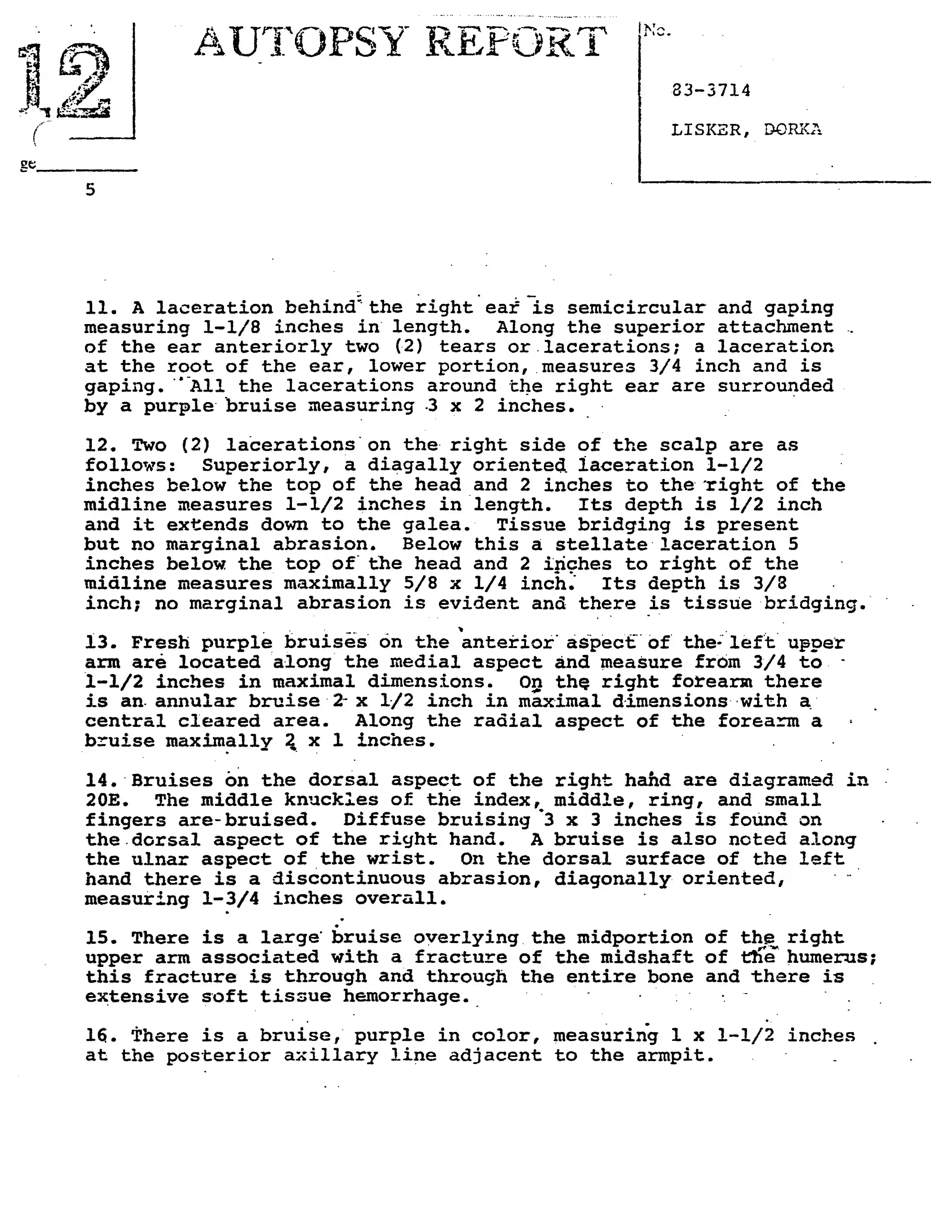
545.
LAPD Follow-Up Investigation
Page 8
"DETECTIVE LANDGREN ALSO ADVISED DETECTIVE MONSUE THAT VICTIM'S PURSE HAD BEEN GONE THROUGH AND WAS LAYING ON THE LOVE SEAT IN THE LIVING ROOM.";
and:
id. at page 10
"MR. [Robert] LISKER ALSO WAS ASKED IF HIS WIFE USUALLY HAD MONEY IN HER PURSE. HE INFORMED DETECTIVE THAT SHE SHOULD HAVE HAD APPROXIMATELY $150.00 BECAUSE THURSDAY IS HER NORMAL SHOPPING DAY."
and:
Monsue/Ryan Interview Transcript
May 4, 1983 – Page 33 "MONSUE: '... THERE WAS MONEY MISSING AT THE HOUSE.""
547.
Testimony of LAPD detective Andrew R. Monsue (No. 20927) concerning the estimated
survivability of I~s ~isl~Jrgiven her observed injuries
Dennis H./William M. Juvenile Detention Hearing, April 4, 1983 – Page 32
A:"... THE DOCTOR INDICATED THAT IN HIS OPINION THE VICTIM COULD NOT HAVE LIVED IN EXCESS OF 15 MINUTES WITHOUT EMERGENCY TREATMENT."

The doctor later expanded -- tripled, actually -- this estimate to a full forty-five minutes or longer. And if the first aid I delivered is factored in, that estimate expands considerably. Nevertheless, the timeline remains tight enough to render highly unlikely my supposedly setting up an elaborate cover-up scant minutes after they claimed I'd executed an insanely violent, five-weapon brutalization of my own mother. r 1

548.
Testimony of Robert B. Lisker Trial
November 13, 1985 – Page 918
Q:"WHEN YOU WENT TO YOUR RESIDENCE, YOU ARRIVED AT ABOUT 4:30 IN THE AFTERNOON?"
A:"BETWEEN 4:00 AND 4:30."
Q:"WHEN YOU ARRIVED THERE IN THE AFTERNOON, WAS ANYBODY AT YOUR HOUSE AT THAT TIME?"
A:"YES, QUITE A FEW PEOPLE."
Q:"WAS DETECTIVE MONSUE THERE ABOUT THAT TIME?"
A:"YES, HE WAS."
Q:"HOW ABOUT DETECTIVE LANDGREN?"
A:"HE WAS THERE."
Q:"WERE THERE ANY OTHER POLICE OFFICERS THERE AT THAT TIME WHEN YOU ARRIVED BACK?"
A:"DETECTIVE PIDA WAS THERE AND A NUMBER OF OTHER PEOPLE IN PLAINCLOTHES, CIVILIAN CLOTHES." ...
Q:"HOW LONG DID ALL THE POLICE OFFICERS REMAIN AT THAT LOCATION BEFORE DEPARTING THAT DAY?"
A:"MOST OF THE PEOPLE LEFT WITHIN AN HOUR AFTER MY GETTING THERE."
549.
Testimony of LAPD detective Andrew R. Monsue (No. 20927)
Trial
November 4, 1985 – Page 411
Q:"HOW MANY TIMES HAVE YOU BEEN BACK TO [the Lisker residence]?"
A:"I THINK A TOTAL OF FOUR TIMES."
Q:"DID YOU FIND $150 IN THE RESIDENCE ON MARCH 10, 1983?"
A:"NO, SIR, I DID NOT.";
and:
id. at page 442 A: "AT NO TIME HAVE I EVER FOUND THE $150."
550.
Testimony of LAPD detective Andrew R. Monsue (No. 20927)
Trial
November 12, 1985 – Page 473
A:"I DON'T RECALL SEARCHING IT OR LOOKING, YOU KNOW, TAKING EVERYTHING OUT 545 - 550 OF THE DRAWERS AND STUFF. I DID GO BACK IN THE ROOM AND LOOK AROUND." 551
564.

[Footnote 564 is not present in the source Footnotes - 1-719.docx. Bruce — please add the citation here.]
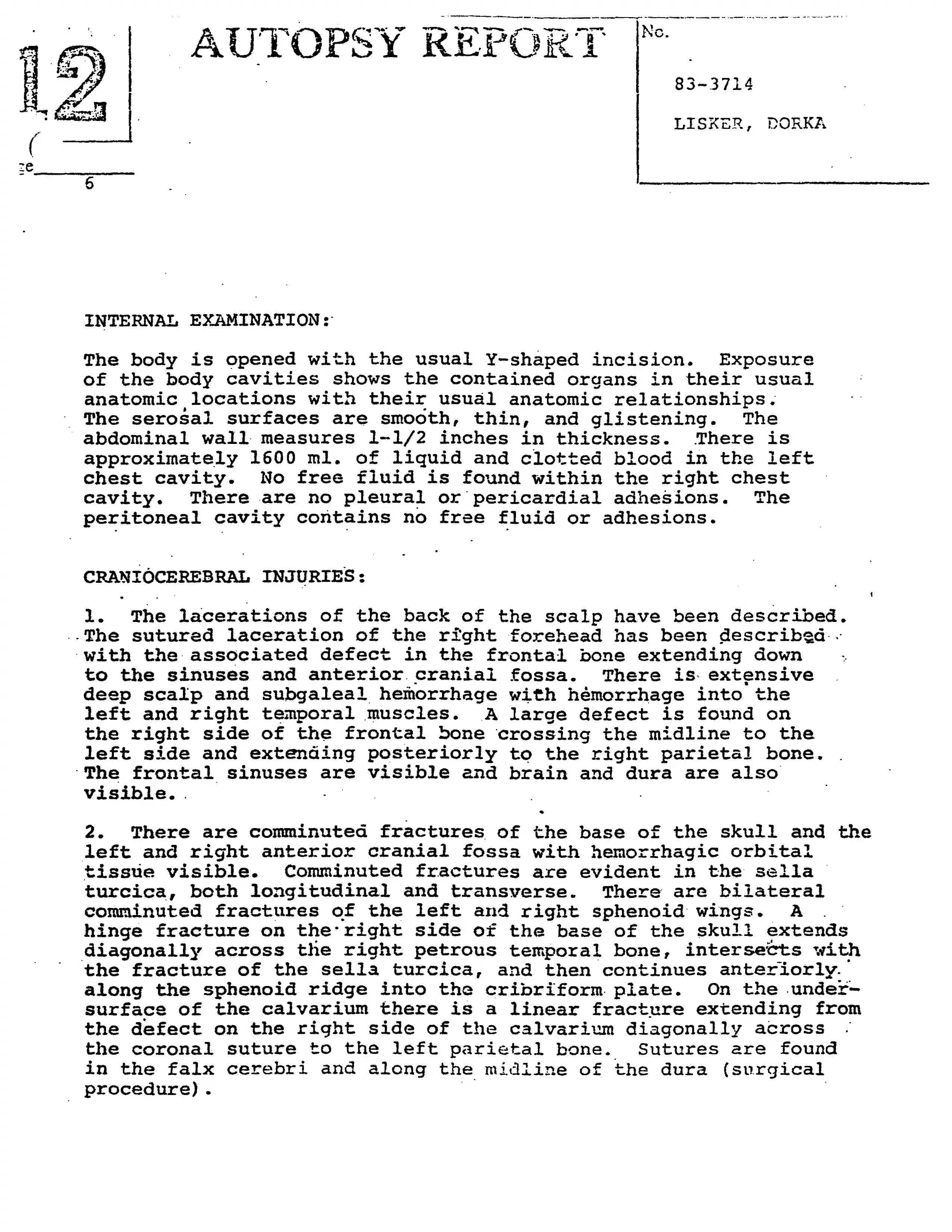
565.

[Footnote 565 is not present in the source Footnotes - 1-719.docx. Bruce — please add the citation here.]
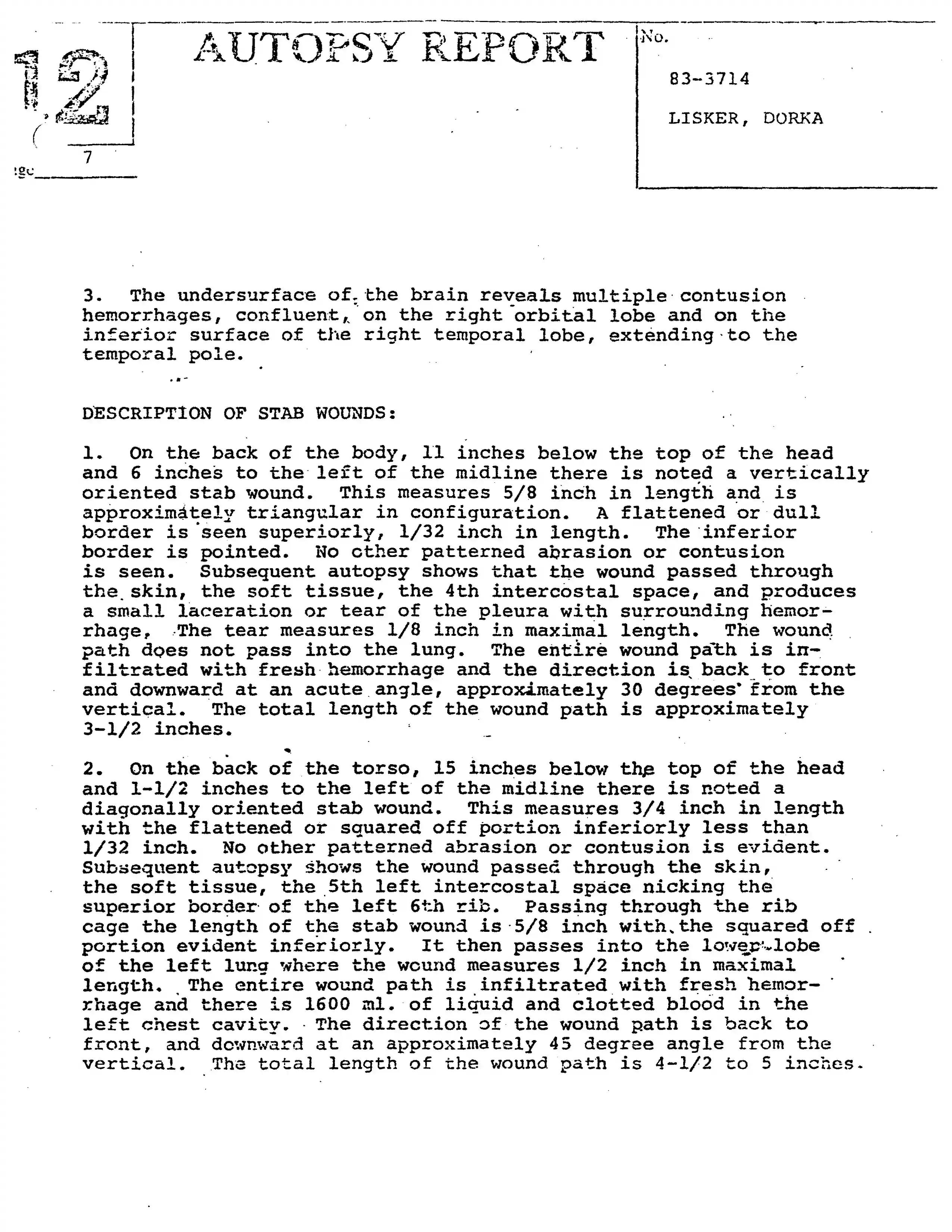
592.
Testimony of LAPD detective Andrew R. Monsue (No. 20927) Trial
December 4, 1984 – Page 524
Q:"IN FRONT OF THE PLANTER?"
659.
Account of Events, by Bruce E. Lisker, page xxliv
"HE JUST STARED AT ME, SILENT. I ASKED HIM IF WE COULD PLEASE GO TO THE HOSPITAL INSTEAD OF WHEREVER WE SEEMED TO BE GOING, AND HE LOOKED OVER AT ME AND STARED ME UP AND DOWN, BEGINNING UP ABOVE MY EYES AT APPROXIMATELY HAIR LEVEL, THEN DOWN OVER MY TORSO AND CLOTHING, THEN BACK UP INTO MY EYES . . . HIS LOOK WAS (IT WAS MY CLEAR AND UNMISTAKABLE IMPRESSION) DESIGNED TO BE BOTH PENETRATING AND ACCUSATORY. A LOOK OF DISDAIN, IS THE BEST I CAN CHARACTERIZE IT."

"MORE THAN ONCE, HE LOOKED OVER AT ME WITH THE SAME BITTER LOOK HE'D GIVEN ME BEFORE. IT BEGAN TO DISTRACT ME FROM MY OTHER CONCERNS, AS SERIOUS AS THEY WERE, LONG ENOUGH TO BEGIN TO WORRY ABOUT MY OWN WELFARE."

660.
Lisker/Monsue Interrogation, March 10, 1983, page 10
MONSLJE: "DID YOU EVER TOUCH HER?" LISKER: "WHAT DO YOU MEAN?" MONSUE: DID YOU ACTUALLY TOUCH HER OR...°' [ellipses in original] LISKER: "YEAH, I WAS HUGGING, HOLDING HER." MOPdSUE: "OK" LISKER: "I DIDN'T REALLY WANT TO GET ALL THAT, YOU KNOW, ON MY BODY. BUT THEY THINK I DID IT OR SOMETHING. I DON'T KNOW. BUT I WAS HUGGING HER, JUST HUGGING, SAYING MOM, IT'S GOING TO BE OK. I LOVE YOU. IF I DON°T GET A CHANCE TO SAY .ANYMORE, I'LL [sic] ALWAYS LOVED YOU AND I KNOW YOU HAVE ALWAYS LOVED ME." MONSUE: "HUM HA"
661.

Lisker/Monsue Interrogation, March 10, 1983, page 39

662.
Lisker/Monsue Interrogation
March 10, 1983 – Page 45-46 663 Monsue/Ryan Interview Transcript, May 4, 1983 – Page 23
663.

[Footnote 663 is not present in the source Footnotes - 1-719.docx. Bruce — please add the citation here.]
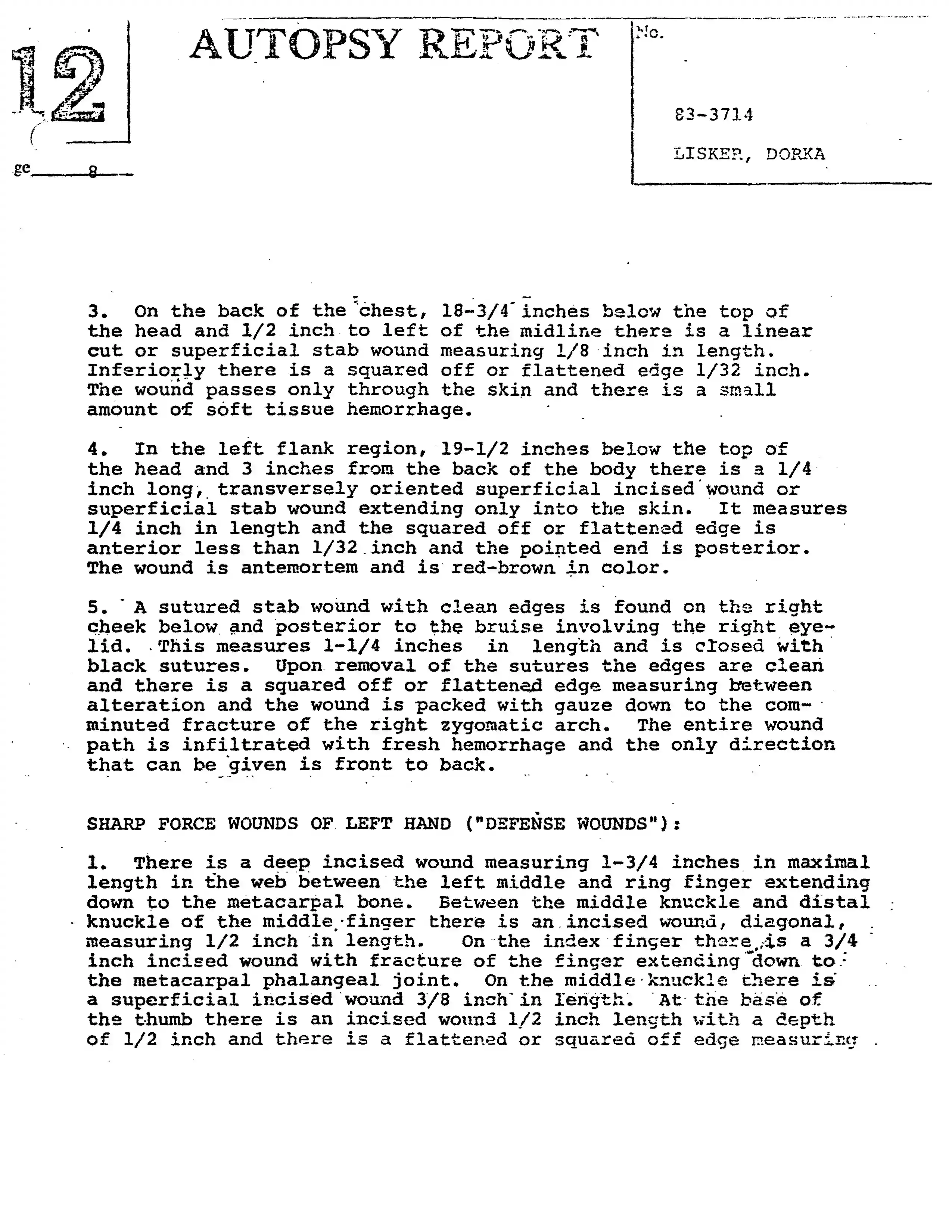
664.
Monsue/Ryan Interview Transcript
May 4, 1983 – Page 24-25
MONSUE:"DID BRUCE EVER HAVE ANY WORK OUT EQUIPMENT IN THE APARTMENT?°'
RYAN:"YEA, ONE SET OF WEIGHTS. THEY WERE LIKE A, I THINK IT WEIGHED ABOUT 35 POUNDS ALTOGETHER.°"
MONSUE:"DID HE HAVE ANY OTHER TYPE OF WORKOUT EQUIPMENT?"
RYAN:"I DON'T THINK SO."
MONSUE:"DID HE EVER SHOW YOU HIS ROOM AT HOME? DID HE HAVE ANY WORKOUT EQUIPMENT THERE?'°
RYAN:"I'VE BEEN IN HIS ROOM, BUT I'VE NEVER SEEN ANYTHING."
MONSUE:"HE HAD A BIG EXERCISE BAR, LIKE THAT. DID YOU EVER SEE THAT?"
RYAN:"YOU MEAN LIKE WHEN YOU BENCH PRESS WITH."
MONSUE:"ONE OF THESE THAT YOU SQUEEZE. YOU KNOW IN THE BACK OF THE MUSCLE MAGAZINES, THEY ARE ALWAYS RUNNING ADS ABOUT THE IRON MAN AND…"
RYAN:"I DON'T THINK SO."
666.
LAPD Follow-Up Investigation
Page 5
667.

Second Declaration of Robert Lisker

668.

Lisker/Monsue Interrogation, March 10, 1983, page 43

669.
Monsue Letter to California Board of Prison Terms
April 7, 1998
[View Monsue's BPT Letter]
670.
(Scan in Adina Aloni Letter to Paul Ingels
June 13, 2001)
571 (Scan in Declaration of Morton P. Borenstein)
671.

[Footnote 671 is not present in the source Footnotes - 1-719.docx. Bruce — please add the citation here.]